



 Chat with AI
Exam 11: Factor Markets

Exam 1: Foundations of Economics100 Questions
Exam 1: Extension: Understanding Graphs27 Questions
Exam 2: Markets and Economies104 Questions
Exam 3: Demand116 Questions
Exam 4: Supply118 Questions
Exam 5: Market Equilibrium118 Questions
Exam 6: Elasticity126 Questions
Exam 7: Consumer Behavior104 Questions
Exam 8: Production Costs125 Questions
Exam 9: Perfect Competition117 Questions
Exam 10: Market Power102 Questions
Exam 11: Factor Markets105 Questions
Exam 12: Market Failure and Government Failure82 Questions
Exam 13: Measuring an Economys Performance103 Questions
Exam 14: Aggregate Demand and Aggregate Supply105 Questions
Exam 15: Fiscal Policy105 Questions
Exam 16: Money and Banking74 Questions
Exam 17: Monetary Policy103 Questions
Exam 18: Economic Growth and Development49 Questions
Exam 19: International Trade and Finance110 Questions
Select questions type


Use Figure: Minimum Wage and Job Loss I. If the government sets a minimum wage of $14 per hour, then how many of the total number of unemployed workers were previously employed and lost their jobs from the hike in minimum wage?
Minimum Wage and Job Loss I

(Multiple Choice)
4.7/5  (68)
(68) The availability of good substitutes for labor in the production process makes the demand curve for labor more _____, so increasing minimum wage in this case will lead to _____ unemployment.
(Multiple Choice)
4.9/5 (64)
(64) If a firm has a perfectly inelastic labor demand curve, then a minimum wage will lead to _____ in the number of workers hired and _____ in the wage of workers.
(Multiple Choice)
4.8/5 (81)
(81) Because the opportunity cost of work _____ as individuals spend more time working, the labor supply curve is _____ sloping.
(Multiple Choice)
5.0/5 (97)
(97) Mike and Alice work in different industries that have identical demand for workers. Mike receives a wage of $18 per hour, and Alice receives a wage of $12 per hour. Based on this, we can conclude that the industry in which Mike works has a relatively ______ supply of workers and that the compensating wage differential for Mike is:
(Multiple Choice)
4.9/5 (91)
(91) If workers are employed in an industry where they cannot be easily replaced, then the demand curve of labor will be relatively more _____, and an increase in minimum wage will lead to ____ job losses compared to industries where close substitutes of labor are available.
(Multiple Choice)
4.7/5 (76)
(76) A firm in a perfectly competitive market is looking to hire an additional worker. The marginal revenue from selling the good produced by the worker is $3, and the marginal product of the worker is 12. Therefore, the marginal revenue product of the worker is:
(Multiple Choice)
4.9/5 (60)
(60) The labor demand curve for a firm in a perfectly competitive labor market is _____, and its labor supply curve is:
(Multiple Choice)
4.9/5 (83)
(83) A local Starbucks needs exactly five baristas to make coffee during a shift. In this case, the demand curve for baristas is perfectly _____, and an increase in minimum wage will lead to _____ in the number of baristas employed by Starbucks.
(Multiple Choice)
4.8/5 (70)
(70) A policymaker has been asked to examine whether raising the minimum wage will lead to a lot of job losses-that is, if many workers currently employed will lose their jobs. What key piece of information is required to answer this question? Explain your answer.
(Essay)
4.9/5 (88)
(88) Because the demand for a factor of production depends on the demand for the good or service that the factor produces, factor demand is referred to as _____ demand.
(Multiple Choice)
4.9/5 (73)
(73) Use Figure: Minimum Wage and Job Loss II. If the government sets a minimum wage of $12 per hour, then how many workers will be employed?
Minimum Wage and Job Loss II

(Multiple Choice)
4.8/5 (78)
(78) All else equal, a decrease in the productivity of workers will lead to _____ in the quantity of labor hired and _____ in the wage rate.
(Multiple Choice)
4.9/5 (84)
(84) Use Figure: Equilibrium in the Labor Market. Which one of the following can shift the equilibrium from point B to point A?
Figure: Equilibrium in the Labor Market

(Multiple Choice)
4.9/5 (81)
(81) Use Figure: Minimum Wage and Job Loss I. If the government sets a minimum wage of $14 per hour, then the total number of unemployed people in the economy will be:
Minimum Wage and Job Loss I

(Multiple Choice)
4.9/5 (71)
(71) Use Table: Marginal Revenue Product. The table lists the number of workers and the marginal revenue product per hour that is generated by each worker for a firm in a perfectly competitive market. If we know that the firm is hiring five workers, then the wage of labor is greater than _____ and less than or equal to:

(Multiple Choice)
4.8/5 (82)
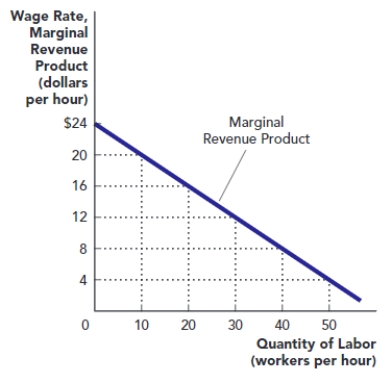
(82) Use Figure: Marginal Revenue Product and Labor Demand. The figure shows the marginal revenue product per hour of labor for a competitive firm. If the wage that is determined in a competitive labor market is $16 per hour, then how many workers per hour will the firm hire?
Figure: Marginal Revenue Product and Labor Demand
(Multiple Choice)
4.8/5 (88)
(88) 
Filters
- Essay(0)
- Multiple Choice(0)
- Short Answer(0)
- True False(0)
- Matching(0)