



 Chat with AI
Exam 3: The Biosphere

Exam 1: The Web of Life68 Questions
Exam 2: The Physical Environment76 Questions
Exam 3: The Biosphere73 Questions
Exam 4: Coping With Environmental Variation:74 Questions
Exam 5: Coping With Environmental Variation: Energy71 Questions
Exam 6: Evolution and Ecology68 Questions
Exam 7: Life History69 Questions
Exam 8: Behavioral Ecology71 Questions
Exam 9: Population Distribution and Abundance80 Questions
Exam 10: Population Dynamics68 Questions
Exam 11: Population Growth and Regulation69 Questions
Exam 12: Predation70 Questions
Exam 13: Parasitism72 Questions
Exam 14: Competition74 Questions
Exam 15: Mutualism and Commensalism71 Questions
Exam 16: The Nature of Communities71 Questions
Exam 17: Change in Communities73 Questions
Exam 18: Biogeography70 Questions
Exam 19: Species Diversity in Communities72 Questions
Exam 20: Production73 Questions
Exam 21: Energy Flow and Food Webs76 Questions
Exam 22: Nutrient Supply and Cycling76 Questions
Exam 23: Conservation Biology73 Questions
Exam 24: Landscape Ecology and Ecosystem Management71 Questions
Exam 25: Global Ecology74 Questions
Select questions type


Refer to the figure.
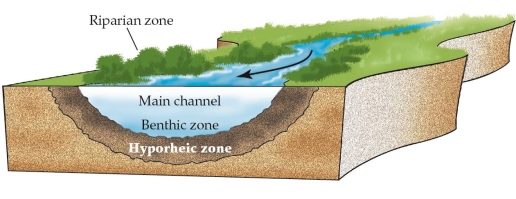 Invertebrates that consume detritus would most likely be found in which zone of the river ecosystem?
 (Multiple Choice)
4.9/5  (95)
(95) The blue candle cactus, found in Mexico's Chihuahuan Desert, and Euphorbia polyacantha, found in the Eastern Hemisphere, both have succulent upright stems and protective spines. These similar characteristics result from
(Multiple Choice)
4.8/5 (78)
(78) A seasonal tropical forest has existed for centuries in Africa. Recently, large herds of mammals including elephants, wildebeests, and zebras, are moving into the area. They are seeking food, driven north by recurring droughts in their original habitats. How will the incursion of these large grazers likely affect the biome?
(Essay)
4.7/5 (69)
(69) Assuming that the concept of a river continuum is correct, how would a second-, third-, and fourth-order river be ranked, in terms of the importance of terrestrial vegetation as a food source for the organisms within it?
(Multiple Choice)
4.8/5 (78)
(78) Refer to the figure.
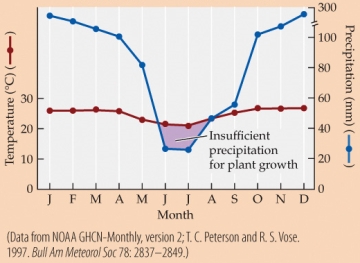 -Suppose that growing a plant requires at least 3 mm of precipitation for every 1°C that the average monthly temperature is above freezing. Based on the climate diagram and assuming that the weather conforms to the long-term average, this plant should be able to grow for about how many months of the year?
 (Multiple Choice)
4.9/5 (73)
(73) Refer to the map.
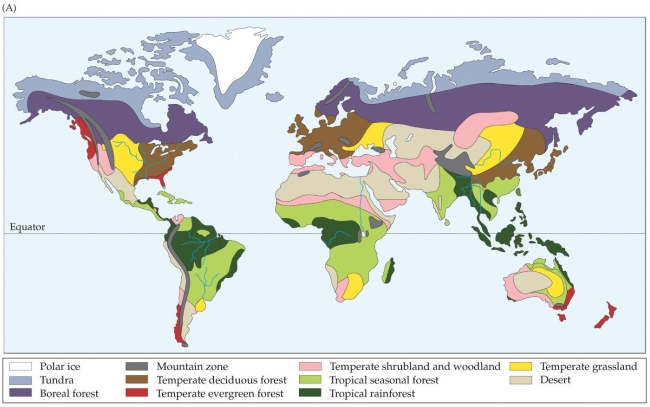 The map shows locations of biomes across the world. To which biome do New Zealand and the southeast section of Australia belong?
 (Multiple Choice)
4.9/5 (80)
(80) Lake Merritt, near Oakland, California, is home to the first official wildlife refuge in the United States. Because it is a place where fresh water and the ocean meet, Lake Merritt should be classified not as a lake, but rather as a(n)
(Multiple Choice)
4.8/5 (84)
(84) The most likely way to halt or limit coral bleaching, or loss of a coral's symbiotic algal partner, would be to
(Multiple Choice)
4.7/5 (88)
(88) Refer to the figure.
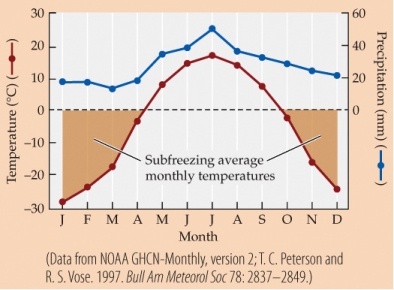 Suppose that trees in the boreal forest biome, a climate diagram for which is shown here, require at least 35 mm of average monthly precipitation to grow. The average growing season is 130 days per year. According to the climate diagram, growth in boreal forests is most likely limited by
 (Multiple Choice)
4.8/5 (84)
(84) Lake Baikal, in Siberia, is 5,200 feet (almost a mile) deep. Lake Erie, one of the U.S. Great Lakes has an average depth of 62 feet, and is 210 feet deep at its deepest point. What is the best comparison of the likely light penetration and nutrient levels in these two lakes?
(Multiple Choice)
5.0/5 (84)
(84) A researcher finds that the physical environment at a certain location alternates between marine and terrestrial with the rise and fall of the tides. A stable substratum provides an anchor against the pounding tides for a diverse array of organisms. Organisms that live there, especially those that are sessile, usually have high tolerance for changes in salinity, temperature, and desiccation. This area is most likely a(n)
(Multiple Choice)
4.9/5 (75)
(75) A biome contains sagebrush and many types of cacti, as well as rattlesnakes and jackrabbits. It has a hot, dry climate, and many microbes, including bacteria and archaea, that are adapted to live in extreme conditions. Which of these factors would be used to classify this biome?
(Multiple Choice)
4.9/5 (95)
(95) A biome in a tropical region gradually shifts from a tropical seasonal forest to a savanna. What environmental factor is most likely responsible for this change?
(Multiple Choice)
4.8/5 (84)
(84) A shallow region of the ocean (less than about 15 m) has a solid, rocky substrate. This would be an ideal substrate for which type of ocean vegetation?
(Multiple Choice)
4.9/5 (77)
(77) In Lake Tahoe, located in California and Nevada, algal growth historically occurred down to more than 100 meters. But since about 1960, increased human activity has caused a change in the lake; algal photosynthesis now occurs only down to between 40 and 60 m. What changes in the lake could account for this change in the depth of the photic zone?
(Essay)
4.9/5 (79)
(79) A nearshore marine environment is located in a tropical area, and is home to salt-tolerant evergreen trees and animals including manatees and crab-eating monkeys. This environment is most likely a(an)
(Multiple Choice)
4.8/5 (84)
(84) Over the centuries, the human use of fire has altered the location and composition of biomes around the world. Explain how this has happened, giving specific examples.
(Essay)
4.8/5 (76)
(76) Refer to the figure.
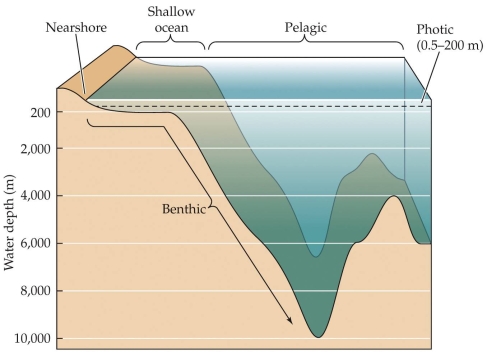 Organisms in the ocean that live on detritus are most likely to live in which zone, shown in the figure?
 (Multiple Choice)
4.8/5 (95)
(95) Refer to the figure.
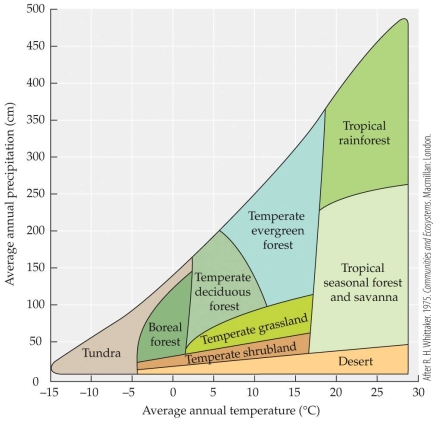 - The figure shows how biomes vary with temperature and precipitation. If the precipitation in Florida (largely temperate evergreen forest) increased to an average of 275 cm per year and the temperature warmed to an average of 19°C, how would that change the landscape?
 (Multiple Choice)
4.7/5 (79)
(79) Refer to the figure.
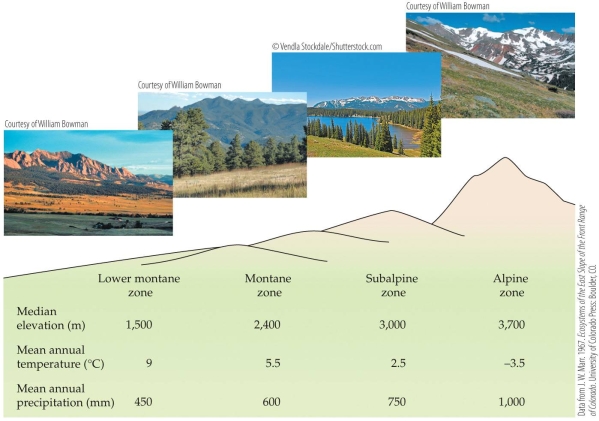 Based on the figure, how does the climate change as one moves from the alpine to the subalpine to the montane zone of a mountain?
 (Multiple Choice)
4.9/5 (84)
(84) 
Filters
- Essay(0)
- Multiple Choice(0)
- Short Answer(0)
- True False(0)
- Matching(0)