



 Chat with AI
Exam 5: Coping With Environmental Variation: Energy

Exam 1: The Web of Life68 Questions
Exam 2: The Physical Environment76 Questions
Exam 3: The Biosphere73 Questions
Exam 4: Coping With Environmental Variation:74 Questions
Exam 5: Coping With Environmental Variation: Energy71 Questions
Exam 6: Evolution and Ecology68 Questions
Exam 7: Life History69 Questions
Exam 8: Behavioral Ecology71 Questions
Exam 9: Population Distribution and Abundance80 Questions
Exam 10: Population Dynamics68 Questions
Exam 11: Population Growth and Regulation69 Questions
Exam 12: Predation70 Questions
Exam 13: Parasitism72 Questions
Exam 14: Competition74 Questions
Exam 15: Mutualism and Commensalism71 Questions
Exam 16: The Nature of Communities71 Questions
Exam 17: Change in Communities73 Questions
Exam 18: Biogeography70 Questions
Exam 19: Species Diversity in Communities72 Questions
Exam 20: Production73 Questions
Exam 21: Energy Flow and Food Webs76 Questions
Exam 22: Nutrient Supply and Cycling76 Questions
Exam 23: Conservation Biology73 Questions
Exam 24: Landscape Ecology and Ecosystem Management71 Questions
Exam 25: Global Ecology74 Questions
Select questions type


Characteristics of an animal's digestive tract can impact the efficiency with which nutrients and energy can be absorbed from food. Which individual's digestive system would probably be most efficient?
(Multiple Choice)
4.7/5  (73)
(73) Organisms that can convert energy from sunlight or from inorganic compounds in their environment, without having to consume other organisms for their energy needs, are called
(Multiple Choice)
4.9/5 (72)
(72) Lichens and other Arctic plants can carry out photosynthesis at very low temperatures, some near freezing. As the Arctic warms rapidly due to climate change, what adaptations might the Arctic's autotrophs make as a result of the changing environmental temperatures?
(Essay)
4.7/5 (93)
(93) Refer to the figure showing delta values for plants using three different biochemical pathways for photosynthesis.
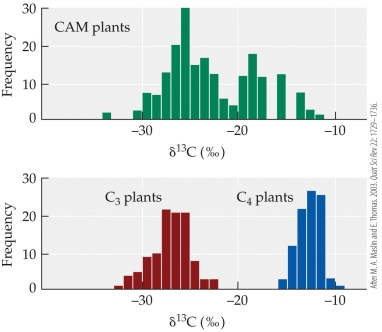 Which of these types of plants shows the most negative delta value, that is, the greatest discrimination against the uptake of 13C?
 (Multiple Choice)
4.9/5 (81)
(81) Which hypothesis about the benefits of photorespiration was supported by Kozaki and Takeba's experiment with tobacco plants, in which the plants were genetically altered to elevate and lower their rates of photorespiration?
(Multiple Choice)
4.9/5 (81)
(81) Refer to the figure showing the results of Bjorkman and colleagues' studies of plant responses to different light levels. The plants were reared at three different levels of light intensity: high (red line), medium (blue line), and low (green line). The acclimatized plants were then subjected to various light levels, and their ability to photosynthesize was measured.
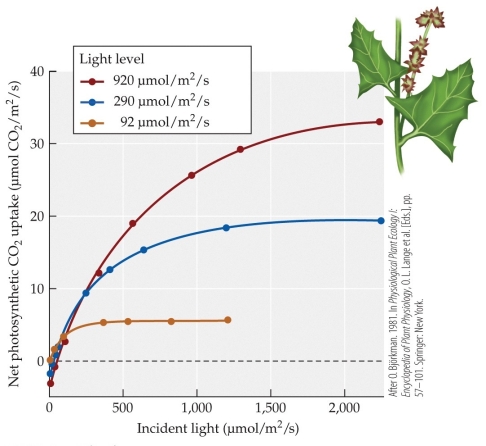 -At approximately what light intensity level are the plants acclimatized to high-intensity light photosynthesizing at twice the rate of those plants acclimatized to low-intensity light?
 (Multiple Choice)
4.8/5 (88)
(88) Suppose a crow normally uses 50 energy units to extract larvae from holes in trees and only 5 energy units foraging for nuts. The crow can get 60 energy units from eating larvae and 15 energy units from eating nuts. The crow can decrease the amount of energy used to extract larvae from holes to 5 energy units, but only if it first spends 15 energy units building a tool. Under which conditions would tool use in these crows be adaptive?
(Multiple Choice)
4.8/5 (75)
(75) An autotrophic organism living in a hydrothermal vent on the bottom of the ocean would be expected to obtain its energy through
(Multiple Choice)
4.8/5 (85)
(85) Some species in the genus Clusia start out as epiphytes but eventually can take on the tree form, a transformation that is facilitated by a property known as facultative CAM. This property allows them to switch between different types of photosynthesis. Specifically, they are switching between
(Multiple Choice)
4.7/5 (93)
(93) Orangutans are herbivorous primates. Two orangutans have the same physical characteristics except that one individual has a longer digestive system. Is this difference an adaptive trait? Why? What benefit would it provide to the orangutan?
(Essay)
4.9/5 (84)
(84) In the CAM pathway, in contrast to pathways in C3 and C4 plants, CO2 uptake and the Calvin cycle are separated in time, with
(Multiple Choice)
4.8/5 (85)
(85) What takes place during the first step of photosynthesis, referred to as the "light-driven reactions"?
(Multiple Choice)
4.8/5 (76)
(76) Why do researchers think that "sponging" behavior in bottlenose dolphins is a learned trait?
(Multiple Choice)
4.8/5 (83)
(83) Suppose that a small plant, through photosynthesis, has generated 12 trillion molecules of glucose. Based on the net reaction of photosynthesis, the cell has generated how many molecules of oxygen?
(Multiple Choice)
4.8/5 (85)
(85) When heterotrophs consume food (organic compounds), they convert it to usable chemical energy, primarily in the form of _______, during the process of _______.
(Multiple Choice)
4.8/5 (78)
(78) Refer to the figure showing the pattern of photosynthesis in a typical plant that occurs under different levels of light, from complete darkness to full sun.
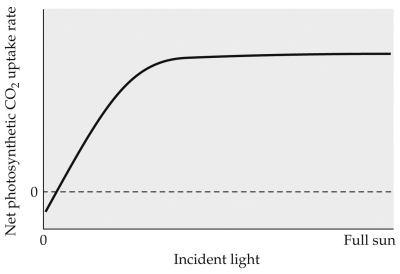 Describe this plant's reaction to light in terms of the concepts of "light compensation point," "light limitation," and "light saturation."
 (Essay)
4.9/5 (63)
(63) Both New Caledonian crows and bottlenose dolphins have been observed using tools. What is a major similarity in their tool use? What are the major differences?
(Essay)
4.9/5 (70)
(70) The bacteria and archaea that inhabited the early Earth oxidized inorganic compounds to obtain energy to fix carbon dioxide. These organisms were probably least likely to oxidize which inorganic compound?
(Multiple Choice)
4.9/5 (84)
(84) Refer to the figure showing the results of Bjorkman and colleagues' studies of plant responses to different light levels. The plants were reared at three different levels of light: high (red line), medium (blue line), and low (green line). The acclimatized plants were then subjected to various light levels, and their ability to photosynthesize was measured.
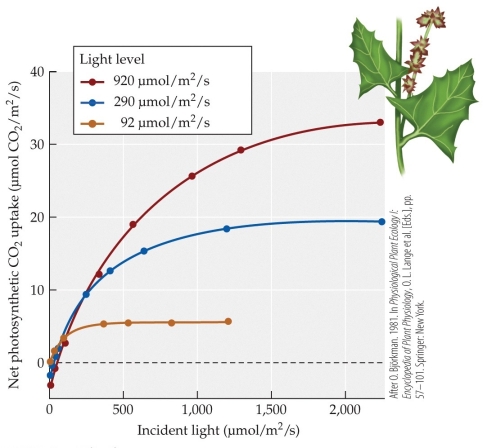 At the light intensity of 1,500 μmol/m2/s, which plants are light-limited?
 (Multiple Choice)
4.8/5 (80)
(80) In contrast to C3 plants, C4 plants have which structure that keeps the CO2 concentration high where the Calvin cycle operates?
(Multiple Choice)
4.8/5 (70)
(70) 
Filters
- Essay(0)
- Multiple Choice(0)
- Short Answer(0)
- True False(0)
- Matching(0)