



 Chat with AI
Exam 6: Evolution and Ecology

Exam 1: The Web of Life68 Questions
Exam 2: The Physical Environment76 Questions
Exam 3: The Biosphere73 Questions
Exam 4: Coping With Environmental Variation:74 Questions
Exam 5: Coping With Environmental Variation: Energy71 Questions
Exam 6: Evolution and Ecology68 Questions
Exam 7: Life History69 Questions
Exam 8: Behavioral Ecology71 Questions
Exam 9: Population Distribution and Abundance80 Questions
Exam 10: Population Dynamics68 Questions
Exam 11: Population Growth and Regulation69 Questions
Exam 12: Predation70 Questions
Exam 13: Parasitism72 Questions
Exam 14: Competition74 Questions
Exam 15: Mutualism and Commensalism71 Questions
Exam 16: The Nature of Communities71 Questions
Exam 17: Change in Communities73 Questions
Exam 18: Biogeography70 Questions
Exam 19: Species Diversity in Communities72 Questions
Exam 20: Production73 Questions
Exam 21: Energy Flow and Food Webs76 Questions
Exam 22: Nutrient Supply and Cycling76 Questions
Exam 23: Conservation Biology73 Questions
Exam 24: Landscape Ecology and Ecosystem Management71 Questions
Exam 25: Global Ecology74 Questions
Select questions type


Refer to the table.
 - Suppose that, following the experiments by Dodd, Drosophila pseudoobscura are fed one of two diets (starch or maltose) for many generations. Once they have adapted to the new food sources, individual females from the starch treatment are given a choice between a male adapted to starch (a starch male), or a male adapted to maltose (a maltose male). When 50 females have chosen a mate, the experiment is repeated with females adapted to maltose. The results are in the table. Which conclusion is best supported by the data?
 (Multiple Choice)
4.9/5  (72)
(72) Refer to the figure.
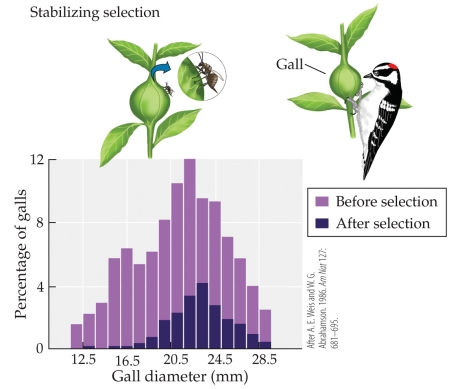 Eurosta flies parasitize goldenrod plants, causing the plant to produce a gall in which the fly larva matures as it feeds on the plant. The larvae within the galls are parasitized by tiny wasps, which tend to parasitize the smallest galls, and are also fed on by Downy woodpeckers, which tend to feed on the largest galls. The figure shows the size distribution of galls before and after both wasps and woodpeckers have impacted their survival. This is an example of
 (Multiple Choice)
4.8/5 (88)
(88) Refer to the figure.
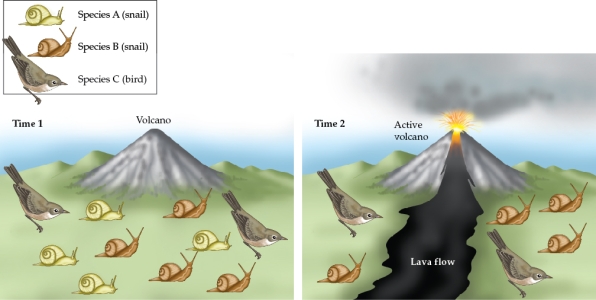 -You are studying a remote island before and after a volcanic eruption. Data at Time 1 were collected one month before the eruption, and data at Time 2 were collected one month after the eruption. All of the species on the island are endemic. The island is 100 km across. Each animal icon represents 20 individuals. Species A and B (the two snail species) generally move a distance of only 2 m a day. Species C (the bird) often covers 20 km a day in search of food. After the eruption, the lava flow hardens, and the island is divided by a 20-km strip of bare rock with few, if any, resources these animals need to survive. Would you expect to see a change in patterns of gene flow in species B and C? Why or why not?
 (Essay)
4.8/5 (79)
(79) Refer to the figure.
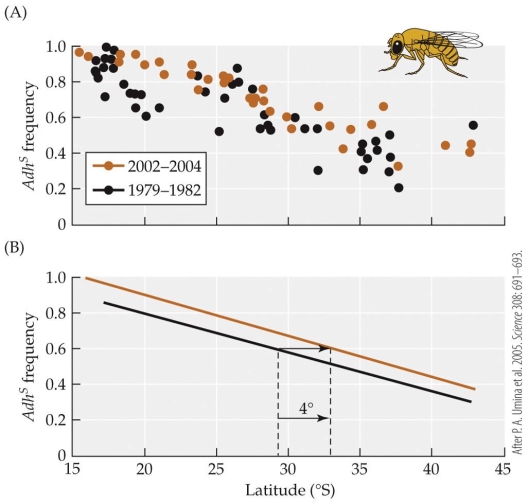 - The figure shows the frequency of the Adhs allele at different latitudes in Australia taken in 1979?1982, and again in 2002?2004. Consider the 1979?1982 data. On a per-degree-of-latitude basis, the frequency of the Adhs allele _______ by approximately _______ as one goes north.
 (Multiple Choice)
4.8/5 (85)
(85) Refer to the figure.
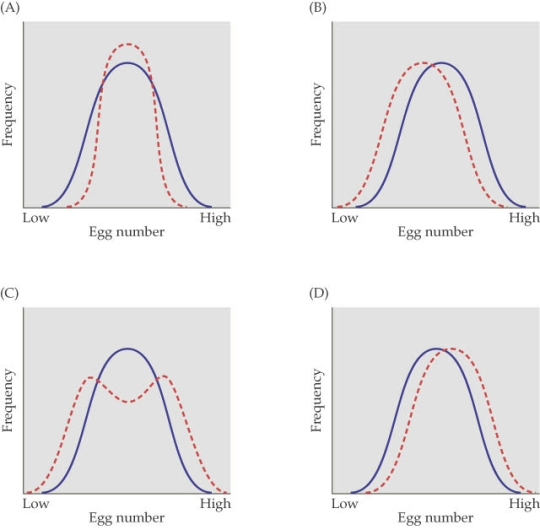 -The figure shows four cases of selection on egg number in a population of flour beetles. The solid blue line represents the frequency of the original population and the dashed red line represents the frequency distribution after eight generations. Which figure most likely represents a case of stabilizing selection?
 (Multiple Choice)
4.9/5 (61)
(61) Refer to the figure.
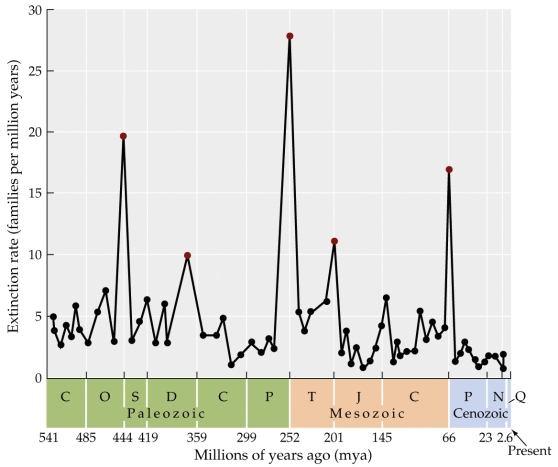 - Consider the three most dramatic mass extinctions in Earth's history. If a fourth major mass extinction occurred after the same interval as the previous ones, around how many million years from now would you predict it would occur?
 (Multiple Choice)
4.9/5 (85)
(85) Refer to the figure.
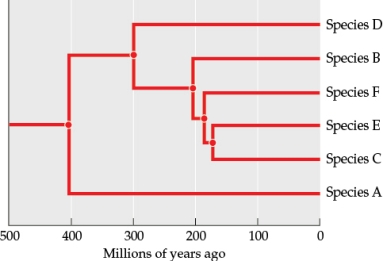 You are studying the evolution of a group of tree species that all share a common ancestor.
-Referring to the figure, which two species are most closely related? What evidence do you have to support this?
You are studying the evolution of a group of tree species that all share a common ancestor.
-Referring to the figure, which two species are most closely related? What evidence do you have to support this? (Essay)
4.8/5 (82)
(82) Which of the following has resulted from commercial fishing for cod?
(Multiple Choice)
4.9/5 (73)
(73) Refer to the table.
 - Suppose that, following the experiments by Dodd, Drosophila pseudoobscura are fed one of two diets (starch or maltose) for many generations. Once they have adapted to the new food sources, individual females from the starch treatment are given a choice between a male adapted to starch (a starch male), or a male adapted to maltose (a maltose male). When 50 females have chosen a mate, the experiment is repeated with females adapted to maltose. According to the results in the table, what percentage of maltose females chose starch males?
 (Multiple Choice)
4.9/5 (88)
(88) If a population of Silene (a plant) has 400 members with 180 of genotype DD, 180 of genotype Dd, and 40 of genotype dd, the frequency of the D allele is
(Multiple Choice)
4.9/5 (85)
(85) Refer to the figure.
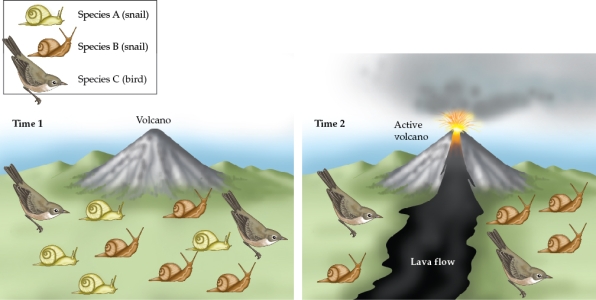 -You are studying a remote island before and after a volcanic eruption. Data at Time 1 were collected one month before the eruption, and data at Time 2 were collected one month after the eruption. All of the species on the island are endemic. The island is 100 km across. Each animal icon represents 20 individuals. Species A and B (the two snail species) generally move a distance of only 2 m a day. Species C (the bird) often covers 20 km a day in search of food. After the eruption, the lava flow hardens, and the island is divided by a 20-km strip of bare rock with few if any resources these animals need to survive. Based on your knowledge of gene flow, genetic drift, and speciation, what do you predict will happen to these species over time? Do you predict that the current species will remain the same species or do you think they might split? How would you determine whether a species had split into two new species?
 (Essay)
4.9/5 (84)
(84) Which evolutionary process is most likely to inhibit speciation?
(Multiple Choice)
4.9/5 (85)
(85) Suppose a genie offers you a trip in a time machine, and you and a paleontologist go back 800 million years in Earth's history. Assuming you have all the appropriate tools to detect life, what should you expect to see?
(Multiple Choice)
4.9/5 (74)
(74) Suppose a population of worms is variable at a genetic locus involved in foraging behavior. There are just two alleles at this locus, F and f. Individuals that are FF or Ff are rovers and will travel widely in pursuit of food. Individuals that are ff are sitters and will not travel as far. The frequency of the F allele is 0.75. The frequency of the f allele is _______ and, assuming the Hardy-Weinberg equation, the percentage of the population that are sitters is therefore _______.
(Multiple Choice)
4.9/5 (84)
(84) Suppose that several flies of a population that previously fed on blueberries start to feed on honeysuckle. Due to genetic differences that accumulate as the flies adapt to feeding on honeysuckle, these "honeysuckle" flies eventually breed earlier than the ancestral flies. This change most likely represents an early stage of speciation brought about by
(Multiple Choice)
4.8/5 (70)
(70) Which of the following describes the process in which some individuals have heritable phenotypic traits that give them an advantage in either survival or reproduction?
(Multiple Choice)
4.8/5 (77)
(77) The mutation rate of a gene involved in lactose metabolism is two mutations per million copies of the gene per generation. Suppose there are 15 million individuals in a population of a yeast, each with two copies of this gene (i.e., they are diploid). In this yeast population, how many new mutations would we expect at this gene each generation?
(Multiple Choice)
4.9/5 (72)
(72) The most recent mass extinction, which wiped out the dinosaurs, occurred approximately _______ million years ago.
(Multiple Choice)
4.8/5 (78)
(78) 
Filters
- Essay(0)
- Multiple Choice(0)
- Short Answer(0)
- True False(0)
- Matching(0)