



 Chat with AI
Exam 16: The Nature of Communities

Exam 1: The Web of Life68 Questions
Exam 2: The Physical Environment76 Questions
Exam 3: The Biosphere73 Questions
Exam 4: Coping With Environmental Variation:74 Questions
Exam 5: Coping With Environmental Variation: Energy71 Questions
Exam 6: Evolution and Ecology68 Questions
Exam 7: Life History69 Questions
Exam 8: Behavioral Ecology71 Questions
Exam 9: Population Distribution and Abundance80 Questions
Exam 10: Population Dynamics68 Questions
Exam 11: Population Growth and Regulation69 Questions
Exam 12: Predation70 Questions
Exam 13: Parasitism72 Questions
Exam 14: Competition74 Questions
Exam 15: Mutualism and Commensalism71 Questions
Exam 16: The Nature of Communities71 Questions
Exam 17: Change in Communities73 Questions
Exam 18: Biogeography70 Questions
Exam 19: Species Diversity in Communities72 Questions
Exam 20: Production73 Questions
Exam 21: Energy Flow and Food Webs76 Questions
Exam 22: Nutrient Supply and Cycling76 Questions
Exam 23: Conservation Biology73 Questions
Exam 24: Landscape Ecology and Ecosystem Management71 Questions
Exam 25: Global Ecology74 Questions
Select questions type


Members of the same functional group must belong to the same
(Multiple Choice)
4.8/5  (81)
(81) Despite having a relatively small biomass, populations of grizzly bears often have strong effects on their communities. The grizzly bear is therefore an example of a
(Multiple Choice)
4.8/5 (82)
(82) Refer to the table.
Table 1
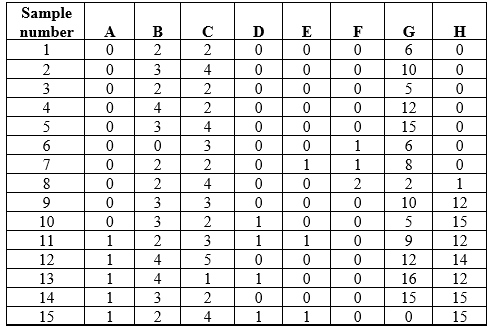 Suppose you are researching an ecological community in a new study area. You divide your study area into quadrats and sample one quadrat a day to determine the species that occupy the area and how many individuals of these species are present. Assume that by the end of your sampling efforts, you have identified all of the species that occur in the study area. Table 1 shows the data collected for each sample for species A-H and indicates the number of individuals of each species identified in each quadrat. Use the table to investigate the pattern of species discoveries in your data. Then, create a new data table (this will be referred to as Table 2) that reflects the number of new species discovered as a function of the number of samples. Include the number of new species observed in each sample and the total number of species discovered over the course of your sampling.
 (Essay)
4.9/5 (67)
(67) Steelhead fish are predators of predatory insects, which in turn feed on midge larvae. The midge larvae feed on algae. By indirect effects, a reduction in the number of steelhead fish should lead to a(n) _______ in midges and a(n) _______ in algae.
(Multiple Choice)
5.0/5 (73)
(73) Refer to the figure.
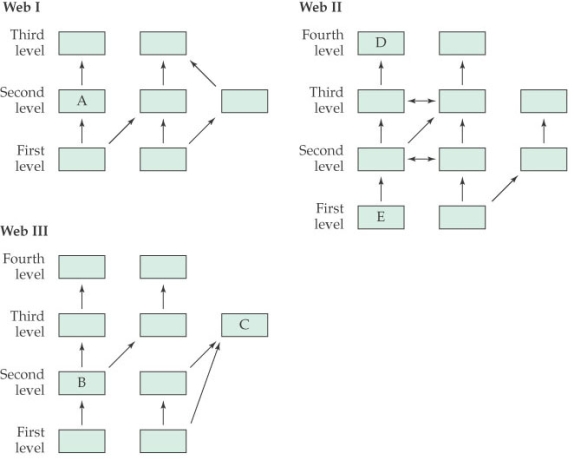 -Which web(s) in the figure is(are) an interaction web?
 (Multiple Choice)
4.9/5 (85)
(85) Which statement describes a limitation of a species accumulation curve in terms of its ability to determine whether species diversity has been adequately sampled?
(Multiple Choice)
5.0/5 (88)
(88) When wolves were returned to Yellowstone National Park in 1995, some of the effects noted were increasing levels of berries available to black bears, stabilization of stream banks, increased nesting habitat for birds, and increasing beaver numbers as a result of rejuvenating aspen trees. These were later determined to be the results of reduced numbers and altered feeding behavior of elk as they were preyed upon by the wolves. Given this information, which of the following best describes wolves in Yellowstone National Park?
(Multiple Choice)
4.8/5 (84)
(84) Species that feed on more than one trophic level are called
(Multiple Choice)
4.9/5 (82)
(82) Suppose you wanted to determine whether you had adequately sampled the species richness of a given community. Which result would lead most strongly to the conclusion that the current sampling had adequately assessed the species diversity?
(Multiple Choice)
4.8/5 (76)
(76) Cougars prey on both white-tailed deer and mule deer. Because of their shared predator, each deer's species abundance is affected by the presence of the other deer species. The cougar and the mule deer are engaged in a(n)
(Multiple Choice)
4.9/5 (93)
(93) A group of interacting species that occur together at the same place and time is known as a
(Multiple Choice)
4.8/5 (83)
(83) 
Refer to the figure.
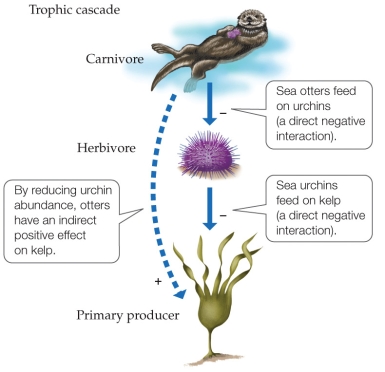 -Research has suggested that in some cases, killer whales (Orcinus orca) have increased their predation on sea otters. This would have a(n) _______ effect on kelp.
 (Multiple Choice)
4.8/5 (80)
(80) Menge and colleagues performed experiments in which they exposed some populations of mussels to sea stars and excluded sea stars from other mussel populations. Suppose two populations of mussels are the same size prior to treatment, and after treatment there are 600 mussels in the treatment without sea stars and 200 mussels in the treatment with sea stars. Suppose further that the sea star population consists of 10 individuals. What is the per capita interaction strength of sea stars on mussels?
(Multiple Choice)
4.8/5 (82)
(82) Which of the following example emphasizes the importance of species composition?
(Multiple Choice)
4.8/5 (71)
(71) Refer to the figure.
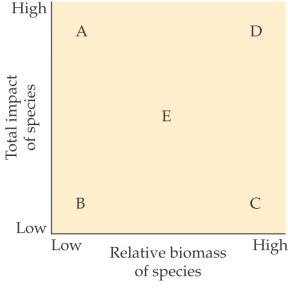 - Where would a foundation species most likely be located in the figure?
 (Multiple Choice)
4.9/5 (78)
(78) Refer to the tables and the figure.
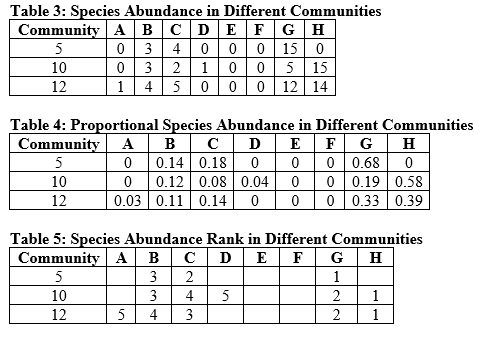 Figure 3
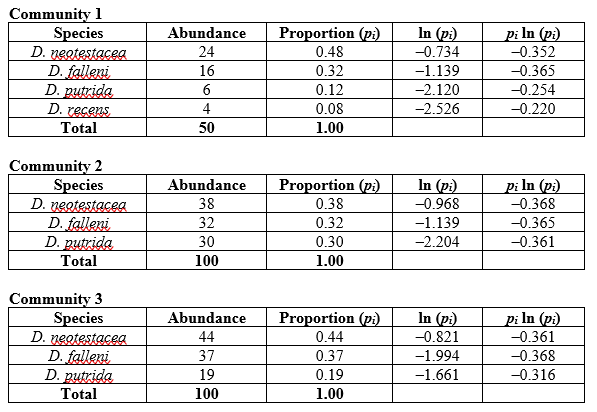
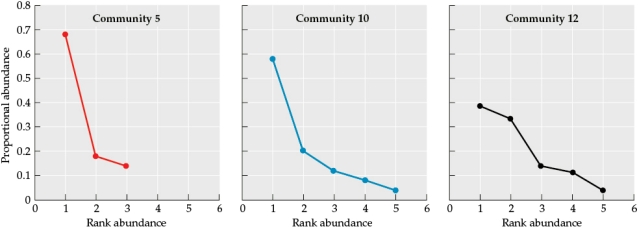 Suppose you are researching an ecological community in a new study area. You divide your study area into quadrats and sample one quadrat a day to determine the species that occupy the area and how many individuals of these species are present. Assume that by the end of your sampling efforts, you have identified all of the species that occur in the study area. Use Tables 3, 4, and 5 as well as Figure 3 to answer the following questions:
a) Which species is most common in each community?
b) Which species is the rarest in each community?
c) Are the same species always common and always rare, or is there variation?
d) How are communities 5 and 10 similar? How do they differ? Consider species composition, proportion, abundance, and richness in your answer.
e) How are communities 10 and 12 similar? How do they differ? Consider species composition, abundance, and richness in your answer.
Figure 3
Suppose you are researching an ecological community in a new study area. You divide your study area into quadrats and sample one quadrat a day to determine the species that occupy the area and how many individuals of these species are present. Assume that by the end of your sampling efforts, you have identified all of the species that occur in the study area. Use Tables 3, 4, and 5 as well as Figure 3 to answer the following questions:
a) Which species is most common in each community?
b) Which species is the rarest in each community?
c) Are the same species always common and always rare, or is there variation?
d) How are communities 5 and 10 similar? How do they differ? Consider species composition, proportion, abundance, and richness in your answer.
e) How are communities 10 and 12 similar? How do they differ? Consider species composition, abundance, and richness in your answer. (Essay)
4.7/5 (66)
(66) Suppose you wanted to determine whether you had adequately sampled the species richness of a given amphibian community. Which result would most likely lead to the conclusion that more sampling was needed to assess the species richness?
(Multiple Choice)
4.9/5 (79)
(79) 
Filters
- Essay(0)
- Multiple Choice(0)
- Short Answer(0)
- True False(0)
- Matching(0)