



 Chat with AI
Exam 17: Change in Communities

Exam 1: The Web of Life68 Questions
Exam 2: The Physical Environment76 Questions
Exam 3: The Biosphere73 Questions
Exam 4: Coping With Environmental Variation:74 Questions
Exam 5: Coping With Environmental Variation: Energy71 Questions
Exam 6: Evolution and Ecology68 Questions
Exam 7: Life History69 Questions
Exam 8: Behavioral Ecology71 Questions
Exam 9: Population Distribution and Abundance80 Questions
Exam 10: Population Dynamics68 Questions
Exam 11: Population Growth and Regulation69 Questions
Exam 12: Predation70 Questions
Exam 13: Parasitism72 Questions
Exam 14: Competition74 Questions
Exam 15: Mutualism and Commensalism71 Questions
Exam 16: The Nature of Communities71 Questions
Exam 17: Change in Communities73 Questions
Exam 18: Biogeography70 Questions
Exam 19: Species Diversity in Communities72 Questions
Exam 20: Production73 Questions
Exam 21: Energy Flow and Food Webs76 Questions
Exam 22: Nutrient Supply and Cycling76 Questions
Exam 23: Conservation Biology73 Questions
Exam 24: Landscape Ecology and Ecosystem Management71 Questions
Exam 25: Global Ecology74 Questions
Select questions type


Which statement concerning Cowles's early work on succession is false?
(Multiple Choice)
4.8/5  (77)
(77) Assume that a glacier is melting at a constant rate of 50 meters per year and that site A is 1.6 km closer to the ice edge than site B is. Based on this data and the principle of "space for time substitution," we can assume that the conditions seen at site A in 2011 are the same as those that _______ seen at site B in _______.
(Multiple Choice)
4.8/5 (86)
(86) In their manipulative studies of succession in a New England salt marsh, Bertness and Shumway altered salt stress in certain fields by
(Multiple Choice)
4.8/5 (82)
(82) Refer to the figure.
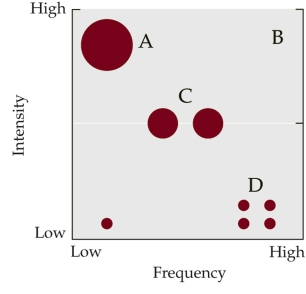 The figure shows examples of possible disturbance intensity (y-axis) and frequency (x- axis) combinations.
- What type of succession occurs after the disturbance in D?
The figure shows examples of possible disturbance intensity (y-axis) and frequency (x- axis) combinations.
- What type of succession occurs after the disturbance in D? (Multiple Choice)
4.8/5 (73)
(73) Assume that the melting of a glacier is taking place at a constant rate of 50 meters per year, and that site A is 1.6 km farther from the ice edge than site B is. Based on this data, and the principle of "space for time substitution," we can assume that the conditions seen at site A in the year 2011 are the same as those that _______ seen at site B in _______.
(Multiple Choice)
4.9/5 (71)
(71) Plants with bacterial symbionts that fix _______ are often important players in _______ stages of succession.
(Multiple Choice)
5.0/5 (66)
(66) Which statement about plants with nitrogen-fixing bacteria is true?
(Multiple Choice)
4.8/5 (78)
(78) At which stage of succession is facilitation usually the most significant factor?
(Multiple Choice)
4.9/5 (72)
(72) The studies by Chapin and colleagues on Glacier Bay succession provide empirical support for which model(s) of succession?
(Multiple Choice)
4.9/5 (81)
(81) According to the _______ model of succession, the early successional species modify the environment so as to facilitate the subsequent colonization of other early colonizing species.
(Multiple Choice)
5.0/5 (84)
(84) Refer to the figure.
Figure 1
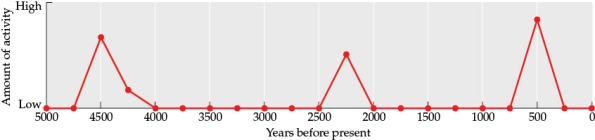 You are studying succession in an area affected by a volcanic eruption. Figure 1 shows the amount of volcanic activity over time, from no activity to high activity. Time periods with no activity indicate that the volcano is inactive and no disturbance is occurring; time periods with high activity indicate that the volcano is active and there are high levels of disturbance.Answer the following questions:
a) How would you describe the frequency of eruptions in terms of ecological timescales? Are eruptions common or rare in this area compared to the lifespan of organisms?
b) Using the frequency of eruptions, create a graph (this will be referred to as Figure 2) that shows where this type of event would be located on the plot of the spectrum of disturbance. Make the x-axis frequency (from low to high), and the y-axis intensity (from low to high).
c) Based on the frequency and intensity of the eruptions, what type of successional response would you predict for this area?
You are studying succession in an area affected by a volcanic eruption. Figure 1 shows the amount of volcanic activity over time, from no activity to high activity. Time periods with no activity indicate that the volcano is inactive and no disturbance is occurring; time periods with high activity indicate that the volcano is active and there are high levels of disturbance.Answer the following questions:
a) How would you describe the frequency of eruptions in terms of ecological timescales? Are eruptions common or rare in this area compared to the lifespan of organisms?
b) Using the frequency of eruptions, create a graph (this will be referred to as Figure 2) that shows where this type of event would be located on the plot of the spectrum of disturbance. Make the x-axis frequency (from low to high), and the y-axis intensity (from low to high).
c) Based on the frequency and intensity of the eruptions, what type of successional response would you predict for this area? (Essay)
4.8/5 (78)
(78) Refer to the figure.
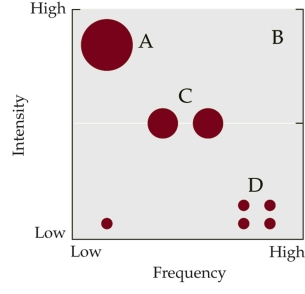 The figure shows examples of possible disturbance intensity (y-axis) and frequency (x-axis) combinations.
-What type of succession occurs after the disturbance in A?
The figure shows examples of possible disturbance intensity (y-axis) and frequency (x-axis) combinations.
-What type of succession occurs after the disturbance in A? (Multiple Choice)
4.8/5 (90)
(90) Refer to the figure.
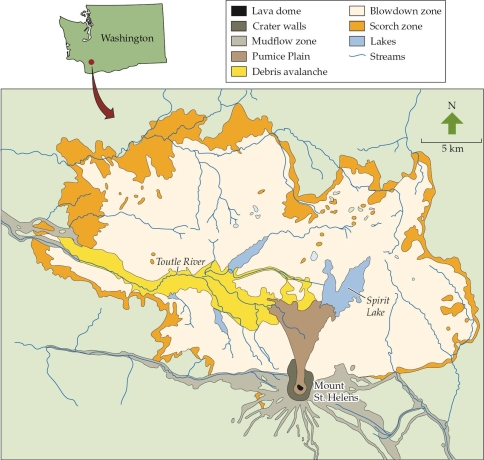 On Mount St. Helens, the intensity of disturbance ranged from extremely high (lava dome, pumice plain) to moderate (mudflow zone, blowdown zone), to low (scorch zone).
-In which area is the abiotic stress of low nitrogen availability most likely to control succession?
On Mount St. Helens, the intensity of disturbance ranged from extremely high (lava dome, pumice plain) to moderate (mudflow zone, blowdown zone), to low (scorch zone).
-In which area is the abiotic stress of low nitrogen availability most likely to control succession? (Multiple Choice)
4.8/5 (81)
(81) 
Filters
- Essay(0)
- Multiple Choice(0)
- Short Answer(0)
- True False(0)
- Matching(0)