



 Chat with AI
Exam 21: Energy Flow and Food Webs

Exam 1: The Web of Life68 Questions
Exam 2: The Physical Environment76 Questions
Exam 3: The Biosphere73 Questions
Exam 4: Coping With Environmental Variation:74 Questions
Exam 5: Coping With Environmental Variation: Energy71 Questions
Exam 6: Evolution and Ecology68 Questions
Exam 7: Life History69 Questions
Exam 8: Behavioral Ecology71 Questions
Exam 9: Population Distribution and Abundance80 Questions
Exam 10: Population Dynamics68 Questions
Exam 11: Population Growth and Regulation69 Questions
Exam 12: Predation70 Questions
Exam 13: Parasitism72 Questions
Exam 14: Competition74 Questions
Exam 15: Mutualism and Commensalism71 Questions
Exam 16: The Nature of Communities71 Questions
Exam 17: Change in Communities73 Questions
Exam 18: Biogeography70 Questions
Exam 19: Species Diversity in Communities72 Questions
Exam 20: Production73 Questions
Exam 21: Energy Flow and Food Webs76 Questions
Exam 22: Nutrient Supply and Cycling76 Questions
Exam 23: Conservation Biology73 Questions
Exam 24: Landscape Ecology and Ecosystem Management71 Questions
Exam 25: Global Ecology74 Questions
Select questions type


An earthworm eats primarily detritus. A robin that then eats the earthworm is operating on a trophic level _______ that of a rabbit that eats grass.
(Multiple Choice)
4.9/5  (70)
(70) Decreases in _______ tend to increase the number of trophic levels in an ecosystem.
(Multiple Choice)
4.8/5 (77)
(77) Refer to the figure.
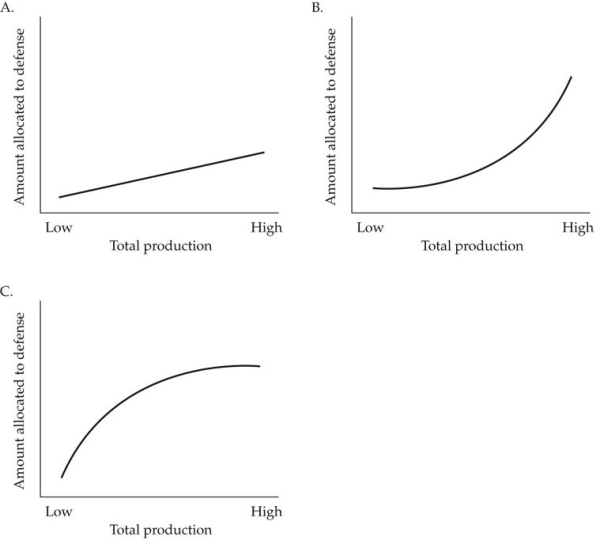 Which figure shows the most likely relationship between the total amount of production and the amount of resources allocated to defense in an ecosystem?
 (Multiple Choice)
4.7/5 (74)
(74) Hairston and colleagues argued that terrestrial ecosystems have a _______ proportion of autotroph biomass consumption compared to aquatic ecosystems because _______ is stronger in terrestrial ecosystems.
(Multiple Choice)
4.7/5 (64)
(64) In an inverted trophic pyramid, _______ biomass is present in the secondary carnivores than in the primary producers. Compared to terrestrial systems, aquatic systems are _______ likely to feature inverted pyramids.
(Multiple Choice)
4.7/5 (82)
(82) What links animals together in the context of ecological function is
(Multiple Choice)
4.9/5 (80)
(80) If a robin with an assimilation efficiency of 30% and a production efficiency of 20% consumes 200 grams of worms, the expected increase in biomass of the bird will be _______ grams.
(Multiple Choice)
4.9/5 (85)
(85) According to the studies by Dyer and Letourneau, high densities of Tarsobaenus beetles in a lowland wet tropical forest led to _______ herbivory and _______ production.
(Multiple Choice)
4.8/5 (60)
(60) Which trophic level generates the most dead organic material in most ecosystems?
(Multiple Choice)
4.9/5 (77)
(77) Refer to the figure.
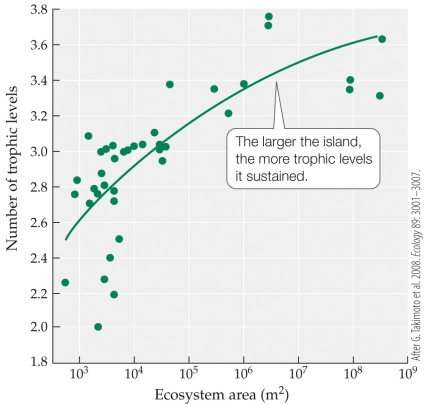 An ecosystem of 103.5 m2 would be expected to have _______ trophic levels.
 (Multiple Choice)
4.8/5 (88)
(88) In Paine's studies of ecosystems in the rocky intertidal zone, removal of Pisaster sea stars led to a long-term
(Multiple Choice)
4.8/5 (71)
(71) The devastating effects of DDT and other pesticides on nontarget birds and mammals were described by _______ in the book Silent Spring.
(Multiple Choice)
4.7/5 (96)
(96) In Paine's studies of the rocky intertidal zone, which species or group of species acted most like a keystone species?
(Multiple Choice)
5.0/5 (74)
(74) In which human communities would one be most likely to find the highest concentrations of PCBs?
(Multiple Choice)
4.7/5 (79)
(79) 
Filters
- Essay(0)
- Multiple Choice(0)
- Short Answer(0)
- True False(0)
- Matching(0)