



 Chat with AI
Exam 22: Nutrient Supply and Cycling

Exam 1: The Web of Life68 Questions
Exam 2: The Physical Environment76 Questions
Exam 3: The Biosphere73 Questions
Exam 4: Coping With Environmental Variation:74 Questions
Exam 5: Coping With Environmental Variation: Energy71 Questions
Exam 6: Evolution and Ecology68 Questions
Exam 7: Life History69 Questions
Exam 8: Behavioral Ecology71 Questions
Exam 9: Population Distribution and Abundance80 Questions
Exam 10: Population Dynamics68 Questions
Exam 11: Population Growth and Regulation69 Questions
Exam 12: Predation70 Questions
Exam 13: Parasitism72 Questions
Exam 14: Competition74 Questions
Exam 15: Mutualism and Commensalism71 Questions
Exam 16: The Nature of Communities71 Questions
Exam 17: Change in Communities73 Questions
Exam 18: Biogeography70 Questions
Exam 19: Species Diversity in Communities72 Questions
Exam 20: Production73 Questions
Exam 21: Energy Flow and Food Webs76 Questions
Exam 22: Nutrient Supply and Cycling76 Questions
Exam 23: Conservation Biology73 Questions
Exam 24: Landscape Ecology and Ecosystem Management71 Questions
Exam 25: Global Ecology74 Questions
Select questions type


Refer to the table.
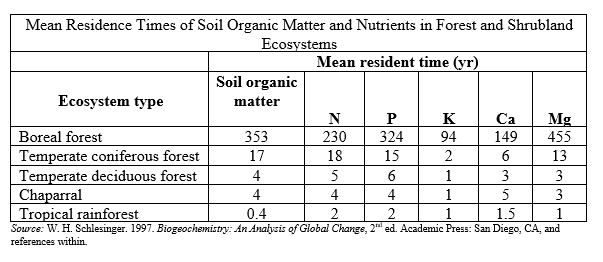 In a series of experiments, a researcher repeatedly measures the mean resident time for phosphate to be approximately 6 years. What ecosystem type is the researcher studying?
 (Multiple Choice)
4.9/5  (71)
(71) Which of the following is one example of the ways in which Arctic plant communities have avoided competition through resource partitioning?
(Multiple Choice)
4.8/5 (81)
(81) By a process known as _______, certain chemoautotrophic bacteria transform ammonia and ammonium into _______, which tends to be more available to plants than other forms of nitrogen.
(Multiple Choice)
4.8/5 (80)
(80) The availability of nutrient cations such as Ca2+, K+, and Mg2+ to plants may be insufficient in some soils that have low amounts of _______ particles. These particles have _______ that allow them to hold onto cations and exchange them with the soil solution.
(Multiple Choice)
4.9/5 (63)
(63) Chemical weathering of minerals in rocks is an important source of nutrients because it
(Multiple Choice)
4.9/5 (73)
(73) Refer to the figure.
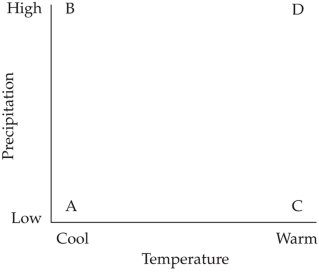 The figure shows the relationship between temperature and precipitation in different climate regimes (points A‒D). Suppose that the climates in the graph have been maintained for a long period of time. With everything else being equal, in which climate regime would you expect soil quality in terms of mineral-derived nutrients to be the lowest?
 (Multiple Choice)
4.7/5 (83)
(83) In the 1950s, anthropogenic eutrophication of Lake Washington was caused by
(Multiple Choice)
4.8/5 (71)
(71) Refer to the figure.
Figure 1
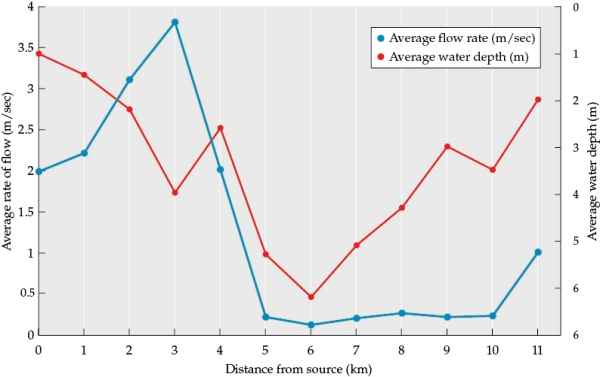 You are studying a river in its natural state, unaffected by human activities. Your data are graphed in Figure 1. You began collecting data at the source of the river ("0 km" on the figure) and continued to sample the river every 1 km.
-What type of succession would you expect to see in this high cation exchange capacity area, and why? How would the rate of soil formation and succession differ from what you would expect in a terrestrial area disturbed by a lava flow?
You are studying a river in its natural state, unaffected by human activities. Your data are graphed in Figure 1. You began collecting data at the source of the river ("0 km" on the figure) and continued to sample the river every 1 km.
-What type of succession would you expect to see in this high cation exchange capacity area, and why? How would the rate of soil formation and succession differ from what you would expect in a terrestrial area disturbed by a lava flow? (Essay)
4.9/5 (82)
(82) Refer to the table and the figure.
Table 1
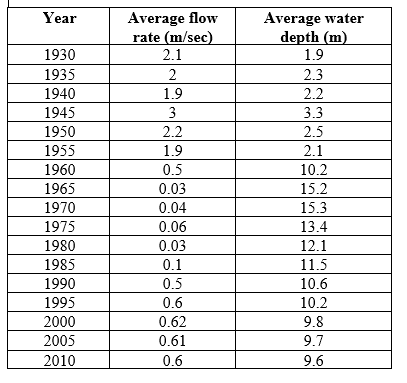 Figure 2
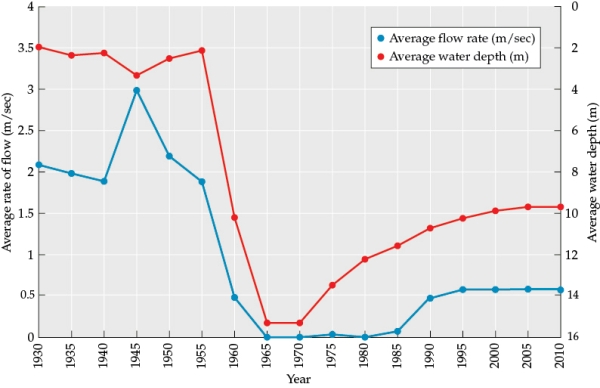 You are studying a river that has been dammed to form a reservoir. You have compiled data collected on this system over time (Table 1 and Figure 2).
-Use the data in Table 1 and Figure 2 to answer the following questions about the effect damning the river will have on the ecosystem:
a) How would the extent of mixing change when the system changed from a river ecosystem to a reservoir?
b) How would you expect the oxygen levels in the benthic zone of the reservoir to differ from those found at the river bottom when the river was in its natural state? How would you expect decomposition to differ?
Figure 2
You are studying a river that has been dammed to form a reservoir. You have compiled data collected on this system over time (Table 1 and Figure 2).
-Use the data in Table 1 and Figure 2 to answer the following questions about the effect damning the river will have on the ecosystem:
a) How would the extent of mixing change when the system changed from a river ecosystem to a reservoir?
b) How would you expect the oxygen levels in the benthic zone of the reservoir to differ from those found at the river bottom when the river was in its natural state? How would you expect decomposition to differ? (Essay)
4.8/5 (73)
(73) Which statement about the nutrient supply in marine ecosystems is false?
(Multiple Choice)
4.9/5 (83)
(83) During the later stages of succession, the nutrient most limiting to primary production in many terrestrial ecosystems is _______ because it _______.
(Multiple Choice)
4.8/5 (73)
(73) Soluble phosphorus combines with iron to form a compound that is no longer useable by organisms. This process is an example of
(Multiple Choice)
4.7/5 (83)
(83) Rivers and streams subjected to high amounts of nitrogen pollution export less nitrate than would be expected because moving stream water is affected by the processes of _______ and _______.
(Multiple Choice)
4.7/5 (83)
(83) How do plants and animals differ in how they take in nutrients?
(Multiple Choice)
4.8/5 (68)
(68) Which statement about the soils on the Colorado Plateau is false?
(Multiple Choice)
4.9/5 (77)
(77) Which of the following statements about nutrient requirements in organisms is false?
(Multiple Choice)
4.9/5 (72)
(72) In the process of nitrification, certain bacteria use inorganic nitrogen released from mineralization as an energy source, influencing the forms of nitrogen available to plants. The chemical transformation that occurs during nitrification is the conversion of _______ into _______.
(Multiple Choice)
4.8/5 (90)
(90) Decomposition of organic matter with a C:N ratio _______ than 25:1 (the optimal ratio for microbial growth) would result in a net release of nutrients into the soil. The reason is that microbial growth in this situation would be more limited by the _______ supply than by the _______ supply.
(Multiple Choice)
4.9/5 (87)
(87) Which statement best describes the relationship between mechanical and chemical weathering?
(Multiple Choice)
4.9/5 (76)
(76) 
Filters
- Essay(0)
- Multiple Choice(0)
- Short Answer(0)
- True False(0)
- Matching(0)