



 Chat with AI
Exam 12: The Milky Way Galaxy

Exam 1: Here and Now97 Questions
Exam 2: A Users Guide to the Sky116 Questions
Exam 3: Cycles of the Sun and Moon154 Questions
Exam 4: The Origin of Modern Astronomy144 Questions
Exam 5: Light and Telescopes156 Questions
Exam 6: Atoms and Spectra125 Questions
Exam 7: The Sun146 Questions
Exam 8: The Family of Stars190 Questions
Exam 9: The Formation and Structure of Stars136 Questions
Exam 10: The Deaths of Stars128 Questions
Exam 11: Neutron Stars and Black Holes99 Questions
Exam 12: The Milky Way Galaxy117 Questions
Exam 13: Galaxies: Normal and Active151 Questions
Exam 14: Modern Cosmology112 Questions
Exam 15: Origin of the Solar System and Extrasolar Planets104 Questions
Exam 16: Earth and Moon: Bases for Comparative Planetology98 Questions
Exam 17: Mercury, Venus, and Mars83 Questions
Exam 18: The Outer Solar System137 Questions
Exam 19: Meteorites, Asteroids, and Comets91 Questions
Exam 20: Astrobiology: Life on Other Worlds97 Questions
Select questions type


Who first determined that the energy/s emitted by (luminosity of) Cepheid variable stars is larger the longer their period of variation is?
(Multiple Choice)
4.8/5  (75)
(75) The traditional "top-down" hypothesis of the formation of our galaxy cannot explain
(Multiple Choice)
4.8/5 (86)
(86) Discuss how astronomers know that our galaxy contains spiral arms in its disk.
(Essay)
4.8/5 (79)
(79) More massive stars are _________ luminous and __________ than less massive stars, thus they pulsate _____________.
(Multiple Choice)
4.9/5 (91)
(91)  In which direction is the above spiral galaxy rotating and which color best represents where the gas is being compressed by the spiral density wave?
 (Multiple Choice)
4.8/5 (78)
(78) Sgr A* is believed to be the center of the Milky Way galaxy because
I. it lies in the general direction of the center of the galaxy based on observations of globular clusters in the plane of the Milky Way.
II. long-wavelength dust-penetrating images show it to be a region crowded with stars.
III. orbits of stars around it indicate a mass several million times that of the Sun within a volume a few light hours in size.
IV. radio observations show it is a concentrated source at the center of swirling clouds of gas.
(Multiple Choice)
4.8/5 (83)
(83) Population II stars contain more metals than Population I stars.
(True/False)
4.8/5 (79)
(79) 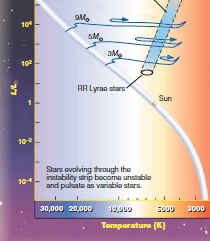
M dwarf main-sequence stars pass through the instability strip as shown above.
M dwarf main-sequence stars pass through the instability strip as shown above. (True/False)
4.9/5 (73)
(73) Getting a cold is like building the chemical elements in nucleosynthesis.
(True/False)
4.8/5 (78)
(78) ___________ in other galaxies should contain luminous O and B stars if they are like the Milky Way.
(Multiple Choice)
4.8/5 (82)
(82)  Which of the above shown variable types is brightest?
The _________________ hypothesis includes mergers with smaller galaxies and infalling gas to the standard formation of the Milky Way galaxy.
(Short Answer)
4.8/5 (79)
(79) What is the difference between a population I star and a population II star?
(Essay)
4.8/5 (71)
(71) The rapid rotation in the outer disk suggests that our galaxy is more massive than previously thought.
(True/False)
4.8/5 (89)
(89) The ____________________ of the galaxy contains population I stars, open clusters, and gas clouds.
(Short Answer)
4.9/5 (70)
(70) 
Filters
- Essay(0)
- Multiple Choice(0)
- Short Answer(0)
- True False(0)
- Matching(0)