



 Chat with AI
Exam 11: Neutron Stars and Black Holes

Exam 1: Here and Now97 Questions
Exam 2: A Users Guide to the Sky116 Questions
Exam 3: Cycles of the Sun and Moon154 Questions
Exam 4: The Origin of Modern Astronomy144 Questions
Exam 5: Light and Telescopes156 Questions
Exam 6: Atoms and Spectra125 Questions
Exam 7: The Sun146 Questions
Exam 8: The Family of Stars190 Questions
Exam 9: The Formation and Structure of Stars136 Questions
Exam 10: The Deaths of Stars128 Questions
Exam 11: Neutron Stars and Black Holes99 Questions
Exam 12: The Milky Way Galaxy117 Questions
Exam 13: Galaxies: Normal and Active151 Questions
Exam 14: Modern Cosmology112 Questions
Exam 15: Origin of the Solar System and Extrasolar Planets104 Questions
Exam 16: Earth and Moon: Bases for Comparative Planetology98 Questions
Exam 17: Mercury, Venus, and Mars83 Questions
Exam 18: The Outer Solar System137 Questions
Exam 19: Meteorites, Asteroids, and Comets91 Questions
Exam 20: Astrobiology: Life on Other Worlds97 Questions
Select questions type


Complete the reaction: e + p → __ _____ ________; the reaction applies to ______ _____ _____.
(Multiple Choice)
4.8/5  (92)
(92) The ___ _______ _ of a black hole is the radius from a black hole at which the escape velocity is approximately equal to the speed of light.
(Multiple Choice)
4.9/5 (66)
(66) The figure shows an image of an isolated black hole. A black hole emits 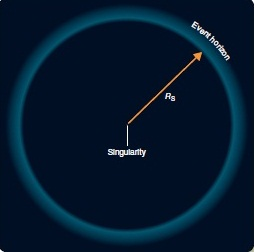
(Multiple Choice)
4.9/5 (77)
(77) We expect neutron stars to spin rapidly because they conserve angular momentum.
(True/False)
4.7/5 (78)
(78) The event horizon marks the boundary within which the density is roughly the same as that of the atomic nucleus.
(True/False)
4.8/5 (79)
(79) When a binary system loses orbital energy, it emits ___ _____ _______ radiation.
(Short Answer)
4.9/5 (79)
(79) Light that is shifted toward the color red due to the light passing very near a compact object is called ____________________.
(Short Answer)
4.9/5 (65)
(65) At extremely high densities and temperatures, electrons can be forced to fuse with protons. This reaction produces
(Multiple Choice)
4.9/5 (66)
(66) Rank the degenerate pressures from least supportive to most supportive:
(Multiple Choice)
4.8/5 (74)
(74) If the accretion disk around a black hole emits X-rays outside the event horizon, the X-rays can escape.
(True/False)
4.8/5 (74)
(74) The slowing of clocks in strongly curved space time is known as
(Multiple Choice)
4.9/5 (92)
(92) LMC X-3 is a binary system that is believed to contain a black hole.
(True/False)
4.9/5 (72)
(72) The ____________________ theory describes pulsars as rotating neutron stars with strong magnetic fields that confine high-speed charged particles in two beams emanating from the magnetic poles of the neutron star.
(Short Answer)
5.0/5 (78)
(78) 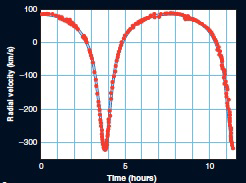 In the above graph of a pulsar in a binary, the motion of the pulsar from 2.75 hours to 3.5 hours is ___________________.
 (Multiple Choice)
4.9/5 (84)
(84) 
Filters
- Essay(0)
- Multiple Choice(0)
- Short Answer(0)
- True False(0)
- Matching(0)