



 Chat with AI
Exam 11: Neutron Stars and Black Holes

Exam 1: Here and Now97 Questions
Exam 2: A Users Guide to the Sky116 Questions
Exam 3: Cycles of the Sun and Moon154 Questions
Exam 4: The Origin of Modern Astronomy144 Questions
Exam 5: Light and Telescopes156 Questions
Exam 6: Atoms and Spectra125 Questions
Exam 7: The Sun146 Questions
Exam 8: The Family of Stars190 Questions
Exam 9: The Formation and Structure of Stars136 Questions
Exam 10: The Deaths of Stars128 Questions
Exam 11: Neutron Stars and Black Holes99 Questions
Exam 12: The Milky Way Galaxy117 Questions
Exam 13: Galaxies: Normal and Active151 Questions
Exam 14: Modern Cosmology112 Questions
Exam 15: Origin of the Solar System and Extrasolar Planets104 Questions
Exam 16: Earth and Moon: Bases for Comparative Planetology98 Questions
Exam 17: Mercury, Venus, and Mars83 Questions
Exam 18: The Outer Solar System137 Questions
Exam 19: Meteorites, Asteroids, and Comets91 Questions
Exam 20: Astrobiology: Life on Other Worlds97 Questions
Select questions type


Pulsars could not be ordinary stars that are pulsating because the pulses are too short.
(True/False)
4.9/5  (79)
(79) When a star of mass comparable to the Sun dies it become a black hole.
(True/False)
4.8/5 (66)
(66) Gamma-ray bursts lasting longer than two seconds appear to be related to ______________.
(Short Answer)
5.0/5 (91)
(91) Why does our theory predict that neutron stars will have strong magnetic fields?
(Essay)
4.8/5 (73)
(73) The escape velocity of an object depends on
I. the mass of that object.
II. the mass of the object trying to escape.
III. the distance from the center of the object and the escaping object.
IV. the speed of light.
(Multiple Choice)
4.8/5 (81)
(81) Gamma-ray bursts seem to be associated with violent events involving _______________.
(Multiple Choice)
5.0/5 (85)
(85) Energy lost by an isolated pulsar is carried away by a __ _____ ______.
(Short Answer)
4.8/5 (80)
(80) A(n) ____________________ is a rapidly spinning neutron star that accelerates charged particles near the poles of its magnetic field.
(Short Answer)
4.8/5 (93)
(93) What happens when a core's density exceeds that which electron degeneracy pressure can support?
(Multiple Choice)
4.8/5 (77)
(77) What happens when a core's mass is less than 3 solar masses but greater than 1.44 solar masses?
(Multiple Choice)
4.7/5 (65)
(65) 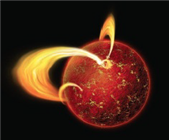 The above cartoon is of a neutron star with a strong magnetic field. We call this a pulsar planet.
 (True/False)
4.8/5 (66)
(66) Theory predicts that neutron stars may not exceed 3 solar masses.
(True/False)
4.7/5 (79)
(79) ___ _____ _ are neutron stars that have magnetic fields 100 times stronger than the average neutron star.
(Multiple Choice)
5.0/5 (79)
(79)  Using the graph above of a pulsar in a binary orbit, what is the orbital period?
 (Multiple Choice)
4.8/5 (86)
(86) Fraud in science is rare because it is difficult to commit. Why is it difficult to commit fraud in science?
(Multiple Choice)
4.8/5 (72)
(72) 
Filters
- Essay(0)
- Multiple Choice(0)
- Short Answer(0)
- True False(0)
- Matching(0)