



 Chat with AI
Exam 11: Gross Domestic Product

Exam 1: Introducing the Economic Way of Thinking254 Questions
Exam 2: Production Possibilities, Opportunity Cost, and Economic Growth209 Questions
Exam 3: Market Demand and Supply361 Questions
Exam 4: Markets in Action259 Questions
Exam 5: Price Elasticity of Demand181 Questions
Exam 6: Production Costs254 Questions
Exam 7: Perfect Competition226 Questions
Exam 8: Monopoly175 Questions
Exam 9: Monopolistic Competition and Oligopoly166 Questions
Exam 10: Labor Markets and Income Distribution185 Questions
Exam 11: Gross Domestic Product207 Questions
Exam 12: Business Cycles and Unemployment199 Questions
Exam 13: Inflation131 Questions
Exam 14: Aggregate Demand and Supply83 Questions
Exam 15: Fiscal Policy205 Questions
Exam 16: The Public Sector131 Questions
Exam 17: Federal Deficits, Surpluses, and the National Debt102 Questions
Exam 18: Money and the Federal Reserve System159 Questions
Exam 19: Money Creation250 Questions
Exam 20: Policy Disputes Using the Self-Correcting Aggregate Demand and Supply Model246 Questions
Exam 21: International Trade and Finance251 Questions
Exam 22: Economies in Transition108 Questions
Exam 23: Growth and the Less-Developed Countries121 Questions
Select questions type


National income is derived from gross domestic product by subtracting:
(Multiple Choice)
4.8/5  (89)
(89) Exhibit 11-6 GDP data (billions of dollars) 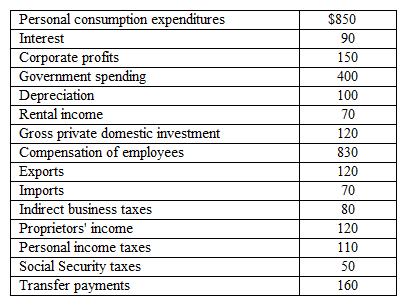 In Exhibit 11-6, and using the expenditures approach, gross domestic product (GDP) equals:
 (Multiple Choice)
4.8/5 (74)
(74) Intermediate goods are included and final goods are not included in calculating gross domestic product.
(True/False)
4.9/5 (88)
(88) The market value of all final goods and services in an economy produced by resources owned by people of that economy:
(Multiple Choice)
4.9/5 (78)
(78) Exhibit 11-8 GDP data (billions of dollars) 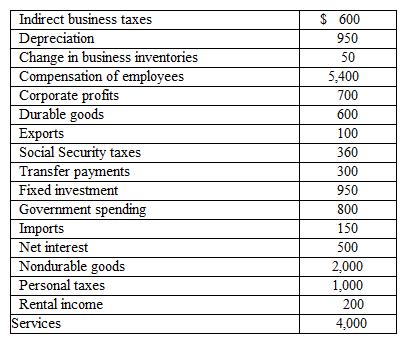 In Exhibit 11-8, compute disposable personal income (DI). Which of the following is correct?
 (Multiple Choice)
4.8/5 (77)
(77) Because GDP does not account for improvements in the quality of goods, the GDP calculation:
(Multiple Choice)
4.9/5 (69)
(69) In the circular flow model, money flows from the business sector to the household sector through the:
(Multiple Choice)
4.8/5 (73)
(73) National income (NI) is the total income earned by resource owners, including wages, rents, interest, and profits.
(True/False)
4.9/5 (91)
(91) Exhibit 11-2 Gross domestic product data 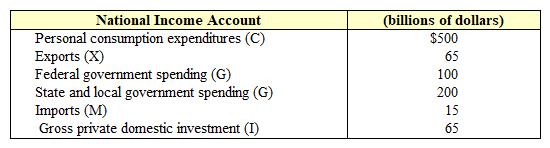 As shown in Exhibit 11-2, total expenditures by households for domestically produced goods is:
 (Multiple Choice)
4.8/5 (66)
(66) The expenditure approach for the calculation of GDP includes spending on:
(Multiple Choice)
4.9/5 (89)
(89) In recent years, people have benefited from greater amounts of leisure time. This trend:
(Multiple Choice)
4.9/5 (73)
(73) Gross domestic product (GDP) is a satisfactory measure of both economic "goods" and "bads".
(True/False)
4.9/5 (77)
(77) The income that people earn in resource or factor markets is called:
(Multiple Choice)
4.7/5 (84)
(84) 
Filters
- Essay(0)
- Multiple Choice(0)
- Short Answer(0)
- True False(0)
- Matching(0)