



 Chat with AI
Exam 17: Effects of Positive Pressure Ventilation on the Pulmonary System

Exam 1: Basic Terms and Concepts of Mechanical Ventilation36 Questions
Exam 2: How Ventilators Work13 Questions
Exam 3: How a Breath Is Delivered30 Questions
Exam 4: Establishing the Need for Mechanical Ventilation27 Questions
Exam 5: Selecting the Ventilator and the Mode32 Questions
Exam 6: Initial Ventilator Settings32 Questions
Exam 7: Final Considerations in Ventilator Setup36 Questions
Exam 8: Initial Patient Assessment37 Questions
Exam 9: Ventilator Graphics32 Questions
Exam 10: Assessment of Respiratory Function55 Questions
Exam 11: Hemodynamic Monitoring56 Questions
Exam 12: Methods to Improve Ventilation in Patient-Ventilator Management32 Questions
Exam 13: Improving Oxygenation and Management of ARDS32 Questions
Exam 14: Ventilator-Associated Pneumonia26 Questions
Exam 15: Sedatives, Analgesics, and Paralytics17 Questions
Exam 16: Extrapulmonary Effects of Mechanical Ventilation17 Questions
Exam 17: Effects of Positive Pressure Ventilation on the Pulmonary System27 Questions
Exam 18: Troubleshooting and Problem Solving26 Questions
Exam 19: Basic Concepts of Noninvasive Positive-Pressure Ventilation27 Questions
Exam 20: Weaning and Discontinuation from Mechanical Ventilation27 Questions
Exam 21: Long-Term Ventilation29 Questions
Exam 22: Neonatal and Pediatric Ventilation40 Questions
Exam 23: Special Techniques in Ventilatory Support21 Questions
Select questions type


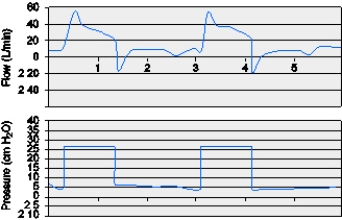
A patient with asthma is being ventilated in PSV,5 cm H₂O,with CPAP of 5 cm H₂O.The patient has chest wall retractions on most breaths and appears to have an increased WOB.The following graphic occurred the entire time the respiratory therapist was assessing the patient.What does this graphic demonstrate?
(Multiple Choice)
4.7/5  (77)
(77) Shear stress injury and loss of surfactant from the resulting unstable lung units result in a loss of surfactant.This type of pulmonary trauma is known as _____________.
(Multiple Choice)
4.9/5 (78)
(78) The RT performs a patient-ventilator system check on a 24-year-old,5-foot,10-inch male patient who has been intubated because of a drug overdose.The RT notices what appears to be swelling around the patient's upper anterior chest and neck area.Palpation elicits a tissue paper feeling.The ventilator settings are: VC-CMV,rate 12/min with no patient assist,Vᴛ 900 mL,PEEP 5 cm H₂O,FɪO₂ 0.4,Tɪ 1.2 sec.The most appropriate action for the RT to take is which of the following?
(Multiple Choice)
4.8/5 (73)
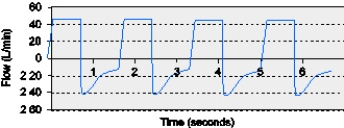
(73) The RT assesses the flow-time scalar from an apneic patient mechanically ventilated in the VC-CMV mode.The most appropriate action for this patient is to do which of the following?
(Multiple Choice)
4.9/5 (86)
(86) In what areas of the lung are ventilation and perfusion best matched during spontaneous ventilation in the supine position?
(Multiple Choice)
4.9/5 (83)
(83) Ventilator-induced lung injury (VILI)is associated with which of the following?
(Multiple Choice)
4.9/5 (80)
(80) Shear stress is most likely to affect a patient with which of the following?
(Multiple Choice)
4.9/5 (82)
(82) 
Filters
- Essay(0)
- Multiple Choice(0)
- Short Answer(0)
- True False(0)
- Matching(0)