



 Chat with AI
Exam 12: Methods to Improve Ventilation in Patient-Ventilator Management

Exam 1: Basic Terms and Concepts of Mechanical Ventilation36 Questions
Exam 2: How Ventilators Work13 Questions
Exam 3: How a Breath Is Delivered30 Questions
Exam 4: Establishing the Need for Mechanical Ventilation27 Questions
Exam 5: Selecting the Ventilator and the Mode32 Questions
Exam 6: Initial Ventilator Settings32 Questions
Exam 7: Final Considerations in Ventilator Setup36 Questions
Exam 8: Initial Patient Assessment37 Questions
Exam 9: Ventilator Graphics32 Questions
Exam 10: Assessment of Respiratory Function55 Questions
Exam 11: Hemodynamic Monitoring56 Questions
Exam 12: Methods to Improve Ventilation in Patient-Ventilator Management32 Questions
Exam 13: Improving Oxygenation and Management of ARDS32 Questions
Exam 14: Ventilator-Associated Pneumonia26 Questions
Exam 15: Sedatives, Analgesics, and Paralytics17 Questions
Exam 16: Extrapulmonary Effects of Mechanical Ventilation17 Questions
Exam 17: Effects of Positive Pressure Ventilation on the Pulmonary System27 Questions
Exam 18: Troubleshooting and Problem Solving26 Questions
Exam 19: Basic Concepts of Noninvasive Positive-Pressure Ventilation27 Questions
Exam 20: Weaning and Discontinuation from Mechanical Ventilation27 Questions
Exam 21: Long-Term Ventilation29 Questions
Exam 22: Neonatal and Pediatric Ventilation40 Questions
Exam 23: Special Techniques in Ventilatory Support21 Questions
Select questions type


A mechanically ventilated patient continues to have rhonchi after deep suctioning.The respiratory therapist should recommend which of the following?
(Multiple Choice)
4.8/5  (78)
(78) A 59-kg IBW female patient is being mechanically ventilated in the CMV mode,f = 12/min,Vᴛ = 400 mL,PEEP = 5 cm H₂O,FɪO₂ = 0.5.The ABG results on these settings show a respiratory acidosis and severe hypoxemia.The respiratory therapist increases the set Vᴛ and increases the PEEP to 12 cm H₂O.The resulting ABGs show improved oxygenation,but the patient still has a respiratory acidosis.The respiratory acidosis may be due to which of the following?
(Multiple Choice)
5.0/5 (69)
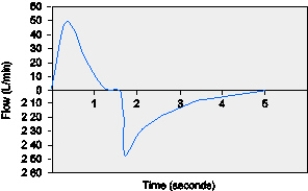
(69) A male patient (74-kg IBW)is being ventilated with PC-CMV,f = 12/min,PIP = 20 cm H₂O,TI = 1.5 seconds; the resulting flow-time scalar is shown below.The patient's measured Vᴛ is 435 mL.ABG results on these settings are: pH 7.32,PaCO2 54 mm Hg,HCO3⁻ 25 mEq/L.The most appropriate action to take is which of the following?
(Multiple Choice)
4.8/5 (96)
(96) A patient with an IBW of 68 kg is intubated and being mechanically ventilated with VC-CMV,f = 12/min,and Vᴛ = 470 mL.The patient has a combined respiratory rate of 25/min.The ABG results are: pH 7.56,PₐCO₂ 26 mm Hg,and HCO₃⁻ 22 mEq/L.The most appropriate action is to do which of the following?
(Multiple Choice)
4.9/5 (70)
(70) A 45-year-old female (58-kg IBW)with a past medical history of asthma arrives at the emergency department short of breath,anxious,diaphoretic,and unable to perform a peak expiratory flow measurement.She also has a combined acidosis.Breath sounds reveal the patient is not moving much air.The patient is intubated,stabilized,and transported to the ICU.The ventilator settings are: PC-CMV,f = 12/min,PIP = 30 cm H₂O,FɪO₂ = 0.6,and PEEP = 3 cm H₂O.The patient is sedated and paralyzed; the resulting ABGs are: pH 7.17,PₐCO₂ 69.3 mm Hg,PₐO₂ 90 mm Hg,and HCO₃⁻ 21 mEq/L after continuous bronchodilator therapy.The respiratory rate is increased to 20/min,and the next ABG results are: pH 7.26,PₐCO₂ 58 mm Hg,PₐO₂ 96 mm Hg,and HCO₃⁻ 22 mEq/L.The respiratory therapist should suggest which of the following at this time?
(Multiple Choice)
4.9/5 (86)
(86) A patient with CHF is being mechanically ventilated.The patient's current PₐCO₂ = 28 mm Hg,and the ventilator set rate is 16 per minute.The desired PₐCO₂ for this patient is 40 mm Hg.To what should the set rate be changed?
(Multiple Choice)
4.9/5 (68)
(68) A female patient (59-kg IBW)with no history of pulmonary disease is being invasively ventilated with VC-CMV,f = 12/min,Vᴛ = 470 mL,PEEP = 5 cm H₂O,FɪO₂ = 0.5.ABG results with these settings are: pH 7.31,PₐCO₂ 54 mm Hg,PₐO₂ 92 mm Hg,SₐO₂ 90%,HCO₃⁻ 24 mEq/L.The most appropriate action for the respiratory therapist to take is which of the following?
(Multiple Choice)
4.8/5 (82)
(82) An invasively ventilated patient with ARDS is on PC-CMV,PIP = 30 cm H₂O,PEEP = 12 cm H₂O,FɪO₂ = 1.0.The patient's returned Vᴛ is 320 mL.The ABG results on these settings are: pH 7.3,PₐCO₂ 53 mm Hg,PₐO₂ 62 mm Hg.The patient is placed in the prone position,and after 1 hour,ABG results show: pH 7.38,PₐCO₂ 46 mm Hg,PₐO₂ 83 mm Hg.The respiratory therapist should do which of the following?
(Multiple Choice)
4.9/5 (91)
(91) A physician and a respiratory therapist are performing bedside bronchoscopy of an invasively ventilated patient.Fentanyl and midazolam were used for conscious sedation.After the bronchoscopy,the patient is not arousable.Which of the following should be done at this time?
(Multiple Choice)
4.8/5 (89)
(89) At what point during deep suctioning should negative pressure be applied?
(Multiple Choice)
4.9/5 (76)
(76) A 28-year-old female (55-kg IBW)is being mechanically ventilated with VC-CMV,f = 14/min,Vᴛ = 700 mL.The patient has no history of pulmonary disease.The resulting ABG values are: pH 7.55,PₐCO₂ 27 mm Hg,HCO₃⁻ 23 mEq/L.The most appropriate action to take is which of the following?
(Multiple Choice)
4.7/5 (76)
(76) 
Filters
- Essay(0)
- Multiple Choice(0)
- Short Answer(0)
- True False(0)
- Matching(0)