



 Chat with AI
Exam 2: Molecules of Life

Exam 1: Invitation to Biology100 Questions
Exam 2: Molecules of Life100 Questions
Exam 3: Cell Structure101 Questions
Exam 4: Energy and Metabolism100 Questions
Exam 5: Capturing and Releasing Energy100 Questions
Exam 6: Dna Structure and Function100 Questions
Exam 7: Gene Expression and Control100 Questions
Exam 8: How Cells Reproduce100 Questions
Exam 9: Patterns of Inheritance96 Questions
Exam 10: Biotechnology100 Questions
Exam 11: Evidence of Evolution85 Questions
Exam 12: Processes of Evolution99 Questions
Exam 13: Early Life Forms and the Viruses99 Questions
Exam 14: Plants and Fungi100 Questions
Exam 15: Animal Evolution100 Questions
Exam 16: Population Ecology100 Questions
Exam 17: Communities and Ecosystems100 Questions
Exam 18: The Biosphere and Human Effects99 Questions
Exam 19: Animal Tissues and Organs100 Questions
Exam 20: How Animals Move100 Questions
Exam 21: Circulation and Respiration100 Questions
Exam 22: Immunity100 Questions
Exam 23: Digestion and Excretion100 Questions
Exam 24: Neural Control and the Senses100 Questions
Exam 25: Endocrine Control100 Questions
Exam 26: Reproduction and Development100 Questions
Exam 27: Plant Form and Function100 Questions
Exam 28: Plant Reproduction and Development100 Questions
Select questions type


Match the following terms to the correct description .
Premises:
measure of the relative concentration of hydrogen ions in a solution
Responses:
acid
base
pH
Correct Answer: Verified
Premises:
Responses:
(Matching)
4.9/5  (76)
(76) Which food product would likely contain the largest amount of unsaturated fat?
(Multiple Choice)
4.8/5 (84)
(84) Match the following terms to the correct description .
Premises:
substance that can maintain the pH of a solution at a relatively constant level
Responses:
neutral
buffer
pH
Correct Answer:Verified
VerifiedPremises:
Responses:
(Matching)
4.8/5 (81)
(81) Match the following terms to the correct description.
Premises:
total number of protons and neutrons in the nucleus of an atom
Responses:
mass number
ions
isotopes
Correct Answer:Verified
VerifiedPremises:
Responses:
(Matching)
4.8/5 (79)
(79) Fats will dissolve in ethanol. Ethanol is an example of a ____.
(Multiple Choice)
5.0/5 (88)
(88) 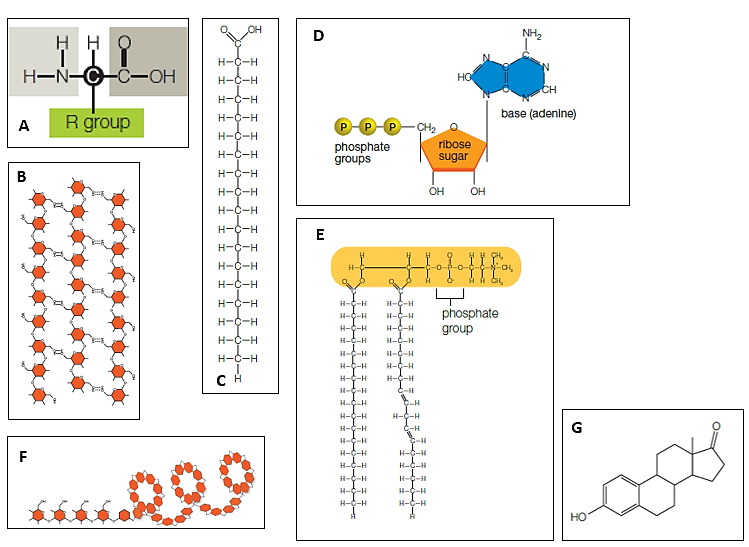
Match the structures below with the appropriate label in the figure above.
Premises:
nucleotide
Responses:
A
C
B
Correct Answer:Verified
VerifiedPremises:
Responses:
(Matching)
4.9/5 (82)
(82) The following are types of chemical bonds. Match these to the correct description.
Premises:
the bond between the two strands of DNA in a double helix
Responses:
covalent
hydrogen
ionic
Correct Answer:Verified
VerifiedPremises:
Responses:
(Matching)
4.8/5 (73)
(73) Match the following terms to the correct description.
Premises:
isotope with an unstable nucleus
Responses:
isotopes
mass number
ions
Correct Answer:Verified
VerifiedPremises:
Responses:
(Matching)
4.8/5 (79)
(79) Oxygen has an atomic number of 8. This means that oxygen has ____.
(Multiple Choice)
4.8/5 (76)
(76) Which property of water molecules is responsible for movement of water from roots to leaves in a plant?
(Multiple Choice)
4.9/5 (71)
(71) Match the following terms to the correct description .
Premises:
substance that accepts hydrogen ions in solution
Responses:
acid
neutral
buffer
Correct Answer:Verified
VerifiedPremises:
Responses:
(Matching)
4.8/5 (81)
(81) What category of compounds helps our body fluids to stay within a consistent pH range?
(Multiple Choice)
4.9/5 (76)
(76) The following are types of chemical bonds. Match these to the correct description.
Premises:
the bond that holds organic molecules together
Responses:
ionic
covalent
hydrogen
Correct Answer:Verified
VerifiedPremises:
Responses:
(Matching)
4.9/5 (88)
(88) 
Filters
- Essay(0)
- Multiple Choice(0)
- Short Answer(0)
- True False(0)
- Matching(0)