



 Chat with AI
Exam 16: Population Ecology

Exam 1: Invitation to Biology100 Questions
Exam 2: Molecules of Life100 Questions
Exam 3: Cell Structure101 Questions
Exam 4: Energy and Metabolism100 Questions
Exam 5: Capturing and Releasing Energy100 Questions
Exam 6: Dna Structure and Function100 Questions
Exam 7: Gene Expression and Control100 Questions
Exam 8: How Cells Reproduce100 Questions
Exam 9: Patterns of Inheritance96 Questions
Exam 10: Biotechnology100 Questions
Exam 11: Evidence of Evolution85 Questions
Exam 12: Processes of Evolution99 Questions
Exam 13: Early Life Forms and the Viruses99 Questions
Exam 14: Plants and Fungi100 Questions
Exam 15: Animal Evolution100 Questions
Exam 16: Population Ecology100 Questions
Exam 17: Communities and Ecosystems100 Questions
Exam 18: The Biosphere and Human Effects99 Questions
Exam 19: Animal Tissues and Organs100 Questions
Exam 20: How Animals Move100 Questions
Exam 21: Circulation and Respiration100 Questions
Exam 22: Immunity100 Questions
Exam 23: Digestion and Excretion100 Questions
Exam 24: Neural Control and the Senses100 Questions
Exam 25: Endocrine Control100 Questions
Exam 26: Reproduction and Development100 Questions
Exam 27: Plant Form and Function100 Questions
Exam 28: Plant Reproduction and Development100 Questions
Select questions type


Match the following terms with the most appropriate statement.
Premises:
Black Death
Responses:
11,000 years ago
1940s
Mid-1300s
Correct Answer: Verified
Premises:
Responses:

Free
(Matching)
4.8/5  (88)
(88) Correct Answer:Verified
VerifiedIf reproduction occurs early in the life cycle, ____.
Free
(Multiple Choice)
4.7/5 (77)
(77) Correct Answer:Verified
VerifiedA
Refer to the following figure for questions 53, 54, and 55.
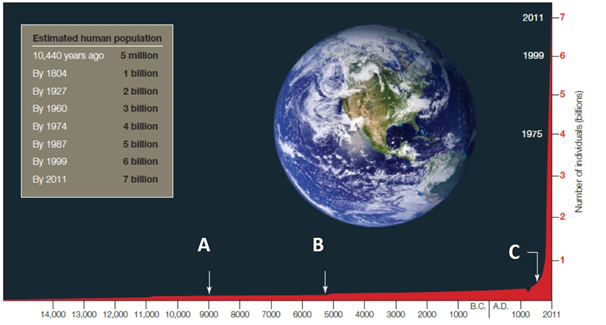
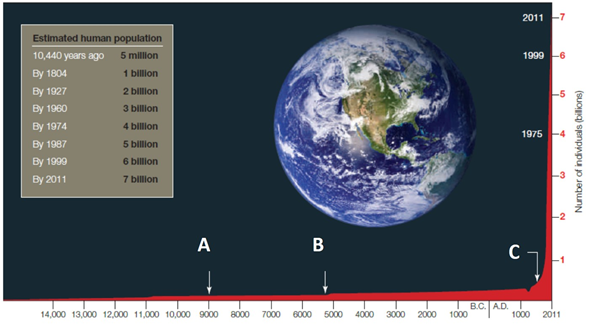 Letter "A" designates the ____, which provided for a more reliable food supply approximately 11,000 years ago.
Free
(Multiple Choice)
4.7/5 (73)
(73) Correct Answer:Verified
VerifiedB
Which growth model occurs when the amount of available resources is not limiting?
(Multiple Choice)
4.9/5 (74)
(74) A patchy distribution of an essential resource leads to a(n)____ population distribution.
(Multiple Choice)
4.9/5 (74)
(74) E. coli is an intestinal bacterium that reproduces every 20 minutes. E. coli is representative of a(n)____ species.
(Multiple Choice)
4.9/5 (78)
(78) Match the following terms with the most appropriate statement.
Premises:
the number of individuals added during some interval divided by the initial population size
Responses:
sample
population density
population size
Correct Answer:Verified
VerifiedPremises:
Responses:
(Matching)
4.7/5 (100)
(100) Match the following terms with the most appropriate statement.
Premises:
model for population growth when resources are unlimited
Responses:
exponential
population distribution
ecology
Correct Answer:Verified
VerifiedPremises:
Responses:
(Matching)
4.9/5 (74)
(74) Which element is a density-dependent factor that controls the size of a population?
(Multiple Choice)
4.8/5 (80)
(80) The most sustainable method for limiting human population growth is ____.
(Multiple Choice)
4.9/5 (77)
(77) Match the following terms with the most appropriate statement.
Premises:
use of fossil fuels began
Responses:
Africa
Mid-1300s
1940s
Correct Answer:Verified
VerifiedPremises:
Responses:
(Matching)
4.8/5 (67)
(67) What invention about 11,000 years ago led to a boom in the human population?
(Multiple Choice)
4.9/5 (91)
(91) The study of interactions among organisms and between organisms and their environment is known as ____.
(Multiple Choice)
4.9/5 (80)
(80) A J-shaped growth curve is converted to an S-shaped one ____.
(Multiple Choice)
4.8/5 (86)
(86) Refer to the following figure for questions 53, 54, and 55.
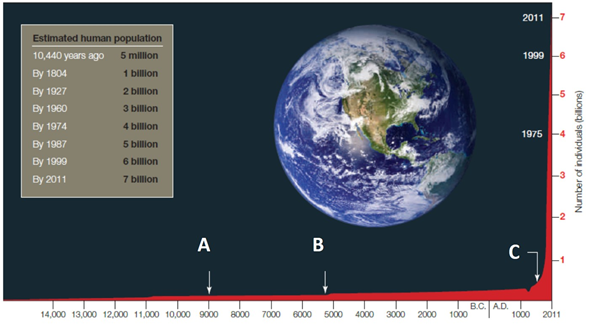
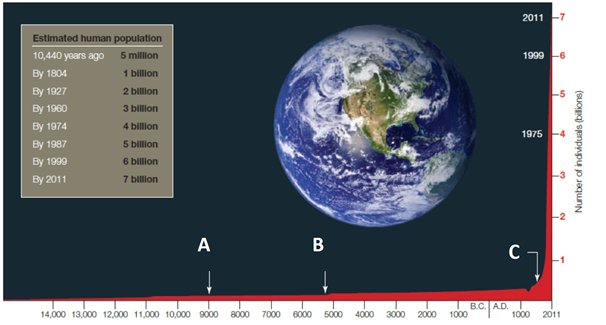 The steep increase in human population at point "C" indicates the beginning of the ____.
 (Multiple Choice)
4.8/5 (81)
(81) Match the terms with the most appropriate statement.
Premises:
clams, insects, many fish species fit into this model
Responses:
demographic transitional stage
density-dependent factor
density-independent factor
Correct Answer:Verified
VerifiedPremises:
Responses:
(Matching)
4.7/5 (72)
(72) In which demographic model is population growth the fastest?
(Multiple Choice)
4.9/5 (87)
(87) Match the following terms with the most appropriate statement.
Premises:
vaccines became widespread in developed countries
Responses:
18th century
Africa
1800s
Correct Answer:Verified
VerifiedPremises:
Responses:
(Matching)
5.0/5 (69)
(69) 
Filters
- Essay(0)
- Multiple Choice(0)
- Short Answer(0)
- True False(0)
- Matching(0)