



 Chat with AI
Exam 11: Evidence of Evolution

Exam 1: Invitation to Biology100 Questions
Exam 2: Molecules of Life100 Questions
Exam 3: Cell Structure101 Questions
Exam 4: Energy and Metabolism100 Questions
Exam 5: Capturing and Releasing Energy100 Questions
Exam 6: Dna Structure and Function100 Questions
Exam 7: Gene Expression and Control100 Questions
Exam 8: How Cells Reproduce100 Questions
Exam 9: Patterns of Inheritance96 Questions
Exam 10: Biotechnology100 Questions
Exam 11: Evidence of Evolution85 Questions
Exam 12: Processes of Evolution99 Questions
Exam 13: Early Life Forms and the Viruses99 Questions
Exam 14: Plants and Fungi100 Questions
Exam 15: Animal Evolution100 Questions
Exam 16: Population Ecology100 Questions
Exam 17: Communities and Ecosystems100 Questions
Exam 18: The Biosphere and Human Effects99 Questions
Exam 19: Animal Tissues and Organs100 Questions
Exam 20: How Animals Move100 Questions
Exam 21: Circulation and Respiration100 Questions
Exam 22: Immunity100 Questions
Exam 23: Digestion and Excretion100 Questions
Exam 24: Neural Control and the Senses100 Questions
Exam 25: Endocrine Control100 Questions
Exam 26: Reproduction and Development100 Questions
Exam 27: Plant Form and Function100 Questions
Exam 28: Plant Reproduction and Development100 Questions
Select questions type


Darwin was inspired by ____ ideas on the geologic history of Earth, which allowed him to better understand the geology of the regions he would visit on his journey aboard the Beagle .

Free
(Multiple Choice)
4.8/5  (75)
(75) Correct Answer: Verified
A
After the publication of On the Origin of Species , the idea of evolution was generally accepted. What part of Darwin's theory of evolution, however, was fiercely debated?
Free
(Multiple Choice)
4.9/5 (75)
(75) Correct Answer:Verified
VerifiedA
The time it takes for half of the atoms in a radioisotope sample to decay is called the ____.
Free
(Multiple Choice)
4.9/5 (82)
(82) Correct Answer:Verified
VerifiedB
In his voyage around the world in the Beagle , what observation did Darwin make about animals?
(Multiple Choice)
4.9/5 (84)
(84) Which genes guide the formation of specific body parts during embryonic development?
(Multiple Choice)
4.8/5 (78)
(78) These statements ask about elements and isotopes that have been important in learning about earth's history and the age of organisms. For each one, select the best choice from the five isotopes or elements below.
Premises:
ruptures in Earth's crust where plates meet
Responses:
magma
trench
faults
Correct Answer:Verified
VerifiedPremises:
Responses:
(Matching)
4.8/5 (88)
(88) Lyell's ideas that gradual, everyday geologic processes had shaped Earth challenged the prevailing estimate of Earth's age at ____, because ____.
(Multiple Choice)
4.9/5 (75)
(75) Zircon crystals that form in molten magma are easily dated because they initially contain ____.
(Multiple Choice)
4.8/5 (76)
(76) A mass extinction, in which the dinosaurs disappeared from Earth, occurred approximately ____ years ago.
(Multiple Choice)
4.9/5 (80)
(80) When a certain form of a trait increases the fitness of the individual, this allele will tend to ____ over time.
(Multiple Choice)
4.8/5 (85)
(85) Fossilization most often occurs through the geologic process(es)of ____.
(Multiple Choice)
5.0/5 (80)
(80) Fossils older than ____ cannot be dated by their 14C content because ____.
(Multiple Choice)
4.8/5 (83)
(83) These statements ask about the various theories that were presented in an attempt to explain the new information discovered during the 19th century. Match the theory with the description.
Premises:
Species represent links in a chain leading towards perfection.
Responses:
catastrophism
theory of uniformity
evolution
Correct Answer:Verified
VerifiedPremises:
Responses:
(Matching)
4.8/5 (94)
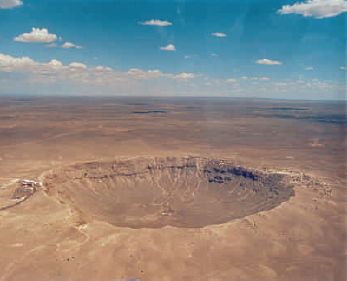
(94) Scientists have determined that this crater was created by a(n)____.
(Multiple Choice)
4.9/5 (82)
(82) These statements ask about elements and isotopes that have been important in learning about earth's history and the age of organisms. For each one, select the best choice from the five isotopes or elements below.
Premises:
wells up at oceanic ridges and drives the movement of tectonic plates
Responses:
tectonic plate
faults
trench
Correct Answer:Verified
VerifiedPremises:
Responses:
(Matching)
4.8/5 (81)
(81) The Kaibab limestone layer of sedimentary rock is the closest to Earth's surface; therefore ____.
(Multiple Choice)
4.8/5 (95)
(95) 
Filters
- Essay(0)
- Multiple Choice(0)
- Short Answer(0)
- True False(0)
- Matching(0)