



 Chat with AI
Exam 28: Plant Reproduction and Development

Exam 1: Invitation to Biology100 Questions
Exam 2: Molecules of Life100 Questions
Exam 3: Cell Structure101 Questions
Exam 4: Energy and Metabolism100 Questions
Exam 5: Capturing and Releasing Energy100 Questions
Exam 6: Dna Structure and Function100 Questions
Exam 7: Gene Expression and Control100 Questions
Exam 8: How Cells Reproduce100 Questions
Exam 9: Patterns of Inheritance96 Questions
Exam 10: Biotechnology100 Questions
Exam 11: Evidence of Evolution85 Questions
Exam 12: Processes of Evolution99 Questions
Exam 13: Early Life Forms and the Viruses99 Questions
Exam 14: Plants and Fungi100 Questions
Exam 15: Animal Evolution100 Questions
Exam 16: Population Ecology100 Questions
Exam 17: Communities and Ecosystems100 Questions
Exam 18: The Biosphere and Human Effects99 Questions
Exam 19: Animal Tissues and Organs100 Questions
Exam 20: How Animals Move100 Questions
Exam 21: Circulation and Respiration100 Questions
Exam 22: Immunity100 Questions
Exam 23: Digestion and Excretion100 Questions
Exam 24: Neural Control and the Senses100 Questions
Exam 25: Endocrine Control100 Questions
Exam 26: Reproduction and Development100 Questions
Exam 27: Plant Form and Function100 Questions
Exam 28: Plant Reproduction and Development100 Questions
Select questions type


Match the fruit with its description.
Premises:
cherry
Responses:
accessory fruit; an aggregate of individual fleshy fruits
accessory fruit; an aggregate of individual dry fruits
accessory fruit; a multiple fruit formed by the fusion of small, fleshy berries
Correct Answer: Verified
Premises:
Responses:
cherry

Free
(Matching)
4.7/5  (78)
(78) Correct Answer:Verified
VerifiedMatch the plant hormone with its description.
Premises:
closes stomata in times of stress
Responses:
auxin
cytokinin
gibberellin
Correct Answer:Verified
VerifiedPremises:
Responses:
Free
(Matching)
4.9/5 (68)
(68) Correct Answer:Verified
VerifiedThe compounds involved in phototropism are ____.
Free
(Multiple Choice)
4.8/5 (75)
(75) Correct Answer:Verified
VerifiedA
Hooker's evening primrose keeps its flowers closed until the early evening when they open. This is an example of ____.
(Multiple Choice)
4.9/5 (82)
(82) The process of inducing a cutting from one plant to fuse with the tissues of another plant is called ____.
(Multiple Choice)
4.9/5 (94)
(94) Seasonal abscission of fruits and leaves is mediated by ____.
(Multiple Choice)
4.9/5 (89)
(89) Phytochrome is converted from the inactive to the active form by being exposed to light of what color?
(Multiple Choice)
5.0/5 (80)
(80) Which of the following chemicals is used to induce polyploidy?
(Multiple Choice)
4.7/5 (72)
(72) The evolution of flowers and insects is an example of ____.
(Multiple Choice)
4.8/5 (93)
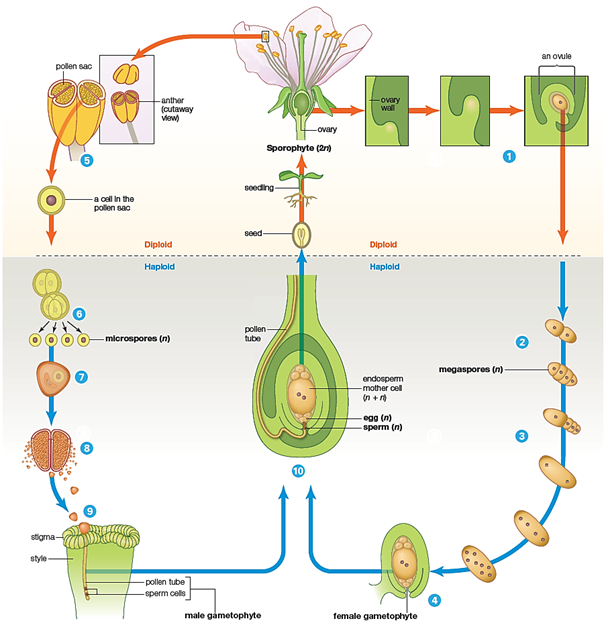
(93) The following diagram depicts the life cycle of a cherry, a eudicot. Match the specified labels in the diagram with the corresponding life cycle stage.
Premises:
Which stage is indicated by label 8?
Responses:
pollen grain lands on a receptive stigma and germinates
four haploid ( n )megaspores form by meiosis and cytoplasmic division of the enlarged cell in the ovule
uneven cytoplasmic divisions produce a seven-celled female gametophyte
Correct Answer:Verified
VerifiedPremises:
Responses:
(Matching)
4.8/5 (88)
(88) On a hot, dry day a plant closes its stomata thereby conserving water. Which plant hormone is responsible for the closing of the stomata?
(Multiple Choice)
4.7/5 (77)
(77) Match the plant hormone with its description.
Premises:
inhibits seed germination
Responses:
cytokinin
abscisic acid
ethylene
Correct Answer:Verified
VerifiedPremises:
Responses:
(Matching)
4.8/5 (80)
(80) The structure at the tip of a stamen that contains pollen sacs is called the ____.
(Multiple Choice)
4.9/5 (74)
(74) 
Filters
- Essay(0)
- Multiple Choice(0)
- Short Answer(0)
- True False(0)
- Matching(0)