



 Chat with AI
Exam 27: Plant Form and Function

Exam 1: Invitation to Biology100 Questions
Exam 2: Molecules of Life100 Questions
Exam 3: Cell Structure101 Questions
Exam 4: Energy and Metabolism100 Questions
Exam 5: Capturing and Releasing Energy100 Questions
Exam 6: Dna Structure and Function100 Questions
Exam 7: Gene Expression and Control100 Questions
Exam 8: How Cells Reproduce100 Questions
Exam 9: Patterns of Inheritance96 Questions
Exam 10: Biotechnology100 Questions
Exam 11: Evidence of Evolution85 Questions
Exam 12: Processes of Evolution99 Questions
Exam 13: Early Life Forms and the Viruses99 Questions
Exam 14: Plants and Fungi100 Questions
Exam 15: Animal Evolution100 Questions
Exam 16: Population Ecology100 Questions
Exam 17: Communities and Ecosystems100 Questions
Exam 18: The Biosphere and Human Effects99 Questions
Exam 19: Animal Tissues and Organs100 Questions
Exam 20: How Animals Move100 Questions
Exam 21: Circulation and Respiration100 Questions
Exam 22: Immunity100 Questions
Exam 23: Digestion and Excretion100 Questions
Exam 24: Neural Control and the Senses100 Questions
Exam 25: Endocrine Control100 Questions
Exam 26: Reproduction and Development100 Questions
Exam 27: Plant Form and Function100 Questions
Exam 28: Plant Reproduction and Development100 Questions
Select questions type


Choose the one most appropriate answer for each.
Premises:
cork cambium
Responses:
one type of dead cell that conducts water and lends structural support to plant parts
provides metabolic support and transfer sugars into sieve elements
embryonic leaf of a flowering plant
Correct Answer: Verified
Premises:
Responses:

Free
(Matching)
4.8/5  (86)
(86) Correct Answer:Verified
VerifiedIf you were to penetrate through the epidermal layer of a root, you would next encounter the ____.
Free
(Multiple Choice)
4.8/5 (87)
(87) Correct Answer:Verified
VerifiedC
If a mutation prevented the formation of lignin, which tissue would be most affected?
Free
(Multiple Choice)
4.8/5 (97)
(97) Correct Answer:Verified
VerifiedD
Match the letters on the diagram to the following parts of a leaf.
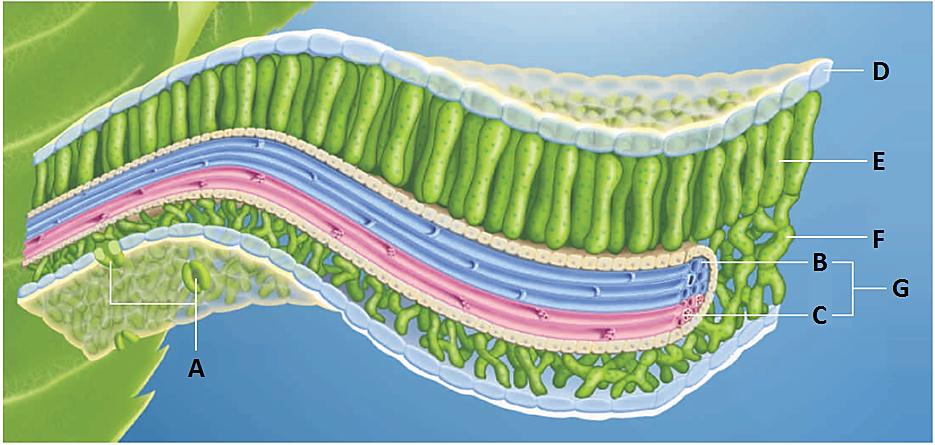
Premises:
palisade mesophyll
Responses:
C
E
B
Correct Answer:Verified
VerifiedPremises:
Responses:
(Matching)
4.8/5 (85)
(85) Annual growth rings are formed in woody stems principally through the activities of the ____.
(Multiple Choice)
4.8/5 (75)
(75) Most flowering plants maximize their ability to take up nutrients by taking part in mutualisms with fungi. These mutualisms are called ____.
(Multiple Choice)
4.8/5 (80)
(80) Movement of soluble organic material through plants is known as ____.
(Multiple Choice)
5.0/5 (83)
(83) From the outside to the inside, which is the correct order of tissues in a eudicot root?
(Multiple Choice)
4.8/5 (68)
(68) The tissue systems of the root and shoot systems are classified as ____.
(Multiple Choice)
4.8/5 (86)
(86) The names of the monocot and eudicot groups refer to the number of ____.
(Multiple Choice)
4.8/5 (71)
(71) Structure of an older, woody eudicot stem.
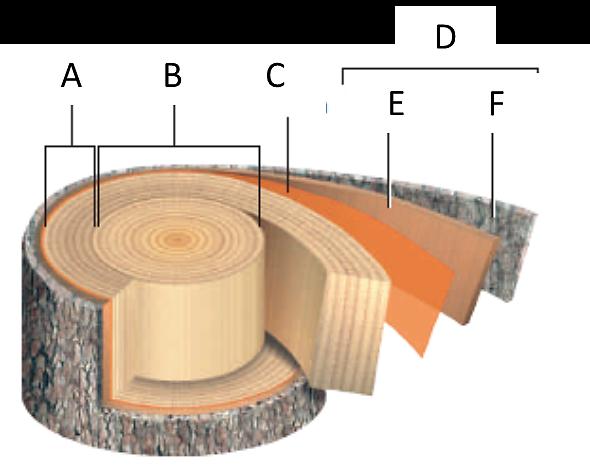
Premises:
Secondary phloem is denoted by letter _____.
Responses:
F
C
B
Correct Answer:Verified
VerifiedPremises:
Responses:
(Matching)
4.9/5 (67)
(67) The openings in leaves that function to exchange gases are called ____.
(Multiple Choice)
4.9/5 (73)
(73) Endodermis cells of the root secrete a waxy substance on ____.
(Multiple Choice)
4.9/5 (85)
(85) 
Filters
- Essay(0)
- Multiple Choice(0)
- Short Answer(0)
- True False(0)
- Matching(0)