



 Chat with AI
Exam 28: Plant Reproduction and Development

Exam 1: Invitation to Biology100 Questions
Exam 2: Molecules of Life100 Questions
Exam 3: Cell Structure101 Questions
Exam 4: Energy and Metabolism100 Questions
Exam 5: Capturing and Releasing Energy100 Questions
Exam 6: Dna Structure and Function100 Questions
Exam 7: Gene Expression and Control100 Questions
Exam 8: How Cells Reproduce100 Questions
Exam 9: Patterns of Inheritance96 Questions
Exam 10: Biotechnology100 Questions
Exam 11: Evidence of Evolution85 Questions
Exam 12: Processes of Evolution99 Questions
Exam 13: Early Life Forms and the Viruses99 Questions
Exam 14: Plants and Fungi100 Questions
Exam 15: Animal Evolution100 Questions
Exam 16: Population Ecology100 Questions
Exam 17: Communities and Ecosystems100 Questions
Exam 18: The Biosphere and Human Effects99 Questions
Exam 19: Animal Tissues and Organs100 Questions
Exam 20: How Animals Move100 Questions
Exam 21: Circulation and Respiration100 Questions
Exam 22: Immunity100 Questions
Exam 23: Digestion and Excretion100 Questions
Exam 24: Neural Control and the Senses100 Questions
Exam 25: Endocrine Control100 Questions
Exam 26: Reproduction and Development100 Questions
Exam 27: Plant Form and Function100 Questions
Exam 28: Plant Reproduction and Development100 Questions
Select questions type


Almost all houseplants, woody ornamentals, and orchard trees are clones grown from ____of a parent plant.
(Multiple Choice)
4.9/5  (88)
(88) The apples from the apple trees Johnny Appleseed sold to homesteaders were mainly used to make ____.
(Multiple Choice)
4.7/5 (76)
(76) To which of the following is a megaspore most closely and completely related?
(Multiple Choice)
4.9/5 (93)
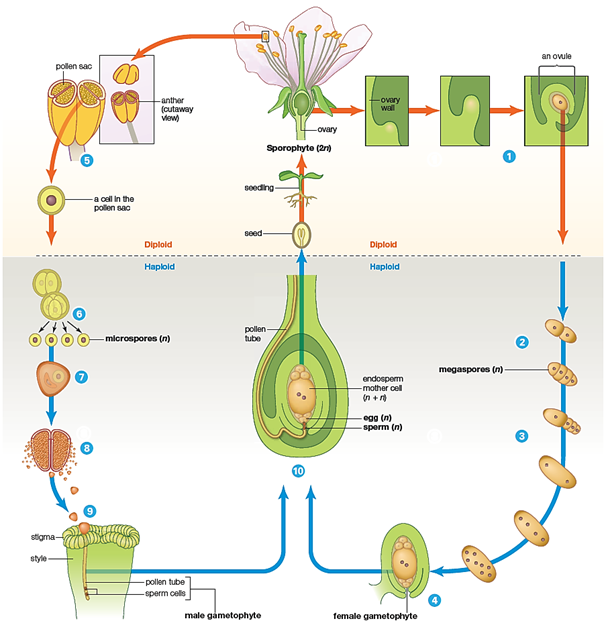
(93) The following diagram depicts the life cycle of a cherry, a eudicot. Match the specified labels in the diagram with the corresponding life cycle stage.
Premises:
Which stage is indicated by label 7?
Responses:
four haploid ( n )microspores form by meiosis and cytoplasmic division of a cell in the pollen sac
pollen grain lands on a receptive stigma and germinates
an ovule forms in the ovary; a cell in the ovule enlarges
Correct Answer: Verified
Premises:
Responses:
(Matching)
4.7/5 (72)
(72) In monocots cultivated for human consumption, such as wheat, rye, and barley, what part of the seed contains most of the minerals and fiber?
(Multiple Choice)
4.9/5 (83)
(83) The term used to describe the cloning of an entire plant from a single cell is ____.
(Multiple Choice)
4.9/5 (77)
(77) The plant hormone that coordinates the effects of other plant hormones during development of shoots and roots is ____.
(Multiple Choice)
4.9/5 (93)
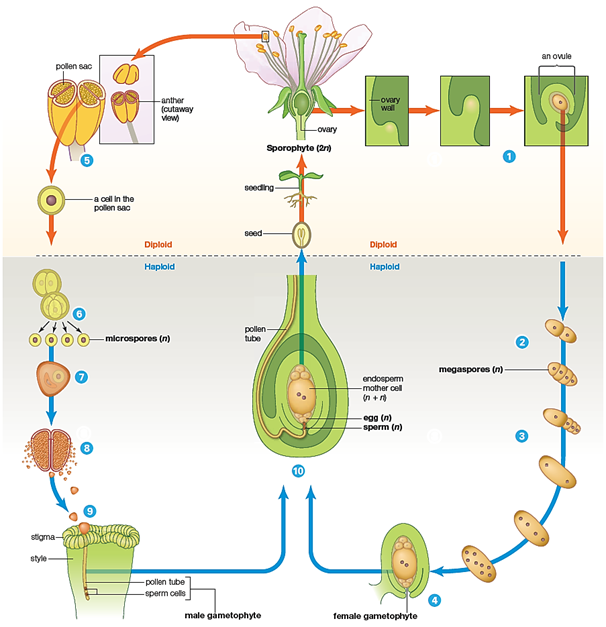
(93) The following diagram depicts the life cycle of a cherry, a eudicot. Match the specified labels in the diagram with the corresponding life cycle stage.
Premises:
Which stage is indicated by label 5?
Responses:
uneven cytoplasmic divisions produce a seven-celled female gametophyte
the pollen tube reaches the ovule, penetrates it, and releases two sperm cells; double fertilization occurs
pollen grains are released from the anther when the pollen sacs split open
Correct Answer:Verified
VerifiedPremises:
Responses:
(Matching)
4.9/5 (72)
(72) If peach trees growing in specific mild climates of the southern United States do not receive about 850 hours of temperatures below 40 degrees, they will not produce flowers in the spring. This is explained by which of the following terms?
(Multiple Choice)
4.7/5 (80)
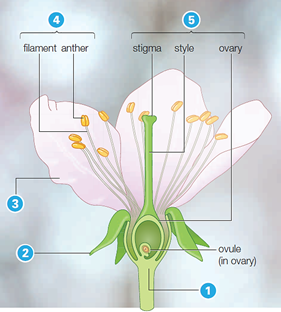
(80) Match the flower parts with the descriptions, in reference to the diagram.
Premises:
The whorl of petals; indicated by label 3.
Responses:
stamen
carpel
corolla
Correct Answer:Verified
VerifiedPremises:
Responses:
(Matching)
4.9/5 (85)
(85) The embryonic shoot and root are separated by a tiny section of embryonic stem, called the ____.
(Multiple Choice)
4.9/5 (78)
(78) In the tropisms with which it is involved, auxin causes ____.
(Multiple Choice)
4.9/5 (78)
(78) The plant louse Phylloxera was responsible for destroying ____ in Europe.
(Multiple Choice)
4.8/5 (93)
(93) 
Filters
- Essay(0)
- Multiple Choice(0)
- Short Answer(0)
- True False(0)
- Matching(0)