



 Chat with AI
Exam 2: Molecules of Life

Exam 1: Invitation to Biology100 Questions
Exam 2: Molecules of Life100 Questions
Exam 3: Cell Structure101 Questions
Exam 4: Energy and Metabolism100 Questions
Exam 5: Capturing and Releasing Energy100 Questions
Exam 6: Dna Structure and Function100 Questions
Exam 7: Gene Expression and Control100 Questions
Exam 8: How Cells Reproduce100 Questions
Exam 9: Patterns of Inheritance96 Questions
Exam 10: Biotechnology100 Questions
Exam 11: Evidence of Evolution85 Questions
Exam 12: Processes of Evolution99 Questions
Exam 13: Early Life Forms and the Viruses99 Questions
Exam 14: Plants and Fungi100 Questions
Exam 15: Animal Evolution100 Questions
Exam 16: Population Ecology100 Questions
Exam 17: Communities and Ecosystems100 Questions
Exam 18: The Biosphere and Human Effects99 Questions
Exam 19: Animal Tissues and Organs100 Questions
Exam 20: How Animals Move100 Questions
Exam 21: Circulation and Respiration100 Questions
Exam 22: Immunity100 Questions
Exam 23: Digestion and Excretion100 Questions
Exam 24: Neural Control and the Senses100 Questions
Exam 25: Endocrine Control100 Questions
Exam 26: Reproduction and Development100 Questions
Exam 27: Plant Form and Function100 Questions
Exam 28: Plant Reproduction and Development100 Questions
Select questions type


Plants store their excess carbohydrates in the form of ____.
(Multiple Choice)
4.9/5  (78)
(78) Match the following terms to the correct description.
Premises:
atoms with more or less electrons than protons
Responses:
isotopes
atomic number
mass number
Correct Answer: Verified
Premises:
Responses:
(Matching)
4.9/5 (65)
(65) Match the following terms to the correct description .
Premises:
substance that releases hydrogen ions in solution
Responses:
pH
base
buffer
Correct Answer:Verified
VerifiedPremises:
Responses:
(Matching)
4.9/5 (83)
(83) Match the following terms to the correct description.
Premises:
number of protons in the atomic nucleus
Responses:
mass number
isotopes
ions
Correct Answer:Verified
VerifiedPremises:
Responses:
(Matching)
4.8/5 (85)
(85) 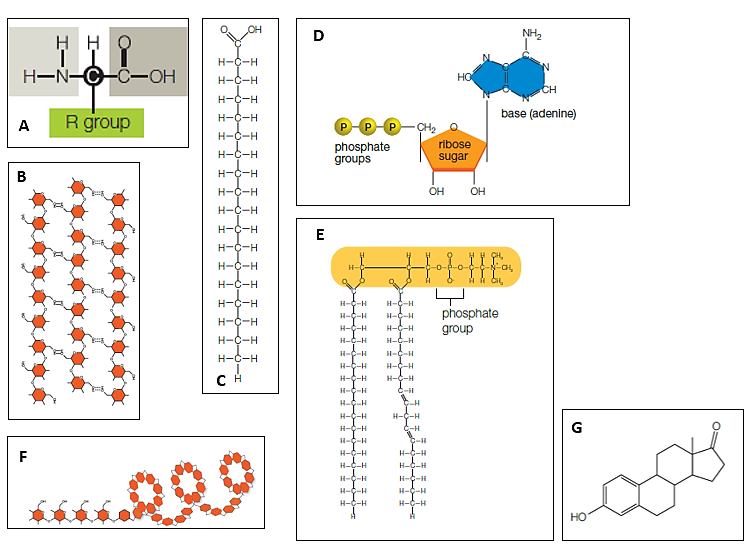
Match the structures below with the appropriate label in the figure above.
Premises:
cellulose
Responses:
C
D
B
Correct Answer:Verified
VerifiedPremises:
Responses:
(Matching)
4.7/5 (94)
(94) Large polymers are formed from smaller subunits by which type of reaction?
(Multiple Choice)
4.9/5 (80)
(80) A(n)____ is a type of chemical bond in which a strong mutual attraction forms between ions of opposite charge.
(Multiple Choice)
4.9/5 (86)
(86) The chemical reactions that cells use to acquire and use energy to live, grow and reproduce are called ____.
(Multiple Choice)
4.9/5 (74)
(74) Two amino acids are bonded together to form a dipeptide by which type of reaction?
(Multiple Choice)
4.8/5 (74)
(74) The following are types of chemical bonds. Match these to the correct description.
Premises:
the bond in which electrons are shared
Responses:
ionic
hydrogen
covalent
Correct Answer:Verified
VerifiedPremises:
Responses:
(Matching)
4.8/5 (67)
(67) Carbon 14 radioisotopes decay into stable ____.
Nitrogen 15 isotopes
(Multiple Choice)
4.8/5 (80)
(80) 
Filters
- Essay(0)
- Multiple Choice(0)
- Short Answer(0)
- True False(0)
- Matching(0)