



 Chat with AI
Exam 2: Molecules of Life

Exam 1: Invitation to Biology100 Questions
Exam 2: Molecules of Life100 Questions
Exam 3: Cell Structure101 Questions
Exam 4: Energy and Metabolism100 Questions
Exam 5: Capturing and Releasing Energy100 Questions
Exam 6: Dna Structure and Function100 Questions
Exam 7: Gene Expression and Control100 Questions
Exam 8: How Cells Reproduce100 Questions
Exam 9: Patterns of Inheritance96 Questions
Exam 10: Biotechnology100 Questions
Exam 11: Evidence of Evolution85 Questions
Exam 12: Processes of Evolution99 Questions
Exam 13: Early Life Forms and the Viruses99 Questions
Exam 14: Plants and Fungi100 Questions
Exam 15: Animal Evolution100 Questions
Exam 16: Population Ecology100 Questions
Exam 17: Communities and Ecosystems100 Questions
Exam 18: The Biosphere and Human Effects99 Questions
Exam 19: Animal Tissues and Organs100 Questions
Exam 20: How Animals Move100 Questions
Exam 21: Circulation and Respiration100 Questions
Exam 22: Immunity100 Questions
Exam 23: Digestion and Excretion100 Questions
Exam 24: Neural Control and the Senses100 Questions
Exam 25: Endocrine Control100 Questions
Exam 26: Reproduction and Development100 Questions
Exam 27: Plant Form and Function100 Questions
Exam 28: Plant Reproduction and Development100 Questions
Select questions type


Glucose monomers linked into a highly branched chain make up ____.
(Multiple Choice)
4.7/5  (90)
(90) Which type of bond exists between two amino acids in a protein?
(Multiple Choice)
4.9/5 (87)
(87) Hydrogen bonding ____ the movement of molecules, therefore, substances that form a lot of hydrogen bonds, like water, will require ____ energy to increase their temperature by one degree Celsius.
(Multiple Choice)
4.7/5 (82)
(82) ____ is the tendency of water molecules to stay attached to one another.
(Multiple Choice)
4.9/5 (80)
(80)  How many carbons are present in this figure?
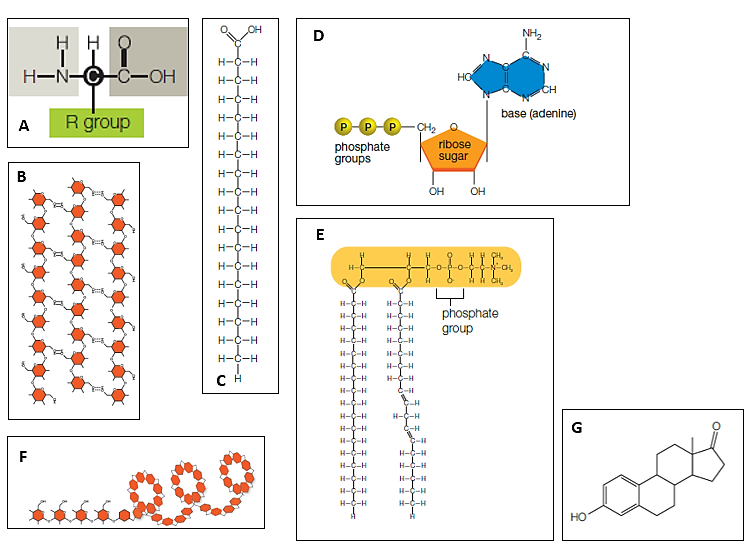
Match the structures below with the appropriate label in the figure above.
Premises:
fatty acid
Responses:
G
E
D
Correct Answer: Verified
Premises:
Responses:
(Matching)
4.8/5 (80)
(80) The following are types of chemical bonds. Match these to the correct description.
Premises:
the bond that breaks when salts dissolve in water
Responses:
ionic
hydrogen
covalent
Correct Answer:Verified
VerifiedPremises:
Responses:
(Matching)
4.9/5 (79)
(79)  In the figure above, which fatty acids are most likely to be solid at room temperature?
 (Multiple Choice)
4.8/5 (91)
(91) 
Filters
- Essay(0)
- Multiple Choice(0)
- Short Answer(0)
- True False(0)
- Matching(0)