



 Chat with AI
Exam 56: Animal Behavior

Exam 1: Introduction to Biological Concepts and Research86 Questions
Exam 2: Life, Chemistry, and Water87 Questions
Exam 3: Biological Molecules: the Carbon Compounds of Life86 Questions
Exam 4: Cells87 Questions
Exam 5: Membranes and Transport88 Questions
Exam 6: Energy, Enzymes, and Biological Reactions87 Questions
Exam 7: Cellular Respiration: Harvesting Chemical Energy88 Questions
Exam 8: Photosynthesis83 Questions
Exam 9: Cell Communication87 Questions
Exam 10: Cell Division and Mitosis88 Questions
Exam 11: Meiosis: the Cellular Basis of Sexual Reproduction80 Questions
Exam 12: Mendel, Genes, and Inheritance79 Questions
Exam 13: Genes, Chromosomes, and Human Genetics92 Questions
Exam 14: Dna Structure, Replication, and Organization79 Questions
Exam 15: Gene Expression: From Dna to Protein83 Questions
Exam 16: Regulation of Gene Expression84 Questions
Exam 17: Bacterial and Viral Genetics85 Questions
Exam 18: Dna Technology: Making and Using Genetically Altered Organisms, and Other Applications90 Questions
Exam 19: Genomes and Proteomes81 Questions
Exam 20: The Development of Evolutionary Thought92 Questions
Exam 21: Microevolution: Genetic Changes Within Populations88 Questions
Exam 22: Speciation89 Questions
Exam 23: Paleobiology and Macroevolution87 Questions
Exam 24: Systematic Biology: Phylogeny and Classification95 Questions
Exam 25: The Origin of Life86 Questions
Exam 26: Prokaryotes and Viruses86 Questions
Exam 27: Protists90 Questions
Exam 28: Seedless Plants88 Questions
Exam 29: Seed Plants90 Questions
Exam 30: Fungi88 Questions
Exam 31: Animal Phylogeny, Acoelomates, and Protostomes95 Questions
Exam 32: Deuterostomes: Vertebrates and Their Closest Relatives93 Questions
Exam 33: The Plant Body90 Questions
Exam 34: Transport in Plants94 Questions
Exam 35: Plant Nutrition85 Questions
Exam 36: Reproduction and Development in Flowering Plants89 Questions
Exam 37: Plant Signals and Responses to the Environment90 Questions
Exam 38: Introduction to Animal Organization and Physiology87 Questions
Exam 39: Information Flow and the Neuron88 Questions
Exam 40: Nervous Systems88 Questions
Exam 41: Sensory Systems87 Questions
Exam 42: The Endocrine System94 Questions
Exam 43: Muscles, Bones, and Body Movements87 Questions
Exam 44: The Circulatory System87 Questions
Exam 45: Defenses Against Disease83 Questions
Exam 46: Gas Exchange: the Respiratory System87 Questions
Exam 47: Digestive Systems and Animal Nutrition92 Questions
Exam 48: Regulating the Internal Environment: Osmoregulation, Excretion, and Thermoregulation88 Questions
Exam 49: Animal Reproduction76 Questions
Exam 50: Animal Development88 Questions
Exam 51: Ecology and the Biosphere88 Questions
Exam 52: Population Ecology92 Questions
Exam 53: Population Interactions and Community Ecology89 Questions
Exam 54: Ecosystems90 Questions
Exam 55: Biodiversity and Conservation Biology89 Questions
Exam 56: Animal Behavior87 Questions
Select questions type


The process of song learning by white-crowned sparrows is similar to the process of territory-holding by African cichlid fishes because brain cells in both animals can change ____ in response to well-defined social stimuli.
(Multiple Choice)
4.8/5  (71)
(71) 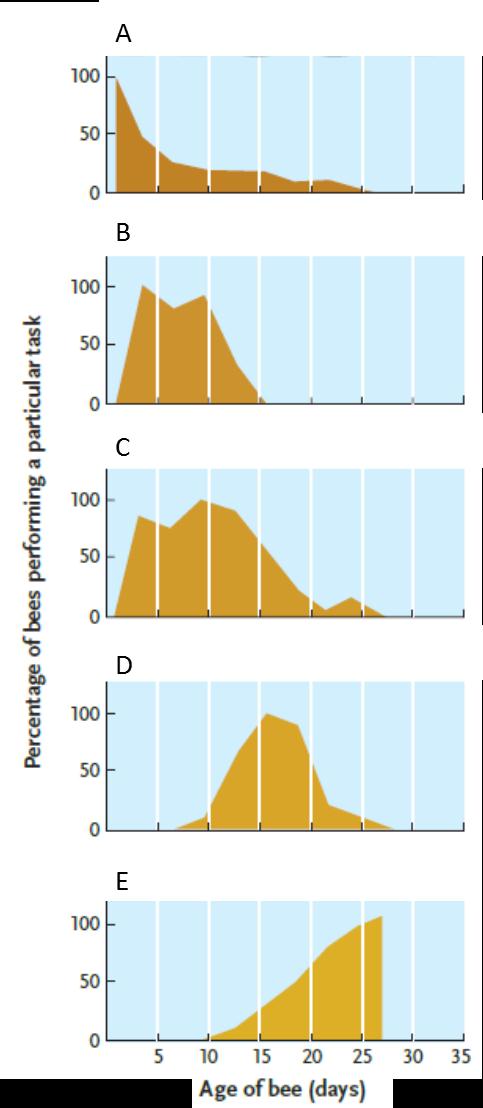 -Answer the question using the accompanying figure. Which graph represents the age span of worker bees primarily involved in packing pollen?
 (Multiple Choice)
4.8/5 (68)
(68) Bioluminescent signals that fireflies and certain fishes send to distant receivers in the dark are classified as ____ signals.
(Multiple Choice)
4.9/5 (65)
(65) The brains of female zebra finches lack the hormonal influences that occur in the brains of males. As a result, what changes are seen in the female brains?
(Multiple Choice)
4.9/5 (87)
(87) What is haplodiploidy, and how is it related to altruism in honeybees?
(Essay)
4.7/5 (67)
(67) Kin selection is a form of natural selection in which ____.
(Multiple Choice)
4.9/5 (75)
(75) Which trait is least consistent with evolution by sexual selection?
(Multiple Choice)
4.9/5 (84)
(84) Answer questions using the accompanying figure. Examine the figure depicting pheromone-producing glands in an ant's body. Match each letter of the figure with the appropriate structure.
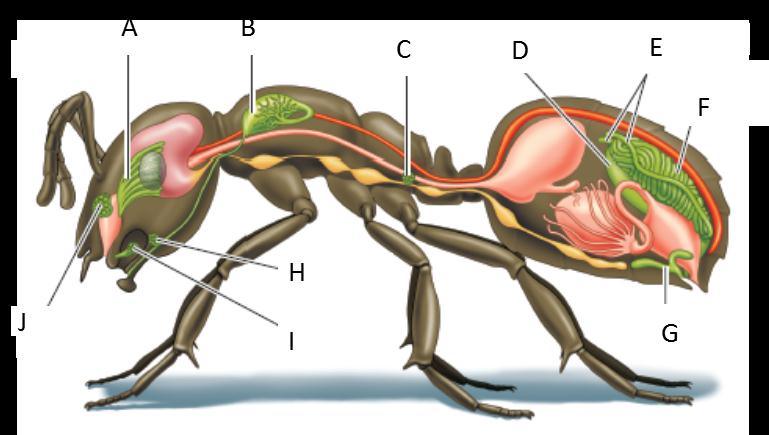
Correct Answer: Verified
Premises:
Responses:
(Matching)
4.9/5 (66)
(66) In an experiment on wayfinding, indigo buntings were housed in outdoor cages with blotting paper walls and inkpads on the floors. Which line of evidence demonstrated to researchers that the indigo bunting uses the positions of stars to orient its migration?
(Multiple Choice)
4.8/5 (86)
(86) A subordinate animal in a dominance hierarchy has limited access to food and mates. The most likely reason he remains in a social group that dominates him is because ____.
(Multiple Choice)
5.0/5 (75)
(75) What are the proximate causes that underlie an animal's ability to detect and respond to stimuli?
(Multiple Choice)
4.8/5 (71)
(71) Match each of the learned behaviors with its corresponding description.
Correct Answer:Verified
VerifiedPremises:
Responses:
(Matching)
4.9/5 (78)
(78) In studying the dance of the honeybees, Karl von Frisch determined that the duration of the dance conveyed the ____ of the food and the angle of the dance conveyed the ____ of the food.
(Multiple Choice)
4.9/5 (79)
(79) Some migratory birds that fly during the day position themselves using the location of the Sun in conjunction with an internal biological clock. This wayfinding mechanism is called ____.
(Multiple Choice)
4.8/5 (77)
(77) When Tinbergen arranged pinecones around the nest of a female digger wasp, then moved them when the wasp was gone, the wasp ____.
(Multiple Choice)
4.9/5 (66)
(66) In honeybees, queen bees are haploid organisms while male drones are diploid.
(True/False)
4.8/5 (94)
(94) Instinctive behaviors are ____, while learned behaviors are ____.
(Multiple Choice)
4.8/5 (81)
(81) 
Filters
- Essay(0)
- Multiple Choice(0)
- Short Answer(0)
- True False(0)
- Matching(0)