



 Chat with AI
Exam 56: Animal Behavior

Exam 1: Introduction to Biological Concepts and Research86 Questions
Exam 2: Life, Chemistry, and Water87 Questions
Exam 3: Biological Molecules: the Carbon Compounds of Life86 Questions
Exam 4: Cells87 Questions
Exam 5: Membranes and Transport88 Questions
Exam 6: Energy, Enzymes, and Biological Reactions87 Questions
Exam 7: Cellular Respiration: Harvesting Chemical Energy88 Questions
Exam 8: Photosynthesis83 Questions
Exam 9: Cell Communication87 Questions
Exam 10: Cell Division and Mitosis88 Questions
Exam 11: Meiosis: the Cellular Basis of Sexual Reproduction80 Questions
Exam 12: Mendel, Genes, and Inheritance79 Questions
Exam 13: Genes, Chromosomes, and Human Genetics92 Questions
Exam 14: Dna Structure, Replication, and Organization79 Questions
Exam 15: Gene Expression: From Dna to Protein83 Questions
Exam 16: Regulation of Gene Expression84 Questions
Exam 17: Bacterial and Viral Genetics85 Questions
Exam 18: Dna Technology: Making and Using Genetically Altered Organisms, and Other Applications90 Questions
Exam 19: Genomes and Proteomes81 Questions
Exam 20: The Development of Evolutionary Thought92 Questions
Exam 21: Microevolution: Genetic Changes Within Populations88 Questions
Exam 22: Speciation89 Questions
Exam 23: Paleobiology and Macroevolution87 Questions
Exam 24: Systematic Biology: Phylogeny and Classification95 Questions
Exam 25: The Origin of Life86 Questions
Exam 26: Prokaryotes and Viruses86 Questions
Exam 27: Protists90 Questions
Exam 28: Seedless Plants88 Questions
Exam 29: Seed Plants90 Questions
Exam 30: Fungi88 Questions
Exam 31: Animal Phylogeny, Acoelomates, and Protostomes95 Questions
Exam 32: Deuterostomes: Vertebrates and Their Closest Relatives93 Questions
Exam 33: The Plant Body90 Questions
Exam 34: Transport in Plants94 Questions
Exam 35: Plant Nutrition85 Questions
Exam 36: Reproduction and Development in Flowering Plants89 Questions
Exam 37: Plant Signals and Responses to the Environment90 Questions
Exam 38: Introduction to Animal Organization and Physiology87 Questions
Exam 39: Information Flow and the Neuron88 Questions
Exam 40: Nervous Systems88 Questions
Exam 41: Sensory Systems87 Questions
Exam 42: The Endocrine System94 Questions
Exam 43: Muscles, Bones, and Body Movements87 Questions
Exam 44: The Circulatory System87 Questions
Exam 45: Defenses Against Disease83 Questions
Exam 46: Gas Exchange: the Respiratory System87 Questions
Exam 47: Digestive Systems and Animal Nutrition92 Questions
Exam 48: Regulating the Internal Environment: Osmoregulation, Excretion, and Thermoregulation88 Questions
Exam 49: Animal Reproduction76 Questions
Exam 50: Animal Development88 Questions
Exam 51: Ecology and the Biosphere88 Questions
Exam 52: Population Ecology92 Questions
Exam 53: Population Interactions and Community Ecology89 Questions
Exam 54: Ecosystems90 Questions
Exam 55: Biodiversity and Conservation Biology89 Questions
Exam 56: Animal Behavior87 Questions
Select questions type


Territorial behavior provides a specific example of ____, the conveyance of information to other individuals.
(Multiple Choice)
4.8/5  (84)
(84) According to Niko Tinbergen, which question is least likely to be addressed by basic studies of animal behavior?
(Multiple Choice)
4.9/5 (89)
(89) Place the events illustrating how genes and hormones interact in the development of behavior in the correct order.
1) target neurons change intracellularly
2) hormones change genetic activity and enzymatic biochemistry in their target neurons
3) genes code for hormone production
4) animal's behavior changes
(Multiple Choice)
4.9/5 (78)
(78) Instinctive behaviors that are performed in exactly the same way every time they are triggered are defined as ____.
(Multiple Choice)
4.8/5 (82)
(82) 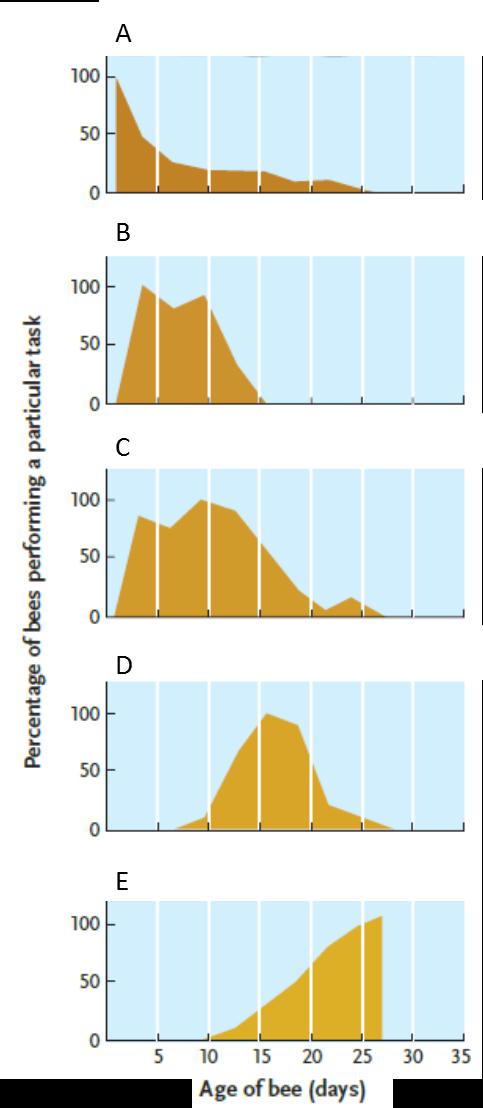 - Answer the question using the accompanying figure. Which graph represents the age span of worker bees primarily involved in foraging?
 (Multiple Choice)
4.9/5 (83)
(83) An animal that finds its way by the mechanism known as piloting is using ____.
(Multiple Choice)
4.9/5 (70)
(70) GnRH-producing cells in the brains of male cichlids are larger in territorial individuals.
(True/False)
4.7/5 (77)
(77) When geese or ducks are imprinted, this means that they ____.
(Multiple Choice)
4.9/5 (79)
(79)  Figure 56.29
-Answer the question using the accompanying figure. Bees C and D ____.
Figure 56.29
-Answer the question using the accompanying figure. Bees C and D ____. (Multiple Choice)
4.8/5 (72)
(72) Biologists categorize the cue that stimulates young herring gulls to peck as a sign stimulus because the pecking behavior ____.
(Multiple Choice)
4.7/5 (77)
(77) Figure 56.29
-Answer the question using the accompanying figure. The male bee represented by letter A is ____ and the queen bee represented by letter B is ____.
Figure 56.29
-Answer the question using the accompanying figure. The male bee represented by letter A is ____ and the queen bee represented by letter B is ____. (Multiple Choice)
4.9/5 (85)
(85) Which type of signal only operates over very short distances?
(Multiple Choice)
4.9/5 (75)
(75) When individuals of a species do not form close pair bonds, and both males and females mate with multiple partners, the species' mating system is described as promiscuous.
(True/False)
4.9/5 (89)
(89) The degree of relatedness between a niece and an uncle is ____, and the degree of relatedness between first cousins is ____.
(Multiple Choice)
4.9/5 (87)
(87) Half siblings share on average 50% of their alleles by inheritance from their shared parent, making their degree of relatedness 0.50.
(True/False)
4.8/5 (89)
(89) When behavioral biologists look at the ultimate evolutionary benefit of animal communication, they are primarily focusing on the effects of the communication on the individual's ability to ____.
(Multiple Choice)
4.7/5 (73)
(73) Recent research suggests that a homing pigeon can navigate to its home coop from any direction by using ____ as their compass and ____ as their map.
(Multiple Choice)
4.7/5 (72)
(72) The most complex wayfinding mechanism is ____, in which animals use both a compass and a mental map of the area.
(Multiple Choice)
4.9/5 (74)
(74) Migratory birds in the Northern Hemisphere most likely head to tropical overwintering grounds because ____.
(Multiple Choice)
4.8/5 (73)
(73) Research of knockout mice with no active copies of the Dvl1 gene can be used to study ____ in humans.
(Multiple Choice)
4.9/5 (80)
(80) 
Filters
- Essay(0)
- Multiple Choice(0)
- Short Answer(0)
- True False(0)
- Matching(0)