



 Chat with AI
Exam 52: Population Ecology

Exam 1: Introduction to Biological Concepts and Research86 Questions
Exam 2: Life, Chemistry, and Water87 Questions
Exam 3: Biological Molecules: the Carbon Compounds of Life86 Questions
Exam 4: Cells87 Questions
Exam 5: Membranes and Transport88 Questions
Exam 6: Energy, Enzymes, and Biological Reactions87 Questions
Exam 7: Cellular Respiration: Harvesting Chemical Energy88 Questions
Exam 8: Photosynthesis83 Questions
Exam 9: Cell Communication87 Questions
Exam 10: Cell Division and Mitosis88 Questions
Exam 11: Meiosis: the Cellular Basis of Sexual Reproduction80 Questions
Exam 12: Mendel, Genes, and Inheritance79 Questions
Exam 13: Genes, Chromosomes, and Human Genetics92 Questions
Exam 14: Dna Structure, Replication, and Organization79 Questions
Exam 15: Gene Expression: From Dna to Protein83 Questions
Exam 16: Regulation of Gene Expression84 Questions
Exam 17: Bacterial and Viral Genetics85 Questions
Exam 18: Dna Technology: Making and Using Genetically Altered Organisms, and Other Applications90 Questions
Exam 19: Genomes and Proteomes81 Questions
Exam 20: The Development of Evolutionary Thought92 Questions
Exam 21: Microevolution: Genetic Changes Within Populations88 Questions
Exam 22: Speciation89 Questions
Exam 23: Paleobiology and Macroevolution87 Questions
Exam 24: Systematic Biology: Phylogeny and Classification95 Questions
Exam 25: The Origin of Life86 Questions
Exam 26: Prokaryotes and Viruses86 Questions
Exam 27: Protists90 Questions
Exam 28: Seedless Plants88 Questions
Exam 29: Seed Plants90 Questions
Exam 30: Fungi88 Questions
Exam 31: Animal Phylogeny, Acoelomates, and Protostomes95 Questions
Exam 32: Deuterostomes: Vertebrates and Their Closest Relatives93 Questions
Exam 33: The Plant Body90 Questions
Exam 34: Transport in Plants94 Questions
Exam 35: Plant Nutrition85 Questions
Exam 36: Reproduction and Development in Flowering Plants89 Questions
Exam 37: Plant Signals and Responses to the Environment90 Questions
Exam 38: Introduction to Animal Organization and Physiology87 Questions
Exam 39: Information Flow and the Neuron88 Questions
Exam 40: Nervous Systems88 Questions
Exam 41: Sensory Systems87 Questions
Exam 42: The Endocrine System94 Questions
Exam 43: Muscles, Bones, and Body Movements87 Questions
Exam 44: The Circulatory System87 Questions
Exam 45: Defenses Against Disease83 Questions
Exam 46: Gas Exchange: the Respiratory System87 Questions
Exam 47: Digestive Systems and Animal Nutrition92 Questions
Exam 48: Regulating the Internal Environment: Osmoregulation, Excretion, and Thermoregulation88 Questions
Exam 49: Animal Reproduction76 Questions
Exam 50: Animal Development88 Questions
Exam 51: Ecology and the Biosphere88 Questions
Exam 52: Population Ecology92 Questions
Exam 53: Population Interactions and Community Ecology89 Questions
Exam 54: Ecosystems90 Questions
Exam 55: Biodiversity and Conservation Biology89 Questions
Exam 56: Animal Behavior87 Questions
Select questions type


What was the long-term effect of the introduction of myxoma virus to control rabbits in Australia?
(Multiple Choice)
4.8/5  (87)
(87) Parasitism is a density- independent factor of population control.
(True/False)
4.8/5 (63)
(63) 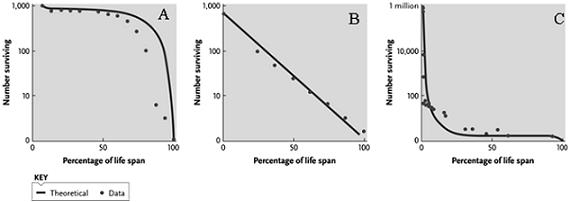 -Answer the question using the accompanying figure. Humans living in environments with access to good medical care are most likely to exhibit which of the following survivorship curves?
 (Multiple Choice)
4.9/5 (83)
(83) The logistic model assumes that ____ will become increasingly limited as population grows larger.
(Multiple Choice)
4.9/5 (80)
(80) Biologists captured and marked 120 butterflies, and later captured 150 of which 30 were marked. The population estimate is 1000 butterflies.
(True/False)
4.7/5 (63)
(63) Match each of the following terms with its correct definition.
Correct Answer: Verified
Premises:
Responses:
(Matching)
5.0/5 (73)
(73) Males have little influence on population growth in populations with ____.
(Multiple Choice)
4.7/5 (85)
(85) Egg yolk and seed endosperm are examples of passive parental care.
(True/False)
4.8/5 (78)
(78) An increase in generation time with increasing body size is least likely in ____.
(Multiple Choice)
4.8/5 (86)
(86) Use the five equations listed below to answer the following question(s).
Correct Answer:Verified
VerifiedPremises:
Responses:
(Matching)
4.9/5 (90)
(90) The sum total of all the resources we use is called the ____.
(Multiple Choice)
4.9/5 (77)
(77) Populations of bay checkerspot butterflies that occupy large patches of suitable habitat serve as sink populations for individuals that recolonize small patches of suitable habitat where butterfly populations frequently become extinct.
(True/False)
4.9/5 (76)
(76) Uniform dispersion usually results from individuals of a species repelling each other.
(True/False)
4.7/5 (78)
(78) A human population living without medical care in a developing country would probably have ____.
(Multiple Choice)
4.8/5 (75)
(75) A population of 100 animals undergoing logistic growth has rmax= 0.4 and K = 102. Given that r = rmax(K - N)/K, calculate the value of r.
(Multiple Choice)
4.9/5 (75)
(75) Which characteristic is descriptive of a population experiencing geometric population growth?
(Multiple Choice)
4.7/5 (76)
(76) 
Filters
- Essay(0)
- Multiple Choice(0)
- Short Answer(0)
- True False(0)
- Matching(0)