



 Chat with AI
Exam 52: Population Ecology

Exam 1: Introduction to Biological Concepts and Research86 Questions
Exam 2: Life, Chemistry, and Water87 Questions
Exam 3: Biological Molecules: the Carbon Compounds of Life86 Questions
Exam 4: Cells87 Questions
Exam 5: Membranes and Transport88 Questions
Exam 6: Energy, Enzymes, and Biological Reactions87 Questions
Exam 7: Cellular Respiration: Harvesting Chemical Energy88 Questions
Exam 8: Photosynthesis83 Questions
Exam 9: Cell Communication87 Questions
Exam 10: Cell Division and Mitosis88 Questions
Exam 11: Meiosis: the Cellular Basis of Sexual Reproduction80 Questions
Exam 12: Mendel, Genes, and Inheritance79 Questions
Exam 13: Genes, Chromosomes, and Human Genetics92 Questions
Exam 14: Dna Structure, Replication, and Organization79 Questions
Exam 15: Gene Expression: From Dna to Protein83 Questions
Exam 16: Regulation of Gene Expression84 Questions
Exam 17: Bacterial and Viral Genetics85 Questions
Exam 18: Dna Technology: Making and Using Genetically Altered Organisms, and Other Applications90 Questions
Exam 19: Genomes and Proteomes81 Questions
Exam 20: The Development of Evolutionary Thought92 Questions
Exam 21: Microevolution: Genetic Changes Within Populations88 Questions
Exam 22: Speciation89 Questions
Exam 23: Paleobiology and Macroevolution87 Questions
Exam 24: Systematic Biology: Phylogeny and Classification95 Questions
Exam 25: The Origin of Life86 Questions
Exam 26: Prokaryotes and Viruses86 Questions
Exam 27: Protists90 Questions
Exam 28: Seedless Plants88 Questions
Exam 29: Seed Plants90 Questions
Exam 30: Fungi88 Questions
Exam 31: Animal Phylogeny, Acoelomates, and Protostomes95 Questions
Exam 32: Deuterostomes: Vertebrates and Their Closest Relatives93 Questions
Exam 33: The Plant Body90 Questions
Exam 34: Transport in Plants94 Questions
Exam 35: Plant Nutrition85 Questions
Exam 36: Reproduction and Development in Flowering Plants89 Questions
Exam 37: Plant Signals and Responses to the Environment90 Questions
Exam 38: Introduction to Animal Organization and Physiology87 Questions
Exam 39: Information Flow and the Neuron88 Questions
Exam 40: Nervous Systems88 Questions
Exam 41: Sensory Systems87 Questions
Exam 42: The Endocrine System94 Questions
Exam 43: Muscles, Bones, and Body Movements87 Questions
Exam 44: The Circulatory System87 Questions
Exam 45: Defenses Against Disease83 Questions
Exam 46: Gas Exchange: the Respiratory System87 Questions
Exam 47: Digestive Systems and Animal Nutrition92 Questions
Exam 48: Regulating the Internal Environment: Osmoregulation, Excretion, and Thermoregulation88 Questions
Exam 49: Animal Reproduction76 Questions
Exam 50: Animal Development88 Questions
Exam 51: Ecology and the Biosphere88 Questions
Exam 52: Population Ecology92 Questions
Exam 53: Population Interactions and Community Ecology89 Questions
Exam 54: Ecosystems90 Questions
Exam 55: Biodiversity and Conservation Biology89 Questions
Exam 56: Animal Behavior87 Questions
Select questions type


Lizards can control spider populations on Caribbean islands by which density-dependent mechanism(s)?
(Multiple Choice)
4.8/5  (65)
(65) Recent studies have demonstrated evolution in some populations over a span of time as short as ____.
(Multiple Choice)
4.9/5 (90)
(90) The increased mortality of coniferous trees in the Pacific Northwest between 1955 and 2007 is an example of a reaction to ____.
(Multiple Choice)
4.8/5 (77)
(77) A time lag in the response of survivorship and fecundity to a population's density can occur because ____ is usually determined by the availability of resources at some time in the past.
(Multiple Choice)
5.0/5 (82)
(82) Mathematical models suggest that ____ will be favored by natural selection if organisms grow larger as they age.
(Multiple Choice)
4.7/5 (79)
(79) 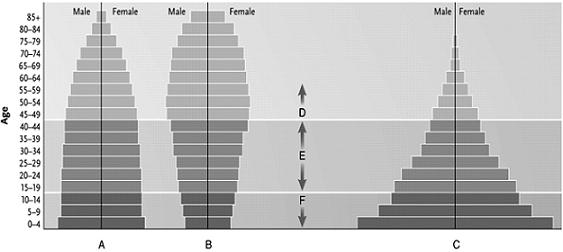 -Answer the question using the accompanying figure. The letter "A" represents ____.
 (Multiple Choice)
4.8/5 (81)
(81) The lifetime patterns of growth, maturation, and reproduction determine the ____ of a species.
(Multiple Choice)
4.9/5 (77)
(77) Life history patterns of guppies in Trinidad are a result of which natural selection force?
(Multiple Choice)
4.8/5 (82)
(82) A stage 3 society, based on the demographic transition model, would not be characterized by ____.
(Multiple Choice)
4.8/5 (84)
(84) The difference between the per capita birth rate and the per capita death rate is the ____.
(Multiple Choice)
4.8/5 (84)
(84) Organisms use ____ for maintenance, growth, and reproduction.
(Multiple Choice)
4.8/5 (87)
(87) The transformation of humans from hunter-gatherer societies to agriculturally based ones occurred approximately ____.
(Multiple Choice)
4.9/5 (82)
(82) What is the relationship between age-specific mortality and age-specific survivorship?
(Multiple Choice)
4.9/5 (81)
(81) Categorize the following traits as belonging predominantly to an r -selected species or a K -selected species.
Correct Answer: Verified
Premises:
Responses:
(Matching)
4.8/5 (78)
(78) It took 3 million years for the human population to reach 1 billion, 123 years to grow to 2 billion, and 12 years to grow from 6 to 7 billion.
(True/False)
4.7/5 (73)
(73) In the equation ΔN/Δt = B - D, expressing deaths and births as per capita rates allows ecologists to _____.
(Multiple Choice)
4.8/5 (85)
(85) 
Filters
- Essay(0)
- Multiple Choice(0)
- Short Answer(0)
- True False(0)
- Matching(0)