



 Chat with AI
Exam 24: Systematic Biology: Phylogeny and Classification

Exam 1: Introduction to Biological Concepts and Research86 Questions
Exam 2: Life, Chemistry, and Water87 Questions
Exam 3: Biological Molecules: the Carbon Compounds of Life86 Questions
Exam 4: Cells87 Questions
Exam 5: Membranes and Transport88 Questions
Exam 6: Energy, Enzymes, and Biological Reactions87 Questions
Exam 7: Cellular Respiration: Harvesting Chemical Energy88 Questions
Exam 8: Photosynthesis83 Questions
Exam 9: Cell Communication87 Questions
Exam 10: Cell Division and Mitosis88 Questions
Exam 11: Meiosis: the Cellular Basis of Sexual Reproduction80 Questions
Exam 12: Mendel, Genes, and Inheritance79 Questions
Exam 13: Genes, Chromosomes, and Human Genetics92 Questions
Exam 14: Dna Structure, Replication, and Organization79 Questions
Exam 15: Gene Expression: From Dna to Protein83 Questions
Exam 16: Regulation of Gene Expression84 Questions
Exam 17: Bacterial and Viral Genetics85 Questions
Exam 18: Dna Technology: Making and Using Genetically Altered Organisms, and Other Applications90 Questions
Exam 19: Genomes and Proteomes81 Questions
Exam 20: The Development of Evolutionary Thought92 Questions
Exam 21: Microevolution: Genetic Changes Within Populations88 Questions
Exam 22: Speciation89 Questions
Exam 23: Paleobiology and Macroevolution87 Questions
Exam 24: Systematic Biology: Phylogeny and Classification95 Questions
Exam 25: The Origin of Life86 Questions
Exam 26: Prokaryotes and Viruses86 Questions
Exam 27: Protists90 Questions
Exam 28: Seedless Plants88 Questions
Exam 29: Seed Plants90 Questions
Exam 30: Fungi88 Questions
Exam 31: Animal Phylogeny, Acoelomates, and Protostomes95 Questions
Exam 32: Deuterostomes: Vertebrates and Their Closest Relatives93 Questions
Exam 33: The Plant Body90 Questions
Exam 34: Transport in Plants94 Questions
Exam 35: Plant Nutrition85 Questions
Exam 36: Reproduction and Development in Flowering Plants89 Questions
Exam 37: Plant Signals and Responses to the Environment90 Questions
Exam 38: Introduction to Animal Organization and Physiology87 Questions
Exam 39: Information Flow and the Neuron88 Questions
Exam 40: Nervous Systems88 Questions
Exam 41: Sensory Systems87 Questions
Exam 42: The Endocrine System94 Questions
Exam 43: Muscles, Bones, and Body Movements87 Questions
Exam 44: The Circulatory System87 Questions
Exam 45: Defenses Against Disease83 Questions
Exam 46: Gas Exchange: the Respiratory System87 Questions
Exam 47: Digestive Systems and Animal Nutrition92 Questions
Exam 48: Regulating the Internal Environment: Osmoregulation, Excretion, and Thermoregulation88 Questions
Exam 49: Animal Reproduction76 Questions
Exam 50: Animal Development88 Questions
Exam 51: Ecology and the Biosphere88 Questions
Exam 52: Population Ecology92 Questions
Exam 53: Population Interactions and Community Ecology89 Questions
Exam 54: Ecosystems90 Questions
Exam 55: Biodiversity and Conservation Biology89 Questions
Exam 56: Animal Behavior87 Questions
Select questions type


Turtles, lizards, snakes, crocodilians, and birds descended most recently from an ancestral ____.
(Multiple Choice)
4.8/5  (90)
(90) The principle of parsimony ____ for constructing the phylogenetic tree that represents the smallest number of evolutionary changes.
(Multiple Choice)
4.7/5 (85)
(85) What are molecular clocks? How they can be used to estimate the time of evolutionary divergences?
(Essay)
4.8/5 (87)
(87) Crocodilians are classified as reptiles; however, they share a common ancestor with birds, which are not classified as reptiles. Therefore, Reptilia is a ____ taxon.
(Multiple Choice)
4.9/5 (70)
(70) Which traits were originally used for classifying organisms into taxonomic categories?
(Multiple Choice)
4.7/5 (73)
(73) Homarus americanus and Bufo americanus are ____ because ____.
(Multiple Choice)
4.8/5 (75)
(75) Answer the questions using the accompanying figure depicting the phylogenetic tree for human evolution. Match each letter of the figure to the taxonomic group with which it corresponds.
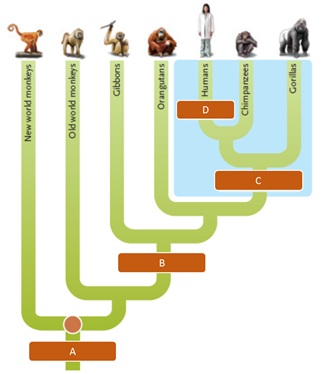
Figure 24.2B
Figure 24.2B
Correct Answer: Verified
Premises:
Responses:
(Matching)
4.9/5 (89)
(89)  Figure 24.3
-Answer the question using the accompanying figure. In the figure, letter B represents a ____ taxon, which includes ____.
Figure 24.3
-Answer the question using the accompanying figure. In the figure, letter B represents a ____ taxon, which includes ____. (Multiple Choice)
4.9/5 (77)
(77) The class Reptilia is a group of species that share a common ancestor and some, but not all of its descendants. It is therefore considered ____.
(Multiple Choice)
4.8/5 (94)
(94) Ferns comprise a good outgroup of the vascular plant phylogenetic tree because they share all of the same derived character states as the ingroup.
(True/False)
4.9/5 (72)
(72) Match each of the following terms with its corresponding definition.
Premises:
technique to amplify DNA for use in sequencing
Responses:
molecular clock
outgroup
homoplasy
Correct Answer:Verified
VerifiedPremises:
Responses:
(Matching)
4.7/5 (83)
(83) According to the convention for properly writing Latin binomials, the scientific name for modern human beings should be written as ____.
(Multiple Choice)
4.8/5 (83)
(83) The ____ is a bone in the middle ear of tetrapod vertebrates that evolved from, and is therefore ____to, the hyomandibula in early fishes.
(Multiple Choice)
5.0/5 (91)
(91) Match each of the following terms with its corresponding definition.
Premises:
classification system based on evolutionary relationships
Responses:
synapomorphy
taxonomy
outgroup
Correct Answer:Verified
VerifiedPremises:
Responses:
(Matching)
5.0/5 (71)
(71) Mammalia, the taxon that includes all mammals, is ____ because all mammals are the descendants of a common ancestor.
(Multiple Choice)
4.8/5 (63)
(63) The traditional kingdom Monera is now divided into two domains, Archaea and Bacteria.
(True/False)
4.9/5 (68)
(68) 
Filters
- Essay(0)
- Multiple Choice(0)
- Short Answer(0)
- True False(0)
- Matching(0)