



 Chat with AI
Exam 16: Regulation of Gene Expression

Exam 1: Introduction to Biological Concepts and Research86 Questions
Exam 2: Life, Chemistry, and Water87 Questions
Exam 3: Biological Molecules: the Carbon Compounds of Life86 Questions
Exam 4: Cells87 Questions
Exam 5: Membranes and Transport88 Questions
Exam 6: Energy, Enzymes, and Biological Reactions87 Questions
Exam 7: Cellular Respiration: Harvesting Chemical Energy88 Questions
Exam 8: Photosynthesis83 Questions
Exam 9: Cell Communication87 Questions
Exam 10: Cell Division and Mitosis88 Questions
Exam 11: Meiosis: the Cellular Basis of Sexual Reproduction80 Questions
Exam 12: Mendel, Genes, and Inheritance79 Questions
Exam 13: Genes, Chromosomes, and Human Genetics92 Questions
Exam 14: Dna Structure, Replication, and Organization79 Questions
Exam 15: Gene Expression: From Dna to Protein83 Questions
Exam 16: Regulation of Gene Expression84 Questions
Exam 17: Bacterial and Viral Genetics85 Questions
Exam 18: Dna Technology: Making and Using Genetically Altered Organisms, and Other Applications90 Questions
Exam 19: Genomes and Proteomes81 Questions
Exam 20: The Development of Evolutionary Thought92 Questions
Exam 21: Microevolution: Genetic Changes Within Populations88 Questions
Exam 22: Speciation89 Questions
Exam 23: Paleobiology and Macroevolution87 Questions
Exam 24: Systematic Biology: Phylogeny and Classification95 Questions
Exam 25: The Origin of Life86 Questions
Exam 26: Prokaryotes and Viruses86 Questions
Exam 27: Protists90 Questions
Exam 28: Seedless Plants88 Questions
Exam 29: Seed Plants90 Questions
Exam 30: Fungi88 Questions
Exam 31: Animal Phylogeny, Acoelomates, and Protostomes95 Questions
Exam 32: Deuterostomes: Vertebrates and Their Closest Relatives93 Questions
Exam 33: The Plant Body90 Questions
Exam 34: Transport in Plants94 Questions
Exam 35: Plant Nutrition85 Questions
Exam 36: Reproduction and Development in Flowering Plants89 Questions
Exam 37: Plant Signals and Responses to the Environment90 Questions
Exam 38: Introduction to Animal Organization and Physiology87 Questions
Exam 39: Information Flow and the Neuron88 Questions
Exam 40: Nervous Systems88 Questions
Exam 41: Sensory Systems87 Questions
Exam 42: The Endocrine System94 Questions
Exam 43: Muscles, Bones, and Body Movements87 Questions
Exam 44: The Circulatory System87 Questions
Exam 45: Defenses Against Disease83 Questions
Exam 46: Gas Exchange: the Respiratory System87 Questions
Exam 47: Digestive Systems and Animal Nutrition92 Questions
Exam 48: Regulating the Internal Environment: Osmoregulation, Excretion, and Thermoregulation88 Questions
Exam 49: Animal Reproduction76 Questions
Exam 50: Animal Development88 Questions
Exam 51: Ecology and the Biosphere88 Questions
Exam 52: Population Ecology92 Questions
Exam 53: Population Interactions and Community Ecology89 Questions
Exam 54: Ecosystems90 Questions
Exam 55: Biodiversity and Conservation Biology89 Questions
Exam 56: Animal Behavior87 Questions
Select questions type


If an operon is regulated by ____ control, genes are ____ by a regulatory protein called a ____.
(Multiple Choice)
4.7/5  (78)
(78) Transcription factors that control genes for developmental events are encoded by ____ genes.
(Multiple Choice)
4.7/5 (72)
(72) Which statement accurately describes the relationship between RNAi, small interfering RNA (siRNA), and miRNA?
(Multiple Choice)
4.8/5 (81)
(81) When a(n) ____ by mutation, it confers a selective growth advantage to the cell.
(Multiple Choice)
4.9/5 (90)
(90) The trp operon is an example of a(n) ____ operon where tryptophan acts as a(n) ____.
(Multiple Choice)
4.8/5 (69)
(69) Identify each labeled part in the following illustration of the lac operon.
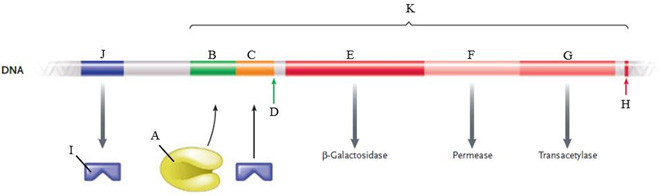
Figure 16.2
Figure 16.2
Correct Answer: Verified
Premises:
Responses:
(Matching)
4.9/5 (83)
(83) The E. coli lac operon encodes three genes. These genes ____.
(Multiple Choice)
4.7/5 (76)
(76) Other than the proteins that they encode, what is a major difference between cell-specific and housekeeping genes?
(Multiple Choice)
5.0/5 (75)
(75) Assume that a bacterial cell produces a Lac repressor that is able to bind to the operator sequence of the lac operon, but cannot bind allolactose. Explain the effect on transcription of the lac operon in the presence and absence of lactose.
(Essay)
4.9/5 (83)
(83) Identify each labeled part of the following illustration of eukaryotic DNA.
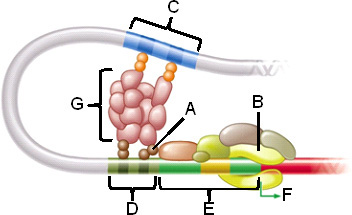
Figure 16.1
Figure 16.1
Correct Answer:Verified
VerifiedPremises:
Responses:
(Matching)
4.8/5 (84)
(84) An unmutated version of an oncogene in a normal cell is called a ____.
(Multiple Choice)
4.9/5 (72)
(72) How is lac operon transcription regulated by the presence or absence of lactose?
(Multiple Choice)
4.9/5 (92)
(92) In RNAi, imperfect pairing of miRNA to target mRNA results in ____ or ____, while perfect pairing of miRNA to target mRNA causes ____.
(Multiple Choice)
4.8/5 (93)
(93) If the lacI repressor gene were permanently silenced by a DNA mutation, what would be the impact on the expression of the lac operon?
(Multiple Choice)
4.8/5 (72)
(72) 
Filters
- Essay(0)
- Multiple Choice(0)
- Short Answer(0)
- True False(0)
- Matching(0)