



 Chat with AI
Exam 5: Membranes and Transport

Exam 1: Introduction to Biological Concepts and Research86 Questions
Exam 2: Life, Chemistry, and Water87 Questions
Exam 3: Biological Molecules: the Carbon Compounds of Life86 Questions
Exam 4: Cells87 Questions
Exam 5: Membranes and Transport88 Questions
Exam 6: Energy, Enzymes, and Biological Reactions87 Questions
Exam 7: Cellular Respiration: Harvesting Chemical Energy88 Questions
Exam 8: Photosynthesis83 Questions
Exam 9: Cell Communication87 Questions
Exam 10: Cell Division and Mitosis88 Questions
Exam 11: Meiosis: the Cellular Basis of Sexual Reproduction80 Questions
Exam 12: Mendel, Genes, and Inheritance79 Questions
Exam 13: Genes, Chromosomes, and Human Genetics92 Questions
Exam 14: Dna Structure, Replication, and Organization79 Questions
Exam 15: Gene Expression: From Dna to Protein83 Questions
Exam 16: Regulation of Gene Expression84 Questions
Exam 17: Bacterial and Viral Genetics85 Questions
Exam 18: Dna Technology: Making and Using Genetically Altered Organisms, and Other Applications90 Questions
Exam 19: Genomes and Proteomes81 Questions
Exam 20: The Development of Evolutionary Thought92 Questions
Exam 21: Microevolution: Genetic Changes Within Populations88 Questions
Exam 22: Speciation89 Questions
Exam 23: Paleobiology and Macroevolution87 Questions
Exam 24: Systematic Biology: Phylogeny and Classification95 Questions
Exam 25: The Origin of Life86 Questions
Exam 26: Prokaryotes and Viruses86 Questions
Exam 27: Protists90 Questions
Exam 28: Seedless Plants88 Questions
Exam 29: Seed Plants90 Questions
Exam 30: Fungi88 Questions
Exam 31: Animal Phylogeny, Acoelomates, and Protostomes95 Questions
Exam 32: Deuterostomes: Vertebrates and Their Closest Relatives93 Questions
Exam 33: The Plant Body90 Questions
Exam 34: Transport in Plants94 Questions
Exam 35: Plant Nutrition85 Questions
Exam 36: Reproduction and Development in Flowering Plants89 Questions
Exam 37: Plant Signals and Responses to the Environment90 Questions
Exam 38: Introduction to Animal Organization and Physiology87 Questions
Exam 39: Information Flow and the Neuron88 Questions
Exam 40: Nervous Systems88 Questions
Exam 41: Sensory Systems87 Questions
Exam 42: The Endocrine System94 Questions
Exam 43: Muscles, Bones, and Body Movements87 Questions
Exam 44: The Circulatory System87 Questions
Exam 45: Defenses Against Disease83 Questions
Exam 46: Gas Exchange: the Respiratory System87 Questions
Exam 47: Digestive Systems and Animal Nutrition92 Questions
Exam 48: Regulating the Internal Environment: Osmoregulation, Excretion, and Thermoregulation88 Questions
Exam 49: Animal Reproduction76 Questions
Exam 50: Animal Development88 Questions
Exam 51: Ecology and the Biosphere88 Questions
Exam 52: Population Ecology92 Questions
Exam 53: Population Interactions and Community Ecology89 Questions
Exam 54: Ecosystems90 Questions
Exam 55: Biodiversity and Conservation Biology89 Questions
Exam 56: Animal Behavior87 Questions
Select questions type


Two solutions of differing glucose concentration are placed in a container separated by a selectively permeable membrane that restricts large molecules like glucose, but allows the free diffusion of water. What will be the glucose concentration in the container after dynamic equilibrium has been reached?
(Multiple Choice)
4.8/5  (71)
(71) The movement of water across a membrane from an area of high to low water concentration is an example of ____.
(Multiple Choice)
4.9/5 (69)
(69) In secondary active transport, when the driving ion concentration is high and the transport ion concentration is low outside of the cell, in which direction will the two ions move?
(Multiple Choice)
4.8/5 (91)
(91) According to the fluid mosaic model of cell membranes, the fluid part of the model refers to ____.
(Multiple Choice)
4.8/5 (74)
(74) Which organelle's membrane contains the enzymes that convert light energy to chemical energy in eukaryotes?
(Multiple Choice)
4.8/5 (86)
(86) Carrier proteins are often used by the cell to transport ____.
(Multiple Choice)
4.8/5 (74)
(74) Which molecules most easily diffuse across a cell membrane?
(Multiple Choice)
4.9/5 (78)
(78) Transport of a molecule across a cell membrane by facilitated diffusion ____.
(Multiple Choice)
4.8/5 (77)
(77) The selective permeability of a cell membrane is due to ____.
(Multiple Choice)
4.7/5 (82)
(82) Explain how cells can adapt to colder temperatures by altering the number of double bonds in the lipids that comprise cell membranes.
(Essay)
4.8/5 (82)
(82) In facilitated diffusion, the membrane components responsible for transport are proteins.
(True/False)
4.8/5 (83)
(83) When a drop of food coloring is placed in a container of clear water, the colored dye molecules ____.
(Multiple Choice)
4.9/5 (79)
(79) In primary active transport, the carrier protein that transports a substance also hydrolyzes ATP to power the transport directly.
(True/False)
5.0/5 (77)
(77) In plants, extreme wilting of leaves and stems can cause the cells to retract from the cell wall, a condition known as ____.
(Multiple Choice)
4.8/5 (70)
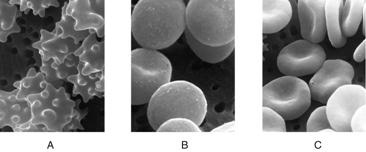
(70) These micrographs show the effects of various aqueous environments on red blood cells. Identify the correct environment depicted in each panel.
Correct Answer: Verified
Premises:
Responses:
(Matching)
5.0/5 (63)
(63) An animal cell placed in a hypertonic solution will swell and perhaps burst.
(True/False)
4.7/5 (82)
(82) People with type A blood have red blood cells that express one type of recognition protein, while those with type B blood express a different recognition protein. People with AB blood express both recognition proteins. Why can a person with AB blood receive blood from a person with type A, but a person with type A blood cannot receive blood from a person with type AB?
(Essay)
4.8/5 (78)
(78) 
Filters
- Essay(0)
- Multiple Choice(0)
- Short Answer(0)
- True False(0)
- Matching(0)