



 Chat with AI
Exam 2: Life, Chemistry, and Water

Exam 1: Introduction to Biological Concepts and Research86 Questions
Exam 2: Life, Chemistry, and Water87 Questions
Exam 3: Biological Molecules: the Carbon Compounds of Life86 Questions
Exam 4: Cells87 Questions
Exam 5: Membranes and Transport88 Questions
Exam 6: Energy, Enzymes, and Biological Reactions87 Questions
Exam 7: Cellular Respiration: Harvesting Chemical Energy88 Questions
Exam 8: Photosynthesis83 Questions
Exam 9: Cell Communication87 Questions
Exam 10: Cell Division and Mitosis88 Questions
Exam 11: Meiosis: the Cellular Basis of Sexual Reproduction80 Questions
Exam 12: Mendel, Genes, and Inheritance79 Questions
Exam 13: Genes, Chromosomes, and Human Genetics92 Questions
Exam 14: Dna Structure, Replication, and Organization79 Questions
Exam 15: Gene Expression: From Dna to Protein83 Questions
Exam 16: Regulation of Gene Expression84 Questions
Exam 17: Bacterial and Viral Genetics85 Questions
Exam 18: Dna Technology: Making and Using Genetically Altered Organisms, and Other Applications90 Questions
Exam 19: Genomes and Proteomes81 Questions
Exam 20: The Development of Evolutionary Thought92 Questions
Exam 21: Microevolution: Genetic Changes Within Populations88 Questions
Exam 22: Speciation89 Questions
Exam 23: Paleobiology and Macroevolution87 Questions
Exam 24: Systematic Biology: Phylogeny and Classification95 Questions
Exam 25: The Origin of Life86 Questions
Exam 26: Prokaryotes and Viruses86 Questions
Exam 27: Protists90 Questions
Exam 28: Seedless Plants88 Questions
Exam 29: Seed Plants90 Questions
Exam 30: Fungi88 Questions
Exam 31: Animal Phylogeny, Acoelomates, and Protostomes95 Questions
Exam 32: Deuterostomes: Vertebrates and Their Closest Relatives93 Questions
Exam 33: The Plant Body90 Questions
Exam 34: Transport in Plants94 Questions
Exam 35: Plant Nutrition85 Questions
Exam 36: Reproduction and Development in Flowering Plants89 Questions
Exam 37: Plant Signals and Responses to the Environment90 Questions
Exam 38: Introduction to Animal Organization and Physiology87 Questions
Exam 39: Information Flow and the Neuron88 Questions
Exam 40: Nervous Systems88 Questions
Exam 41: Sensory Systems87 Questions
Exam 42: The Endocrine System94 Questions
Exam 43: Muscles, Bones, and Body Movements87 Questions
Exam 44: The Circulatory System87 Questions
Exam 45: Defenses Against Disease83 Questions
Exam 46: Gas Exchange: the Respiratory System87 Questions
Exam 47: Digestive Systems and Animal Nutrition92 Questions
Exam 48: Regulating the Internal Environment: Osmoregulation, Excretion, and Thermoregulation88 Questions
Exam 49: Animal Reproduction76 Questions
Exam 50: Animal Development88 Questions
Exam 51: Ecology and the Biosphere88 Questions
Exam 52: Population Ecology92 Questions
Exam 53: Population Interactions and Community Ecology89 Questions
Exam 54: Ecosystems90 Questions
Exam 55: Biodiversity and Conservation Biology89 Questions
Exam 56: Animal Behavior87 Questions
Select questions type


Match each of the following terms with its correct definition.
Correct Answer: Verified
Premises:
Responses:
(Matching)
4.9/5  (82)
(82) 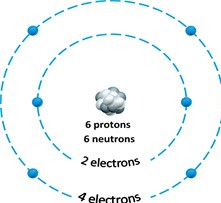 Figure 2.1
-
Answer the question using the accompanying figure. The mass number of the atom depicted in the figure is ____.
Figure 2.1
-
Answer the question using the accompanying figure. The mass number of the atom depicted in the figure is ____. (Multiple Choice)
4.8/5 (73)
(73) Explain how radiometric dating allows scientists to determine the age of a particular fossil.
(Essay)
4.8/5 (76)
(76) In a molecule of methane, CH4, each hydrogen atom shares an orbital with the carbon atom. The total number of shared electrons in CH4is ____.
(Multiple Choice)
4.9/5 (73)
(73) Electronegativity is the tendency of an atom to attract ____ to itself in a chemical bond.
(Multiple Choice)
4.9/5 (78)
(78) 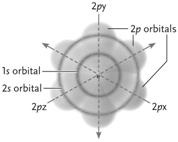 Figure 2.2
-
Answer the question using the accompanying figure. The electrons at the lowest energy level in the neon atom depicted are found in which orbital?
Figure 2.2
-
Answer the question using the accompanying figure. The electrons at the lowest energy level in the neon atom depicted are found in which orbital? (Multiple Choice)
4.9/5 (68)
(68) Water has a molecular weight of 18 g per mole, and glucose has a molecular weight of 180 g per mole. Which masses of water and glucose would have an approximately equal number of molecules?
(Multiple Choice)
4.9/5 (77)
(77) The smallest unit that retains the chemical and physical properties of an element is a(n) ____.
(Multiple Choice)
4.9/5 (80)
(80) If van der Waals forces are weak, how can geckos utilize these forces to cling to and walk up vertical smooth surfaces?
(Essay)
4.9/5 (83)
(83) Four elements, including ____, make up more than 96.5% of the mass of most living organisms.
(Multiple Choice)
4.9/5 (73)
(73) When sugar dissolves in water, water is acting as a ____ and the sugar molecules are acting as ____.
(Multiple Choice)
4.8/5 (76)
(76) Atoms with atomic numbers between lithium and neon have two energy levels.
(True/False)
4.8/5 (83)
(83) The chemical linkages that exert an attractive force over the greatest distance are ____.
(Multiple Choice)
4.9/5 (88)
(88) When the isotope14C undergoes radioactive decay, a neutron splits into an electron and a proton, with ejection of the electron. This decay produces an atom of ____.
(Multiple Choice)
4.9/5 (79)
(79) 
Filters
- Essay(0)
- Multiple Choice(0)
- Short Answer(0)
- True False(0)
- Matching(0)