



 Chat with AI
Exam 2: Life, Chemistry, and Water

Exam 1: Introduction to Biological Concepts and Research86 Questions
Exam 2: Life, Chemistry, and Water87 Questions
Exam 3: Biological Molecules: the Carbon Compounds of Life86 Questions
Exam 4: Cells87 Questions
Exam 5: Membranes and Transport88 Questions
Exam 6: Energy, Enzymes, and Biological Reactions87 Questions
Exam 7: Cellular Respiration: Harvesting Chemical Energy88 Questions
Exam 8: Photosynthesis83 Questions
Exam 9: Cell Communication87 Questions
Exam 10: Cell Division and Mitosis88 Questions
Exam 11: Meiosis: the Cellular Basis of Sexual Reproduction80 Questions
Exam 12: Mendel, Genes, and Inheritance79 Questions
Exam 13: Genes, Chromosomes, and Human Genetics92 Questions
Exam 14: Dna Structure, Replication, and Organization79 Questions
Exam 15: Gene Expression: From Dna to Protein83 Questions
Exam 16: Regulation of Gene Expression84 Questions
Exam 17: Bacterial and Viral Genetics85 Questions
Exam 18: Dna Technology: Making and Using Genetically Altered Organisms, and Other Applications90 Questions
Exam 19: Genomes and Proteomes81 Questions
Exam 20: The Development of Evolutionary Thought92 Questions
Exam 21: Microevolution: Genetic Changes Within Populations88 Questions
Exam 22: Speciation89 Questions
Exam 23: Paleobiology and Macroevolution87 Questions
Exam 24: Systematic Biology: Phylogeny and Classification95 Questions
Exam 25: The Origin of Life86 Questions
Exam 26: Prokaryotes and Viruses86 Questions
Exam 27: Protists90 Questions
Exam 28: Seedless Plants88 Questions
Exam 29: Seed Plants90 Questions
Exam 30: Fungi88 Questions
Exam 31: Animal Phylogeny, Acoelomates, and Protostomes95 Questions
Exam 32: Deuterostomes: Vertebrates and Their Closest Relatives93 Questions
Exam 33: The Plant Body90 Questions
Exam 34: Transport in Plants94 Questions
Exam 35: Plant Nutrition85 Questions
Exam 36: Reproduction and Development in Flowering Plants89 Questions
Exam 37: Plant Signals and Responses to the Environment90 Questions
Exam 38: Introduction to Animal Organization and Physiology87 Questions
Exam 39: Information Flow and the Neuron88 Questions
Exam 40: Nervous Systems88 Questions
Exam 41: Sensory Systems87 Questions
Exam 42: The Endocrine System94 Questions
Exam 43: Muscles, Bones, and Body Movements87 Questions
Exam 44: The Circulatory System87 Questions
Exam 45: Defenses Against Disease83 Questions
Exam 46: Gas Exchange: the Respiratory System87 Questions
Exam 47: Digestive Systems and Animal Nutrition92 Questions
Exam 48: Regulating the Internal Environment: Osmoregulation, Excretion, and Thermoregulation88 Questions
Exam 49: Animal Reproduction76 Questions
Exam 50: Animal Development88 Questions
Exam 51: Ecology and the Biosphere88 Questions
Exam 52: Population Ecology92 Questions
Exam 53: Population Interactions and Community Ecology89 Questions
Exam 54: Ecosystems90 Questions
Exam 55: Biodiversity and Conservation Biology89 Questions
Exam 56: Animal Behavior87 Questions
Select questions type


In the representation of hydrogen gas, H-H, the dash represents two electrons being shared equally.
(True/False)
4.7/5  (87)
(87) The attraction between Na+cations and Cl-anions form ____ that hold the ions together in the compound NaCl.
(Multiple Choice)
4.8/5 (78)
(78) When water molecules exposed to the air form hydrogen bonds between adjacent water molecules below and beside them, molecules in the upper layer become more resistant to separating from those underneath. This property of water is known as ____.
(Multiple Choice)
4.9/5 (65)
(65) Consider the equilibrium established in the carbonic acid-bicarbonate buffer system, which maintains pH balance in mammalian blood:
During hypoventilation, breathing rate decreases, and therefore elimination of CO2 during exhalation decreases. How is optimal blood pH maintained when acid levels increase in our blood from hypoventilating?
(Multiple Choice)
4.9/5 (89)
(89) Water has an unusually high boiling point for its molecular weight because water molecules ____.
(Multiple Choice)
5.0/5 (83)
(83) When added to water, a base will act as a(n) ____ and cause the pH of the solution to ____.
(Multiple Choice)
4.7/5 (83)
(83) In the presence of water, nonpolar associations form between molecules or regions of molecules that are ____.
(Multiple Choice)
4.8/5 (71)
(71) A molecule of water in the middle of a chunk of ice will usually have ____ hydrogen bonds with other water molecules.
(Multiple Choice)
4.8/5 (75)
(75) A polar covalent bond would be most likely to form between ____.
(Multiple Choice)
4.8/5 (91)
(91) The pH of your stomach is between 1 and 3. Use your knowledge of polar and nonpolar substances to explain why the acids in your stomach do not alter the pH of your blood.
(Essay)
4.9/5 (79)
(79) 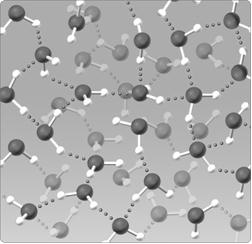 Figure 2.5
The water lattice illustrated in the figure above forms as a result of ____ between water molecules.
Figure 2.5
The water lattice illustrated in the figure above forms as a result of ____ between water molecules. (Multiple Choice)
4.8/5 (79)
(79) Prolonged iodine deficiency causes ____, a condition in which the thyroid gland enlarges so much that the front of the neck swells significantly.
(Multiple Choice)
4.9/5 (81)
(81) Metallic ions such as Ca2+, Na+, and Fe3+readily form ____.
(Multiple Choice)
4.7/5 (78)
(78) The chemical bonds that are formed when atoms share electrons equally are called ____.
(Multiple Choice)
4.8/5 (75)
(75) A mixture of vegetable oil and water will separate into layers because oil is ____ and forms ____.
(Multiple Choice)
4.9/5 (83)
(83) An oxygen atom has ____ surrounding a nucleus composed of ____.
(Multiple Choice)
4.8/5 (80)
(80) Proteins in thermophiles must be stabilized by van der Waals forces, because hydrogen bonds cannot be maintained at high temperatures.
(True/False)
5.0/5 (84)
(84) Sodium has one valence electron in its third energy level. To reach a stable energy configuration, sodium will tend to____.
(Multiple Choice)
4.8/5 (83)
(83) 
Filters
- Essay(0)
- Multiple Choice(0)
- Short Answer(0)
- True False(0)
- Matching(0)