



 Chat with AI
Exam 5: Roads to Revolution

Exam 1: Native Peoples of America72 Questions
Exam 2: The Rise of the Atlantic World131 Questions
Exam 3: The Emergence of Colonial Societies119 Questions
Exam 4: The Bonds of Empire106 Questions
Exam 5: Roads to Revolution112 Questions
Exam 6: Securing Independence, Defining Nationhood129 Questions
Exam 7: Launching the New Republic105 Questions
Exam 8: America at War and Peace113 Questions
Exam 9: The Transformation of American Society99 Questions
Exam 10: Democratic Politics, Religious Revival, and Reform106 Questions
Exam 11: Technology, Culture, and Everyday Life103 Questions
Exam 12: The Old South and Slavery105 Questions
Exam 13: Immigration, Expansion, and Sectional Conflict99 Questions
Exam 14: From Compromise to Secession108 Questions
Exam 15: Crucible of Freedom: Civil War129 Questions
Exam 16: Reconstruction and Resistance99 Questions
Exam 17: The Transformation of the Trans-Mississippi West110 Questions
Exam 18: The Rise of Industrial America92 Questions
Exam 19: Immigration, Urbanization, and Everyday Life91 Questions
Exam 20: Politics and Expansion in an Industrializing Age124 Questions
Exam 21: The Progressive Era122 Questions
Exam 22: Global Involvements and World War I105 Questions
Exam 23: Coping With Change101 Questions
Exam 24: The Great Depression and the New Deal107 Questions
Exam 25: Americans and a World in Crisis105 Questions
Exam 26: The Cold War Abroad and at Home121 Questions
Exam 27: America at Midcentury104 Questions
Exam 28: Liberalism, Civil Rights, and War in Vietnam126 Questions
Exam 29: A Time of Upheaval118 Questions
Exam 30: A Conservative Revival and the End of the Cold War156 Questions
Exam 31: A Changing Nation: Homefront Crises and New Global Realities101 Questions
Select questions type


From the late 1760s to the mid-1770s, an ideology of revolution began to evolve in the colonies. Explain the foundations of that ideology. Did the revolutionary ideology of common Americans differ from that of elite Americans? How did political ideology take on religious dimensions?
(Essay)
4.7/5  (84)
(84) Instructions: Identify the following. Be as specific as possible, and include names, dates, and relevant facts as appropriate. Be sure to explain the significance of the person or term.
Daughters of Liberty
(Short Answer)
4.7/5 (79)
(79) Explore the tensions on the frontier from 1760 to 1775. What were the main areas of conflict, and how were they addressed? What role did these problems play in the coming of the American Revolution?
(Essay)
4.8/5 (68)
(68) Who led the group in Parliament who opposed the domestic and foreign policies of George III?
(Multiple Choice)
4.9/5 (61)
(61) Instructions: Identify the following. Be as specific as possible, and include names, dates, and relevant facts as appropriate. Be sure to explain the significance of the person or term.
Philadelphia
(Short Answer)
4.7/5 (68)
(68) Analyze the breakdown of relations between the colonies and Great Britain between 1763 and 1775. What were relations like prior to 1763? How and why did the relations change by 1775? Was the official break between the colonies and Great Britain in 1776 inevitable? Explain.
(Essay)
4.7/5 (80)
(80) Instructions: Identify the following. Be as specific as possible, and include names, dates, and relevant facts as appropriate. Be sure to explain the significance of the person or term.
Revenue Acts
(Essay)
4.8/5 (84)
(84) Discuss the following assertion: "Of all the world's colonial peoples, none became rebels more reluctantly than did Anglo-Americans in 1776."
(Essay)
4.9/5 (83)
(83) Instructions: Identify the following. Be as specific as possible, and include names, dates, and relevant facts as appropriate. Be sure to explain the significance of the person or term.
Pontiac's War
(Short Answer)
4.9/5 (73)
(73) Instructions: Identify the following. Be as specific as possible, and include names, dates, and relevant facts as appropriate. Be sure to explain the significance of the person or term.
Thomas Paine, Common Sense
(Short Answer)
4.7/5 (67)
(67) What made Thomas Paine's publication of Common Sense so significant?
(Multiple Choice)
4.8/5 (77)
(77) Instructions: Identify the following. Be as specific as possible, and include names, dates, and relevant facts as appropriate. Be sure to explain the significance of the person or term.
Louisbourg
(Short Answer)
4.8/5 (66)
(66) Instructions: Identify the following. Be as specific as possible, and include names, dates, and relevant facts as appropriate. Be sure to explain the significance of the person or term.
Coercive Acts (Intolerable Acts), Quebec Act
(Short Answer)
4.8/5 (74)
(74) Instructions: Identify the following. Be as specific as possible, and include names, dates, and relevant facts as appropriate. Be sure to explain the significance of the person or term.
James Otis
(Short Answer)
4.8/5 (91)
(91) MAP QUESTIONS
Instructions: Choose the letter on the accompanying map of northeastern North America that correctly identifies each of the following:
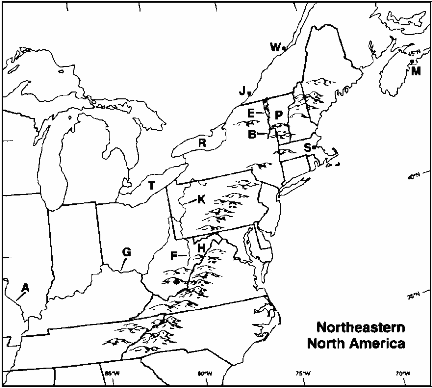 Vermont
 (Short Answer)
5.0/5 (80)
(80) How did the colonists attempt to reconcile with England in 1775?
(Multiple Choice)
4.8/5 (86)
(86) Which of the following was not a result of the Seven Years' War?
(Multiple Choice)
4.9/5 (84)
(84) Examine the role of women in colonial resistance. Why were those roles so important? How successful were the women in fulfilling these roles?
(Essay)
4.8/5 (68)
(68) 
Filters
- Essay(0)
- Multiple Choice(0)
- Short Answer(0)
- True False(0)
- Matching(0)