



 Chat with AI
Exam 5: Roads to Revolution


Instructions: Identify the following. Be as specific as possible, and include names, dates, and relevant facts as appropriate. Be sure to explain the significance of the person or term.
Olive Branch Petition

 (69)
 Answered by Examlex AI Copilot
The Olive Branch Petition was a document sent to King George III by the Second Continental Congress on July 5, 1775, as a final attempt to avoid a full-blown war between Great Britain and the Thirteen Colonies in America. The petition affirmed American loyalty to the British crown and blamed the British Parliament and government ministers, rather than the king himself, for the growing tensions.
Drafted by John Dickinson, the Olive Branch Petition was an effort to assert the rights of the colonists while maintaining their loyalty to the British monarchy. The petition appealed directly to King George III to intervene and seek a peaceful resolution to the escalating conflict. It expressed hope that the king would address the colonies' grievances, which included issues like taxation without representation and the presence of British troops on American soil.
The significance of the Olive Branch Petition lies in its role in the unfolding of the American Revolution. It represented the last conciliatory gesture by the Continental Congress before the full commitment to independence. The petition was rejected by King George III, who in October 1775 declared the colonies to be in a state of rebellion. This rejection hardened the stance of many American colonists, convincing them that reconciliation was impossible and leading to the Declaration of Independence on July 4, 1776.
The Olive Branch Petition is an important historical document because it highlights the complexity of the American colonists' attitudes toward Britain in the early stages of the Revolution. It demonstrates that many colonists still hoped for a peaceful resolution and were not initially seeking independence. The rejection of the petition marked a turning point, after which the idea of complete separation from Britain gained greater support among the colonists.
Instructions: Identify the following. Be as specific as possible, and include names, dates, and relevant facts as appropriate. Be sure to explain the significance of the person or term.
Declaratory Act
(97) Answered by Examlex AI CopilotThe Declaratory Act was a piece of legislation enacted by the British Parliament in 1766, following the repeal of the Stamp Act. The full name of the Act was the American Colonies Act 1766. The significance of the Declaratory Act was that it asserted the British Parliament's right to make laws and statutes of sufficient force and validity to bind the colonies and people of America in all cases whatsoever.
The context for the Declaratory Act was the growing tension between the American colonies and the British government. The Stamp Act of 1765 had imposed direct taxes on the colonies for the first time, specifically through a requirement for printed materials and legal documents to be produced on stamped paper showing that the tax had been paid. This led to widespread protest in the colonies, including the slogan "no taxation without representation," as the colonists had no representatives in the British Parliament.
In response to the protests and economic boycotts, Parliament repealed the Stamp Act in 1766. However, to assert its authority and to avoid setting a precedent that the colonies could get legislation repealed through resistance, Parliament passed the Declaratory Act. This Act stated that Parliament had the same authority in America as in Britain and could pass laws binding on the colonies.
The Declaratory Act was significant because it highlighted the fundamental constitutional dispute between the colonies and the British government: the extent of Parliament's authority over the colonies. While the Act itself did not impose any new taxes or regulations, it inflamed colonial sentiment against what was seen as an assertion of tyrannical power by a distant government.
The Declaratory Act set the stage for further conflicts between the colonies and Britain, as the British government continued to try to assert its authority and the colonists continued to resist. This ongoing tension eventually led to the American Revolutionary War and the subsequent independence of the United States.
The Battle of Alamance Creek was
(88)  Verified
B
Which of the following men was a British prime minister during the reign of George III?
(73) Which of the following was not a provision of the Sugar Act?
(75) MAP QUESTIONS
Instructions: Choose the letter on the accompanying map of northeastern North America that correctly identifies each of the following:
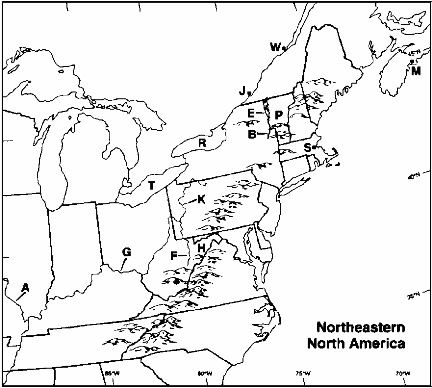 Mississippi River
 (86) Events in the late 1760s and early 1770s helped to bring about a new consensus in the colonies. What was that consensus?
(87) Which of the following would have most influenced the opinion of the average colonial American on political issues of the day?
(87) Instructions: Identify the following. Be as specific as possible, and include names, dates, and relevant facts as appropriate. Be sure to explain the significance of the person or term.
Thomas Jefferson, Declaration of Independence
(87) Which statement is not true concerning the Albany Plan of Union?
(73) Analyze why the British and Americans ultimately won the Seven Years' War in the North America. How did the outcome create tensions that fed the growing divisions between the two?
(85) What agreement did the delegates to the Stamp Act Congress reach?
(73) Instructions: Identify the following. Be as specific as possible, and include names, dates, and relevant facts as appropriate. Be sure to explain the significance of the person or term.
Continental Congresses
(87) Instructions: Identify the following. Be as specific as possible, and include names, dates, and relevant facts as appropriate. Be sure to explain the significance of the person or term.
Stamp Act, Stamp Act Congress
(94) Instructions: Identify the following. Be as specific as possible, and include names, dates, and relevant facts as appropriate. Be sure to explain the significance of the person or term.
John Locke
(71) Instructions: Identify the following. Be as specific as possible, and include names, dates, and relevant facts as appropriate. Be sure to explain the significance of the person or term.
Proclamation of 1763
(70) Instructions: Identify the following. Be as specific as possible, and include names, dates, and relevant facts as appropriate. Be sure to explain the significance of the person or term.
Regulator movement, Battle of Alamance Creek
(79) 
Filters
- Essay(0)
- Multiple Choice(0)
- Short Answer(0)
- True False(0)
- Matching(0)