



 Chat with AI
Exam 20: Politics and Expansion in an Industrializing Age


What did the "separate but equal" doctrine mean?

 (75)
 Verified
C
Instructions: Identify the following. Be as specific as possible, and include names, dates, and relevant facts as appropriate. Be sure to explain the significance of the person or term.
Mugwumps
(85)  Answered by Examlex AI Copilot
Mugwumps were a group of Republican political activists in the United States during the 1884 presidential election who switched their support from the Republican candidate to the Democratic candidate, Grover Cleveland. The term "Mugwump" is believed to have originated from an Algonquian word meaning "person of importance" or "war leader." However, in the political context of the 1880s, it was used derisively to suggest that these individuals were sitting on the fence with their "mugs" on one side and their "wumps" on the other.
The Mugwumps were reform-minded individuals who were opposed to political corruption and the patronage system, also known as the "spoils system," which was prevalent at the time. They were particularly disillusioned with the Republican Party's nomination of James G. Blaine, a former Speaker of the House and Senator from Maine, whose involvement in various corruption scandals made him an unpalatable choice for these reformers.
The Mugwumps included prominent intellectuals, writers, and civil service reformers, such as Charles Eliot Norton, a professor at Harvard, and journalist Carl Schurz. They believed that Grover Cleveland, the Democratic nominee and then-Governor of New York, was a candidate with higher moral standards and a better record on reform.
The defection of the Mugwumps was significant because it reflected a growing concern among some Americans about political corruption and the need for civil service reform. Their support for Cleveland helped to underscore the importance of character and integrity in public office. Although their numbers were relatively small, the Mugwumps attracted considerable public attention and may have influenced the outcome of the election, which was one of the closest in American history. Cleveland won the presidency by a narrow margin, becoming the first Democrat to be elected to the White House since the Civil War.
The legacy of the Mugwumps is seen in the subsequent passage of the Pendleton Civil Service Reform Act in 1883, which began the process of reforming the federal civil service by introducing exams and merit-based appointments, reducing the power of the spoils system. The Mugwumps' advocacy for political reform and their willingness to cross party lines in support of their principles left a lasting mark on American politics.
Instructions: Identify the following. Be as specific as possible, and include names, dates, and relevant facts as appropriate. Be sure to explain the significance of the person or term.
Alfred T. Mahan
(83) Answered by Examlex AI CopilotAlfred Thayer Mahan (September 27, 1840 – December 1, 1914) was a United States Navy admiral, geostrategist, and historian, who has been called "the most important American strategist of the nineteenth century." His ideas on the importance of sea power influenced navies around the world, and helped prompt naval buildups before World War I. Several ships were named USS Mahan, including the lead vessel of a class of destroyers.
Mahan's most famous work, "The Influence of Sea Power upon History, 1660–1783," published in 1890, argued that national greatness was inextricably associated with the sea, with naval strength being a key factor in the rise of the British Empire. He posited that control of the sea was the key to world dominance and urged the United States to build a powerful navy. Mahan stressed the importance of the navy in not just naval warfare, but also in the protection of international shipping lanes, communication, and commerce.
His theories profoundly influenced the navies of many nations, leading to a race for naval supremacy in the early 20th century. The concepts articulated by Mahan were adopted by many nations, notably influencing the naval strategies of powers like the United Kingdom, Germany, Japan, and the United States. His work inspired the United States to expand its naval power, which played a significant role in American imperialism and the country's rise as a world power.
Mahan's emphasis on sea power also played a part in the development of the "Great White Fleet," which was a powerful United States naval fleet that circumnavigated the globe from December 16, 1907, to February 22, 1909. The demonstration of naval strength was a clear application of his theories on the importance of sea power and served as a show of U.S. global reach and blue-water naval capabilities.
In summary, Alfred T. Mahan was a key figure in naval strategy whose ideas on the importance of sea power changed the way nations viewed and invested in their navies. His work had a lasting impact on global naval strategies and the development of naval warfare leading up to and through the 20th century.
Which statement below concerning the farmers' alliance movement is true?
(82) Instructions: Identify the following. Be as specific as possible, and include names, dates, and relevant facts as appropriate. Be sure to explain the significance of the person or term.
Democratic party
(81) Which of the following statements is not true concerning the 1884 presidential campaign?
(93) Instructions: Identify the following. Be as specific as possible, and include names, dates, and relevant facts as appropriate. Be sure to explain the significance of the person or term.
Farmers' alliance movement, Charles W. Macune
(80) Instructions: Identify the following. Be as specific as possible, and include names, dates, and relevant facts as appropriate. Be sure to explain the significance of the person or term.
Grand Army of the Republic (GAR)
(78) Which of the following groups is properly paired with its position on limiting or expanding the money supply?
(82) MAP QUESTIONS
Instructions: Choose the letter on the accompanying map of the Pacific Basin that identifies each of the following:
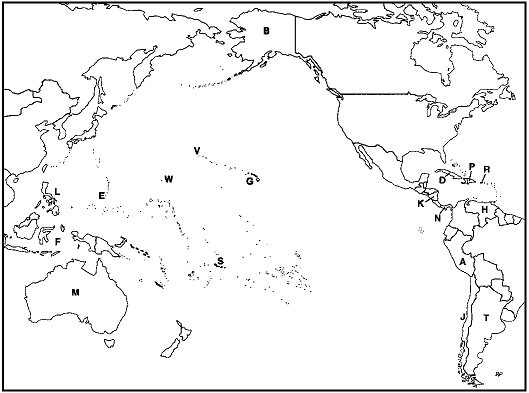 Samoa
Samoa (76) Instructions: Identify the following. Be as specific as possible, and include names, dates, and relevant facts as appropriate. Be sure to explain the significance of the person or term.
Benjamin Harrison
(95) Instructions: Identify the following. Be as specific as possible, and include names, dates, and relevant facts as appropriate. Be sure to explain the significance of the person or term.
Jacob Coxey
(80) Why was the 1896 presidential election a "watershed election"? Who were the main candidates, and what were the main issues? What was the outcome? Why? What were the implications for America's future?
(74) Instructions: Identify the following. Be as specific as possible, and include names, dates, and relevant facts as appropriate. Be sure to explain the significance of the person or term.
Panic of 1893 and Depression of 1893-1897
(87) Instructions: Identify the following. Be as specific as possible, and include names, dates, and relevant facts as appropriate. Be sure to explain the significance of the person or term.
P olitical machine, machine politics
(90) 
Filters
- Essay(0)
- Multiple Choice(0)
- Short Answer(0)
- True False(0)
- Matching(0)