



 Chat with AI
Exam 9: The Transformation of American Society


What caused the rise of industrialization?

 (87)
 Answered by Examlex AI Copilot
The rise of industrialization, which began in Great Britain in the late 18th century before spreading to other parts of the world, was the result of a confluence of several factors:
1. Agricultural Revolution: Improvements in agricultural practices in the 17th and 18th centuries increased food production, which allowed a surplus to feed a growing population and freed up many workers from the land. This surplus labor was essential for the workforce required in new factories.
2. Technological Innovations: The development of new technologies, such as the steam engine by James Watt and the spinning jenny by James Hargreaves, revolutionized production processes. These inventions greatly increased the efficiency and output of manufacturing, leading to the mechanization of industries.
3. Access to Raw Materials: The presence of abundant natural resources, particularly in Great Britain, such as coal and iron ore, provided the necessary raw materials for industrial production. These resources were crucial for powering steam engines and providing the material for constructing machines and infrastructure.
4. Financial Innovations: The establishment of a banking system and the expansion of financial markets facilitated the mobilization of capital for investment in industrial ventures. The development of the stock market and the availability of credit were important for funding new factories and machinery.
5. Transportation Infrastructure: The creation of a modern transportation infrastructure, including canals, improved roadways, and later, railways, allowed for the efficient movement of goods and resources. This reduced the cost of transportation and opened up wider markets for manufactured products.
6. Political Stability and Legal Framework: In Britain, a stable government and a legal framework that supported private property and entrepreneurship encouraged individuals to invest and innovate. The protection of patents, for example, allowed inventors to profit from their inventions.
7. Colonialism and Global Trade: The expansion of European empires provided access to vast markets and resources around the world. The global trade networks established during this period were instrumental in supplying raw materials and in creating demand for manufactured goods.
8. Urbanization: As industries grew, people moved from rural areas to cities in search of work. This urbanization created a concentrated labor force and increased demand for goods and services, further fueling industrial growth.
9. Cultural Factors: The Enlightenment and the Scientific Revolution fostered a culture of rationality, progress, and innovation. This intellectual climate encouraged experimentation and the pursuit of economic growth and efficiency.
10. Economic Theories and Policies: The rise of capitalism and the laissez-faire economic policies promoted by thinkers like Adam Smith encouraged competition and the pursuit of profit, which were key drivers of industrialization.
These factors combined to create an environment conducive to the rapid expansion of industrial production, which marked the beginning of the Industrial Revolution and fundamentally transformed societies around the world.
Canals were hugely expensive to build, and railroads were just around the corner. Reviewing the material in this chapter and in Chapter 11, what do you see as the advantages and disadvantages of investment in canals?
(71) Answered by Examlex AI CopilotThe advantages of investment in canals include the ability to transport goods and people efficiently over long distances, providing a reliable and cost-effective means of transportation. Canals also allowed for the development of new trade routes and the expansion of markets, leading to economic growth and development. Additionally, canals provided a source of employment for many people during their construction and operation.
However, there are also disadvantages to investing in canals. As mentioned, they were hugely expensive to build and required significant financial investment. Additionally, canals were limited in their ability to transport large quantities of goods and were often dependent on natural water sources, making them susceptible to droughts and other environmental factors. Furthermore, the rise of railroads posed a threat to the viability of canals as a primary mode of transportation, as railroads offered faster and more efficient transportation options.
In conclusion, while canals offered several advantages in terms of transportation and economic development, their high cost and limitations in comparison to emerging technologies like railroads made them a risky investment for many.
Instructions: Identify the following. Be as specific as possible, and include names, dates, and relevant facts as appropriate. Be sure to explain the significance of the person or term.
Market Economy
(82) Answered by Examlex AI CopilotA market economy is an economic system in which economic decisions and the pricing of goods and services are guided by the interactions of a country's individual citizens and businesses in a free market. In a market economy, the laws and forces of supply and demand are free from any intervention by a government, a price-setting monopoly, or other authority. It is the opposite of a planned economy, where investment and production decisions are embodied in a plan of production.
In a market economy, decisions on how resources are allocated are made through the voluntary exchange in markets. The fundamental principle is that the market, through the aggregate interactions of buyers and sellers, will determine the allocation of resources. This results in a dynamic efficiency, where resources flow to the most valued uses as determined by consumer preferences and willingness to pay.
Key characteristics of a market economy include:
1. Private Property: Individuals and businesses have the right to own property and use it according to their interests.
2. Freedom of Choice: Consumers are free to buy what they want with their income, and producers are free to decide what they want to sell and how they want to produce it.
3. Motive of Self-Interest: Economic agents operate based on their own self-interest, which drives them to seek the highest possible returns for their labor, capital, and resources.
4. Competition: Businesses compete with each other to sell products and services, which leads to innovation, efficient production, and reasonable prices.
5. Limited Government: The role of the government in a market economy is to enforce contracts, protect property rights, and maintain the rule of law, with minimal intervention in economic transactions.
The concept of a market economy is central to the field of economics and has been a driving force behind the economic development of many countries. The most famous advocate of the market economy was the 18th-century Scottish economist Adam Smith, who argued in his seminal work "The Wealth of Nations" (1776) that when individuals pursue their own self-interest under conditions of competition, the invisible hand of the market would guide resources to their most efficient uses.
The significance of a market economy lies in its ability to efficiently allocate resources, foster innovation, and provide a wide array of goods and services to consumers. However, market economies can also lead to economic inequalities, market failures, and sometimes do not provide goods and services that are socially beneficial. Therefore, most modern economies are mixed economies, incorporating elements of both market and planned economies to address these issues.
Instructions: Identify the following. Be as specific as possible, and include names, dates, and relevant facts as appropriate. Be sure to explain the significance of the person or term.
Erie Canal
(93) Which of the following changes in marriage patterns did not occur in the antebellum period?
(82) During the first half of the 1800s, free blacks in the North
(84) Describe working conditions in early American factories. Compare New York and Philadelphia factories with the Lowell and Waltham mills. How did workers react to the new factory system?
(85) Instructions: Identify the following. Be as specific as possible, and include names, dates, and relevant facts as appropriate. Be sure to explain the significance of the person or term.
Old Northwest, Old Southwest
(82) Instructions: Identify the following. Be as specific as possible, and include names, dates, and relevant facts as appropriate. Be sure to explain the significance of the person or term.
Cherokee Nation v. Georgia and Worcester v. Georgia
(65) Instructions: Identify the following. Be as specific as possible, and include names, dates, and relevant facts as appropriate. Be sure to explain the significance of the person or term.
Horizontal allegiances
(90) Instructions: Identify the following. Be as specific as possible, and include names, dates, and relevant facts as appropriate. Be sure to explain the significance of the person or term.
Lydia Sigourney, Letters to Mothers
(90) The Waltham and Lowell textile mills were more advanced than the mills established by Samuel Slater because they, unlike the Slater mills, produced
(87) Instructions: Identify the following. Be as specific as possible, and include names, dates, and relevant facts as appropriate. Be sure to explain the significance of the person or term.
Robert Fulton and the Clermont
(74) MAP QUESTIONS
Instructions: Choose the letter on the accompanying map of the eastern United States that correctly identifies each of the following:
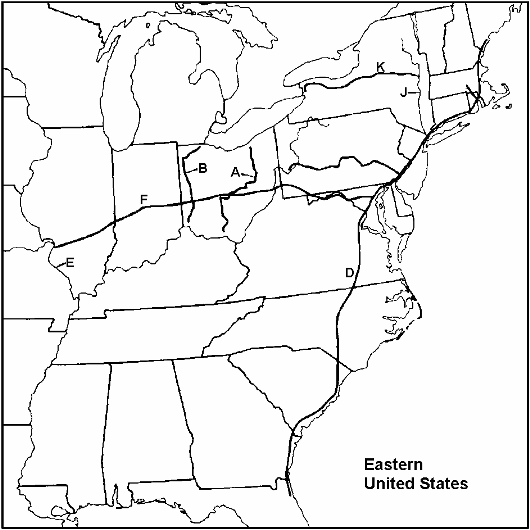 National (Cumberland) Road
 (82) The doctrine of "separate spheres" suggested that many Antebellum Americans believed that
(87) Why was Alexis de Tocqueville interested in visiting the United States?
(74) Instructions: Identify the following. Be as specific as possible, and include names, dates, and relevant facts as appropriate. Be sure to explain the significance of the person or term.
Panic of 1819
(78) What was the consequence of Indian resistance leader Black Hawk's confrontation with federal troops in 1832?
(79) What was one of the major changes that took place in American towns and cities between 1820 and 1860?
(80) 
Filters
- Essay(0)
- Multiple Choice(0)
- Short Answer(0)
- True False(0)
- Matching(0)