



 Chat with AI
Exam 26: The Cold War Abroad and at Home


Instructions: Identify the following. Be as specific as possible, and include names, dates, and relevant facts as appropriate. Be sure to explain the significance of the person or term.
George Kennan, Containment

 (93)
 Answered by Examlex AI Copilot
George Kennan was an American diplomat and historian who is best known for his role in developing the policy of containment during the Cold War. In 1946, Kennan, then serving as the Deputy Chief of Mission in Moscow, sent a telegram to the U.S. State Department outlining his views on the Soviet Union and the need for a policy of containment to prevent the spread of communism.
The policy of containment, as articulated by Kennan, called for the United States to resist the expansion of Soviet influence through diplomatic, economic, and, if necessary, military means. This approach became the cornerstone of U.S. foreign policy during the Cold War and shaped American actions in conflicts such as the Korean War and the Vietnam War.
Kennan's ideas had a significant impact on U.S. foreign policy and continue to be influential in discussions of international relations and diplomacy. His advocacy for containment helped to shape the United States' approach to the Soviet Union and communism, and his insights into the nature of Soviet power and ideology remain relevant to this day. George Kennan's contributions to the development of containment have had a lasting impact on U.S. foreign policy and the broader field of international relations.
In what ways does the postwar assault on domestic radicalism shed light on developments in American life today? How is it similar? How does it differ?
(95) Answered by Examlex AI CopilotThe postwar assault on domestic radicalism sheds light on developments in American life today in several ways. Firstly, it highlights the ongoing tension between national security concerns and civil liberties. The postwar era saw the rise of McCarthyism and the Red Scare, which led to the persecution of individuals suspected of being communist sympathizers. This period of fear and suspicion mirrors contemporary concerns about terrorism and the erosion of privacy rights in the name of national security.
Additionally, the postwar assault on domestic radicalism also sheds light on the persistence of political polarization and the demonization of ideological opponents. The McCarthy era was marked by intense political divisiveness and the vilification of anyone perceived as a threat to the status quo. This is reminiscent of the current political climate, where extreme partisanship and the dehumanization of political opponents have become increasingly common.
However, there are also significant differences between the postwar assault on domestic radicalism and developments in American life today. One key difference is the role of technology in shaping the current landscape. While the postwar era relied on traditional media and government propaganda to fuel the Red Scare, today's political discourse is heavily influenced by social media and the rapid spread of misinformation. This has led to new challenges in combating extremism and disinformation.
Furthermore, the targets of persecution have shifted in the modern era. While the postwar assault on domestic radicalism primarily targeted suspected communists, today's political climate has seen a rise in xenophobia and Islamophobia, with marginalized communities facing increased discrimination and surveillance.
In conclusion, the postwar assault on domestic radicalism sheds light on several parallels and differences in developments in American life today. The persistence of political polarization and the tension between national security and civil liberties remain consistent themes, but the role of technology and the shifting targets of persecution highlight the evolving nature of these challenges. Understanding these historical parallels and differences can provide valuable insights into addressing contemporary issues and promoting a more just and inclusive society.
Instructions: Choose the letter on the accompanying map of the Middle East that correctly identifies each of the following:
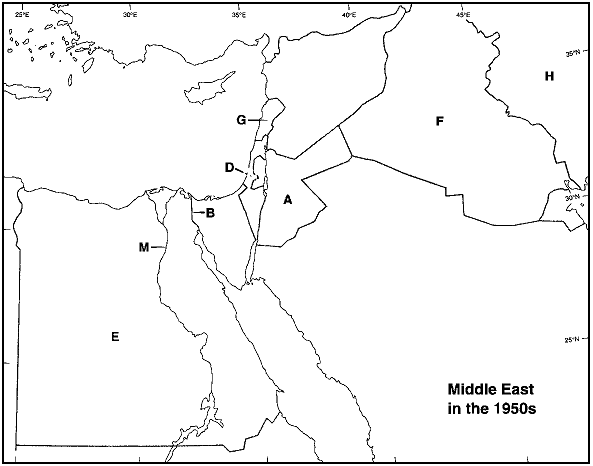 Suez Canal
 (87)  Verified
[B]
The 1947 Marshall Plan provided funding after World War II to help the recovery and rebuilding of
(77) What was the New Look policy? How effective was it in achieving President Dwight Eisenhower's military and foreign policy goals? Why or why not?
(80) Instructions: Identify the following. Be as specific as possible, and include names, dates, and relevant facts as appropriate. Be sure to explain the significance of the person or term.
Eisenhower Doctrine
(86) Instructions: Identify the following. Be as specific as possible, and include names, dates, and relevant facts as appropriate. Be sure to explain the significance of the person or term.
Hollywood Ten
(88) Instructions: Choose the letter on the accompanying map of the Middle East that correctly identifies each of the following:
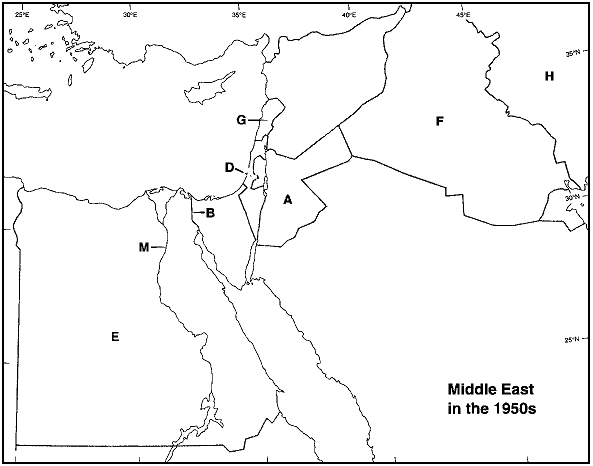 Iran
Iran (77) What was the impact of the investigations conducted by the Federal Employee Loyalty Program between 1947 and 1952?
(70) MAP QUESTIONS
Instructions: Choose the letter on the accompanying map of Europe and the Middle East that correctly identifies each of the following:
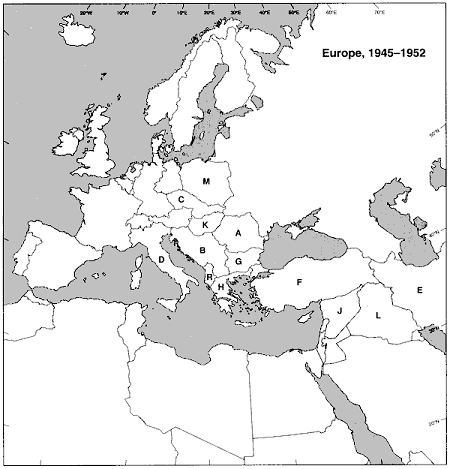 Poland
 (84) In what ways did the Second World War spur decolonization? Explain with examples.
(80) Instructions: Identify the following. Be as specific as possible, and include names, dates, and relevant facts as appropriate. Be sure to explain the significance of the person or term.
Joseph Stalin
(82) MAP QUESTIONS
Instructions: Choose the letter on the accompanying map of Europe and the Middle East that correctly identifies each of the following:
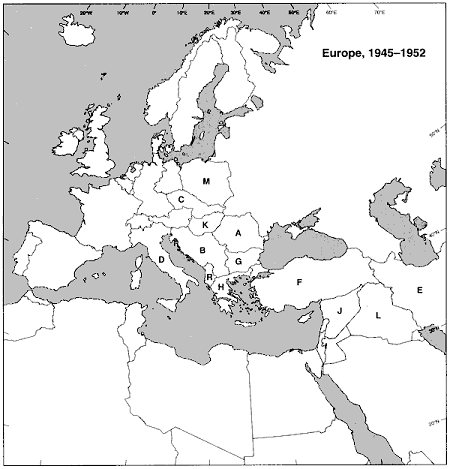 Romania
 (80) Instructions: Identify the following. Be as specific as possible, and include names, dates, and relevant facts as appropriate. Be sure to explain the significance of the person or term.
Central Intelligence Agency
(69) MAP QUESTIONS
Instructions: Choose the letter on the accompanying map of Europe and the Middle East that correctly identifies each of the following:
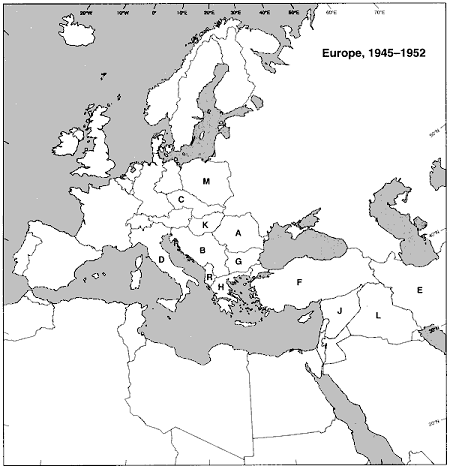 Greece
 (88) What were the issues and who were the personalities in the 1948 presidential elections? Explain the reasons for and impact of splinter parties in 1948. Why did Harry Truman ultimately win the election?
(82) What was the "containment policy"? How did the Truman administration implement it in Europe and in Asia?
(69) 
Filters
- Essay(0)
- Multiple Choice(0)
- Short Answer(0)
- True False(0)
- Matching(0)