



 Chat with AI
Exam 6: Atoms and Spectra

Exam 1: Here and Now53 Questions
Exam 2: A Users Guide to the Sky80 Questions
Exam 3: Cycles of the Sun and Moon116 Questions
Exam 4: The Origin of Modern Astronomy109 Questions
Exam 5: Light and Telescopes114 Questions
Exam 6: Atoms and Spectra82 Questions
Exam 7: The Sun101 Questions
Exam 8: The Family of Stars133 Questions
Exam 9: The Formation and Structure of Stars91 Questions
Exam 10: The Deaths of Stars115 Questions
Exam 11: Neutron Stars and Black Holes70 Questions
Exam 12: The Milky Way Galaxy79 Questions
Exam 13: Galaxies: Normal and Active143 Questions
Exam 14: Modern Cosmology73 Questions
Exam 15: The Origin of the Solar System77 Questions
Exam 16: Earth and Moon: Bases for Comparative Planetology74 Questions
Exam 17: Mercury, Venus and Mars80 Questions
Exam 18: The Outer Solar System103 Questions
Exam 19: Meteorites, Asteroids, and Comets67 Questions
Exam 20: Astrobiology: Life on Other Worlds54 Questions
Select questions type


The H line has a wavelength of 410.2 nm when observed in the laboratory. If the H line appears in a stars spectrum at 410.0 nm, what is the radial velocity of the star?
(Multiple Choice)
5.0/5  (85)
(85) If a light-emitting object is moving away from you, you observe its wavelengths to be ________ its wavelengths if it were at rest.
(Multiple Choice)
4.9/5 (80)
(80) ____ has a negative charge and a mass about 1800 times smaller than a proton.
(Multiple Choice)
4.9/5 (70)
(70) The H line has a wavelength of 434.0 nm when observed in the laboratory. If the H line appears in a stars spectrum at 434.5 nm, what is the radial velocity of the star?
(Multiple Choice)
4.9/5 (76)
(76) If you move an electron in an atom from a low energy level to a higher energy level within the atom, we say that the atom is
(Multiple Choice)
4.8/5 (76)
(76) The number of ____ in the nucleus determines what element the nucleus is.
(Multiple Choice)
4.9/5 (62)
(62) The process of removing an electron from a stable nucleus is known as
(Multiple Choice)
4.8/5 (79)
(79) The most massive part of the atom is(are) the ____ which has(have) a ____ charge.
(Multiple Choice)
5.0/5 (79)
(79) The ____ of a gas is a measure of the average speed of the particles (atoms or molecules) in the gas.
(Multiple Choice)
4.9/5 (88)
(88) Suppose the laboratory wavelength of a spectral line is 600 nm. In a star it is measured to be 599.4 nm. Is the star moving toward or away from us, relative to the line of sight? How fast is it moving? (Hint: c = 300,000 km/s)
(Multiple Choice)
4.9/5 (78)
(78) The radiation emitted from a star has a maximum intensity at a wavelength of 500 nm. What is the temperature of this star?
(Multiple Choice)
4.8/5 (75)
(75) A very bright UFO is seen near the moon's orbit. An astronomer takes a spectrum of it and discovers it has a bright line spectrum on a dark background. The earth's population is near panic when the astronomer announces the UFO is
(Multiple Choice)
4.8/5 (77)
(77) Which one of the hydrogen atoms below is EMITTING light at a wavelength in the Balmer series?
(Multiple Choice)
5.0/5 (85)
(85) The Doppler effect is sensitive only to motion along the line of sight.
(True/False)
4.9/5 (83)
(83) Diagram 6-1 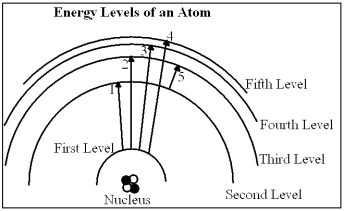 -In Diagram 6-1, which of the transitions would absorb a photon with the greatest energy?
 (Multiple Choice)
4.9/5 (75)
(75) An atom is ionized if one of its electrons jumps to a higher energy level in the atom.
(True/False)
4.8/5 (89)
(89) The Doppler effect states that the motion of any object can
(Multiple Choice)
4.8/5 (71)
(71) 
Filters
- Essay(0)
- Multiple Choice(0)
- Short Answer(0)
- True False(0)
- Matching(0)