



 Chat with AI
Exam 6: Atoms and Spectra

Exam 1: Here and Now53 Questions
Exam 2: A Users Guide to the Sky80 Questions
Exam 3: Cycles of the Sun and Moon116 Questions
Exam 4: The Origin of Modern Astronomy109 Questions
Exam 5: Light and Telescopes114 Questions
Exam 6: Atoms and Spectra82 Questions
Exam 7: The Sun101 Questions
Exam 8: The Family of Stars133 Questions
Exam 9: The Formation and Structure of Stars91 Questions
Exam 10: The Deaths of Stars115 Questions
Exam 11: Neutron Stars and Black Holes70 Questions
Exam 12: The Milky Way Galaxy79 Questions
Exam 13: Galaxies: Normal and Active143 Questions
Exam 14: Modern Cosmology73 Questions
Exam 15: The Origin of the Solar System77 Questions
Exam 16: Earth and Moon: Bases for Comparative Planetology74 Questions
Exam 17: Mercury, Venus and Mars80 Questions
Exam 18: The Outer Solar System103 Questions
Exam 19: Meteorites, Asteroids, and Comets67 Questions
Exam 20: Astrobiology: Life on Other Worlds54 Questions
Select questions type


The process of removing an electron from a stable nucleus is known as ____________________.

Free
(Short Answer)
4.9/5  (70)
(70) Correct Answer: Verified
ionization
Figure 6-1 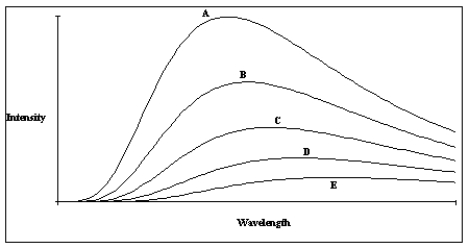 -A plot of the continuous spectra of five different stars is shown in Figure 6-1. Based on these spectra, which of the stars has the lowest temperature?
Free
(Multiple Choice)
4.7/5 (71)
(71) Correct Answer:Verified
VerifiedE
The temperature of an object from which no heat energy can be extracted is
Free
(Multiple Choice)
4.8/5 (77)
(77) Correct Answer:Verified
VerifiedC
Diagram 6-2 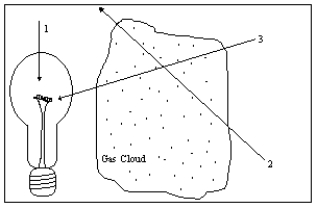 -Diagram 6-2 illustrates a light source, a gas cloud, and three different lines of sight. Along which line of sight would an observer see an absorption spectrum?
 (Multiple Choice)
4.8/5 (77)
(77) The binding energy of the first level in an atom is 2.2*10-18 J, and the binding energy of the second energy level is 1.6*10-18 J. What is the energy of the photon that is emitted if an electron moves from the second level to the first?
(Multiple Choice)
4.9/5 (73)
(73) The ____________________ of a star can be determined from its color.
(Short Answer)
4.9/5 (69)
(69) Two white dwarf stars are the same size, but one has a surface temperature twice as hot as the other. The hotter star will radiate
(Multiple Choice)
4.9/5 (78)
(78) Atoms that have the same number of protons but a different number of neutrons are called
(Multiple Choice)
4.9/5 (79)
(79) Which of the following cannot be determined from the spectrum of a star?
(Multiple Choice)
4.9/5 (69)
(69) If one star has a temperature of 4000 K and another star has a temperature of 40,000 K, how much more energy per second will the hotter star radiate from each square meter of its surface? ____________________
(Short Answer)
4.9/5 (66)
(66) ____ is a set of rules that describes how atoms and subatomic particles behave.
(Multiple Choice)
4.8/5 (89)
(89) The radiation emitted from a star has a maximum intensity at a wavelength of 300 nm. What is the temperature of this star?
(Multiple Choice)
4.9/5 (84)
(84) Which one of the hydrogen atoms below is EMITTING light? The electron jumps from the
(Multiple Choice)
4.8/5 (67)
(67) Which of the following is not a fundamental component of the atom?
(Multiple Choice)
4.8/5 (68)
(68) Why should photons emitted by a hotter gas have, on average, shorter wavelengths than photons emitted by a cooler gas?
(Not Answered)
This question doesn't have any answer yet
The sun has a surface temperature of approximately 5800 K. At what wavelength does the maximum energy radiated by the sun occur?
(Multiple Choice)
4.8/5 (82)
(82) 
Filters
- Essay(0)
- Multiple Choice(0)
- Short Answer(0)
- True False(0)
- Matching(0)