



 Chat with AI
Exam 6: Atoms and Spectra

Exam 1: Here and Now53 Questions
Exam 2: A Users Guide to the Sky80 Questions
Exam 3: Cycles of the Sun and Moon116 Questions
Exam 4: The Origin of Modern Astronomy109 Questions
Exam 5: Light and Telescopes114 Questions
Exam 6: Atoms and Spectra82 Questions
Exam 7: The Sun101 Questions
Exam 8: The Family of Stars133 Questions
Exam 9: The Formation and Structure of Stars91 Questions
Exam 10: The Deaths of Stars115 Questions
Exam 11: Neutron Stars and Black Holes70 Questions
Exam 12: The Milky Way Galaxy79 Questions
Exam 13: Galaxies: Normal and Active143 Questions
Exam 14: Modern Cosmology73 Questions
Exam 15: The Origin of the Solar System77 Questions
Exam 16: Earth and Moon: Bases for Comparative Planetology74 Questions
Exam 17: Mercury, Venus and Mars80 Questions
Exam 18: The Outer Solar System103 Questions
Exam 19: Meteorites, Asteroids, and Comets67 Questions
Exam 20: Astrobiology: Life on Other Worlds54 Questions
Select questions type


Figure 6-1 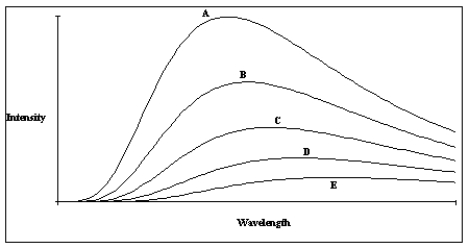 -A plot of the continuous spectra of five different stars is shown in Figure 6-1. Based on these spectra, which of the stars is the hottest?
 (Multiple Choice)
4.7/5  (77)
(77) Describe two ways in which an atom can be excited.
(Not Answered)
This question doesn't have any answer yet
The peak wavelength in the continuous emission spectrum of a body is inversely proportional to its ____________________.
(Short Answer)
4.9/5 (81)
(81) Blue stars emit most of their energy at shorter wavelengths than red stars..
(True/False)
4.8/5 (90)
(90) One star has a temperature of 30,000 K and another star has a temperature of 6,000 K. Compared to the cooler star, how much more energy per second will the hotter star radiate from each square meter of its surface?
(Multiple Choice)
4.8/5 (79)
(79) In the diagram below, draw the transition that would emit a photon with the smallest wavelength. 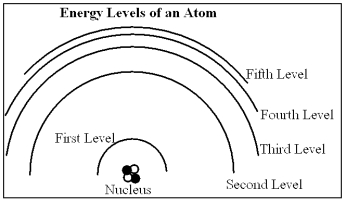
(Short Answer)
4.9/5 (87)
(87) One star has a temperature of 10,000 K and another star has a temperature of 5,000 K. Compared to the cooler star, how much more energy per second will the hotter star radiate from each square meter of its surface?
(Multiple Choice)
4.8/5 (80)
(80) At what wavelength would a star radiate the greatest amount of energy if the star has a surface temperature of 60,000 K?
(Multiple Choice)
4.8/5 (93)
(93) Hydrogen lines are weak in the spectra of hot stars because many of the hydrogen atoms are ionized.
(True/False)
4.7/5 (60)
(60) The ____ is responsible for binding the electrons to the nucleus.
(Multiple Choice)
4.7/5 (79)
(79) What would the spectrum of hydrogen look like if we could see into the ultraviolet?
(Not Answered)
This question doesn't have any answer yet
The wavelength of the hydrogen line from level 1 to level 2 in a hot star is ____________ the wavelength of the same line in a cool star. The stars have the same radial velocities away from Earth.
(Multiple Choice)
4.8/5 (72)
(72) You are standing near a railroad track and a train is moving toward you at 60 mph and blowing its horn. What will you notice as the train moves past you?
(Multiple Choice)
4.9/5 (68)
(68) 
Filters
- Essay(0)
- Multiple Choice(0)
- Short Answer(0)
- True False(0)
- Matching(0)