



 Chat with AI
Exam 8: The Family of Stars

Exam 1: Here and Now53 Questions
Exam 2: A Users Guide to the Sky80 Questions
Exam 3: Cycles of the Sun and Moon116 Questions
Exam 4: The Origin of Modern Astronomy109 Questions
Exam 5: Light and Telescopes114 Questions
Exam 6: Atoms and Spectra82 Questions
Exam 7: The Sun101 Questions
Exam 8: The Family of Stars133 Questions
Exam 9: The Formation and Structure of Stars91 Questions
Exam 10: The Deaths of Stars115 Questions
Exam 11: Neutron Stars and Black Holes70 Questions
Exam 12: The Milky Way Galaxy79 Questions
Exam 13: Galaxies: Normal and Active143 Questions
Exam 14: Modern Cosmology73 Questions
Exam 15: The Origin of the Solar System77 Questions
Exam 16: Earth and Moon: Bases for Comparative Planetology74 Questions
Exam 17: Mercury, Venus and Mars80 Questions
Exam 18: The Outer Solar System103 Questions
Exam 19: Meteorites, Asteroids, and Comets67 Questions
Exam 20: Astrobiology: Life on Other Worlds54 Questions
Select questions type


If a star is twice as hot as the sun and only half the sun's diameter, it will be less luminous than the sun.

Free
(True/False)
4.9/5  (95)
(95) Correct Answer: Verified
False
The absorption lines in the ultraviolet portion of the spectrum of a star that are produced by hydrogen are from the
Free
(Multiple Choice)
4.9/5 (79)
(79) Correct Answer:Verified
VerifiedA
Luminosity class IV objects are known as ____________________.
Free
(Short Answer)
5.0/5 (70)
(70) Correct Answer:Verified
Verifiedsubgiants
What is the most common kind of star? What measurements must be made to discover this information?
(Short Answer)
4.9/5 (93)
(93) The location of a star in the H-R diagram indicates its temperature and intrinsic brightness.
(True/False)
4.9/5 (65)
(65) The two stars near one another are shown. Positions of one member are shown relative to the other star at different times. From plots like this one, astronomers conclude that 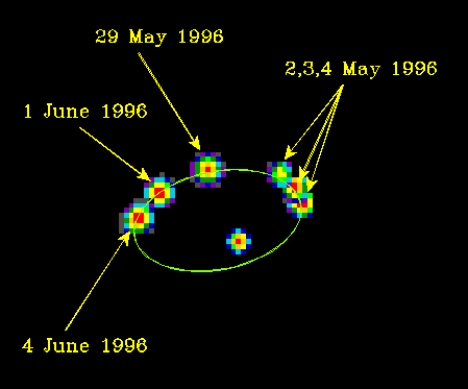
(Multiple Choice)
4.7/5 (95)
(95) Spectroscopic and eclipse duration observations of an eclipsing binary star can enable astronomers to calculate____ of its individual stars.
(Multiple Choice)
4.9/5 (85)
(85) Which are the most common stars, massive stars or low-mass stars (relative to the sun)? High luminosity or low luminosity (relative to the sun)?
(Short Answer)
4.9/5 (66)
(66) Why would parallaxes be easier to observe if Earth were farther from the sun?
(Short Answer)
4.8/5 (63)
(63) Why don't we see hydrogen Balmer lines in the spectra of stars with temperatures of 45,000 K?
(Multiple Choice)
4.9/5 (93)
(93) Explain why the presence of spectral lines of a given element in the solar spectrum tells us that element is present in the sun, but the absence of the lines would not mean the element was absent from the sun?
(Essay)
4.9/5 (76)
(76) The spectra of the coolest stars contain strong absorption features (or lines) of
(Multiple Choice)
4.9/5 (74)
(74) When we see a binary system producing eclipses, we know that the orbit is nearly edge-on.
(True/False)
4.9/5 (73)
(73) Which one of the methods below enables astronomers to measure the distance of a star near the sun in our galaxy?
(Multiple Choice)
5.0/5 (82)
(82) What measurements are needed to determine the orbital motion of a spectroscopic binary star?
(Not Answered)
This question doesn't have any answer yet

Filters
- Essay(0)
- Multiple Choice(0)
- Short Answer(0)
- True False(0)
- Matching(0)