



 Chat with AI
Exam 8: The Family of Stars

Exam 1: Here and Now53 Questions
Exam 2: A Users Guide to the Sky80 Questions
Exam 3: Cycles of the Sun and Moon116 Questions
Exam 4: The Origin of Modern Astronomy109 Questions
Exam 5: Light and Telescopes114 Questions
Exam 6: Atoms and Spectra82 Questions
Exam 7: The Sun101 Questions
Exam 8: The Family of Stars133 Questions
Exam 9: The Formation and Structure of Stars91 Questions
Exam 10: The Deaths of Stars115 Questions
Exam 11: Neutron Stars and Black Holes70 Questions
Exam 12: The Milky Way Galaxy79 Questions
Exam 13: Galaxies: Normal and Active143 Questions
Exam 14: Modern Cosmology73 Questions
Exam 15: The Origin of the Solar System77 Questions
Exam 16: Earth and Moon: Bases for Comparative Planetology74 Questions
Exam 17: Mercury, Venus and Mars80 Questions
Exam 18: The Outer Solar System103 Questions
Exam 19: Meteorites, Asteroids, and Comets67 Questions
Exam 20: Astrobiology: Life on Other Worlds54 Questions
Select questions type


The diagram below illustrates two stars in a visual binary system and the center of mass of this system. Based on this diagram, what is the ratio of the mass of star A to the mass of star B? 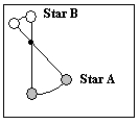
(Multiple Choice)
4.8/5  (90)
(90) Hydrogen lines are weak in the spectra of hot stars because many of the hydrogen atoms have their electrons in levels above the second level.
(True/False)
4.8/5 (71)
(71) On the H-R diagram, lines of constant radius slants down from left to right.
(True/False)
4.9/5 (66)
(66) 
Below is a radial velocity curve for a spectroscopic binary. Which of the stars is most massive? ____________________ 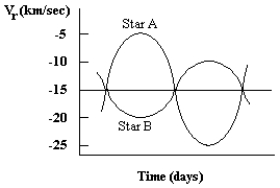
(Short Answer)
4.7/5 (85)
(85) The method of spectroscopic parallax cannot be applied to stars beyond about 100 pc.
(True/False)
4.8/5 (70)
(70) Table 8-1
Use the chart below to answer the following question(s).
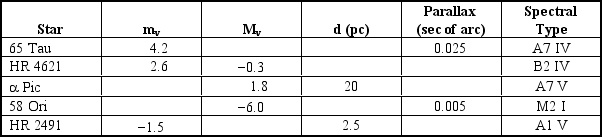 -From the data given, which star in Table 8-1 would appear the faintest in the night sky?
 (Multiple Choice)
4.9/5 (77)
(77) In the list below, the LEAST common stars in our sun's neighborhood are
(Multiple Choice)
4.8/5 (91)
(91) Table 8-2
Use the chart below to answer the following question(s).
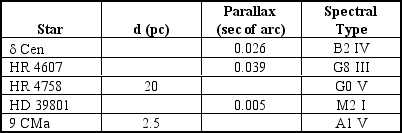 -Which star in Table 8-2 is the closest to Earth?
 (Multiple Choice)
4.8/5 (86)
(86) An eclipsing binary has been analyzed and it has been determined that the ratio of the mass of star A to the mass of star B is 6 and the total mass of the two stars is 26 solar masses. What are the masses of star A and star B?
(Multiple Choice)
4.7/5 (88)
(88) If a binary system has a period of 4 years and a separation of 5 AU, then the total mass is 7.8 solar masses.
(True/False)
4.8/5 (80)
(80) Why do molecular bands only occur in the spectra of the coolest stars?
(Not Answered)
This question doesn't have any answer yet
A G2 I star is ____________________ in diameter and ____________________ luminous than the sun.
(Short Answer)
4.9/5 (77)
(77) If a star's spectrum does not contain spectral lines characteristic of a certain element, can we conclude that the star does not contain that element? Why or why not?
(Not Answered)
This question doesn't have any answer yet
Table 8-2
Use the chart below to answer the following question(s).
-Which star in Table 8-2 has the greatest diameter?
-Which star in Table 8-2 has the greatest diameter? (Multiple Choice)
4.8/5 (69)
(69) Why is spectroscopy of binary stars such an important aspect of astronomy?
(Short Answer)
4.9/5 (77)
(77) What information can we get from eclipsing binaries that we cannot get from visual binaries?
(Not Answered)
This question doesn't have any answer yet

Filters
- Essay(0)
- Multiple Choice(0)
- Short Answer(0)
- True False(0)
- Matching(0)