



 Chat with AI
Exam 8: The Family of Stars

Exam 1: Here and Now53 Questions
Exam 2: A Users Guide to the Sky80 Questions
Exam 3: Cycles of the Sun and Moon116 Questions
Exam 4: The Origin of Modern Astronomy109 Questions
Exam 5: Light and Telescopes114 Questions
Exam 6: Atoms and Spectra82 Questions
Exam 7: The Sun101 Questions
Exam 8: The Family of Stars133 Questions
Exam 9: The Formation and Structure of Stars91 Questions
Exam 10: The Deaths of Stars115 Questions
Exam 11: Neutron Stars and Black Holes70 Questions
Exam 12: The Milky Way Galaxy79 Questions
Exam 13: Galaxies: Normal and Active143 Questions
Exam 14: Modern Cosmology73 Questions
Exam 15: The Origin of the Solar System77 Questions
Exam 16: Earth and Moon: Bases for Comparative Planetology74 Questions
Exam 17: Mercury, Venus and Mars80 Questions
Exam 18: The Outer Solar System103 Questions
Exam 19: Meteorites, Asteroids, and Comets67 Questions
Exam 20: Astrobiology: Life on Other Worlds54 Questions
Select questions type


For what kinds of stars are the masses of stars in the H-R diagram "orderly"? For what kinds of stars are they disorderly? In other words, could you guess the mass of a star from its location (luminosity, temperature) on the H-R diagram?
(Not Answered)
This question doesn't have any answer yet
We can find the masses and diameters of stars that are in eclipsing binary systems.
(True/False)
5.0/5  (88)
(88) Diagram 8-1
Use the H-R diagram below to answer the following question(s). 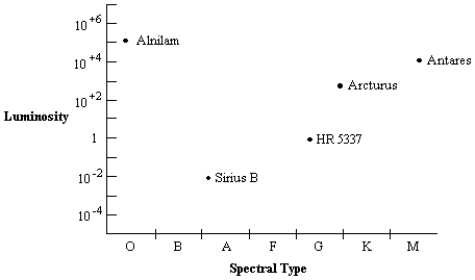 -Which of the stars in Diagram 8-1 has the largest absolute visual magnitude?
 (Multiple Choice)
5.0/5 (93)
(93) From the mass-luminosity relation, a 2-solar-mass star on the main sequence would have a luminosity of approximately ____ solar luminosities.
(Multiple Choice)
4.8/5 (99)
(99) The ____ of a star is a measure of the total energy radiated by the star in one second.
(Multiple Choice)
4.8/5 (98)
(98) To observe a spectroscopic binary, we must be able to see both stars individually.
(True/False)
4.8/5 (79)
(79) How do humans use their eyes to measure relative distance by parallax?
(Multiple Choice)
4.7/5 (74)
(74) The absorption lines in the infrared portion of the spectrum of a star that are produced by hydrogen are from the
(Multiple Choice)
4.7/5 (71)
(71) How does an H-R diagram make it clear that giant stars are larger than main-sequence stars of the same temperature?
(Not Answered)
This question doesn't have any answer yet
Stars in the upper right part of the Hertzsprung-Russell diagram are always ____ when compared to stars near the middle of the diagram.
(Multiple Choice)
4.9/5 (70)
(70) The absorption lines in the visible portion of the spectrum of a star that are produced by hydrogen are from the
(Multiple Choice)
4.8/5 (87)
(87) Why are the Balmer lines weak in the spectra of hot and cool stars, but strong in the spectra of intermediate-temperature stars?
(Not Answered)
This question doesn't have any answer yet
What information about orbital inclination can we get from visual binaries, spectroscopic binaries, and eclipsing binaries?
(Not Answered)
This question doesn't have any answer yet
Five stars and their spectral types are given below. Which star would have the lowest surface temperature?
(Multiple Choice)
4.8/5 (74)
(74) Table 8-1
Use the chart below to answer the following question(s).
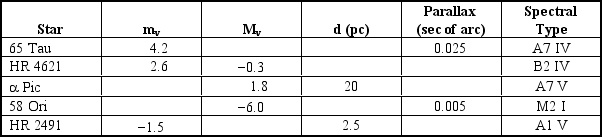 -From the data given,, which star in Table 8-1 has the greatest surface temperature?
 (Multiple Choice)
4.7/5 (81)
(81) Which stars always have large positive absolute magnitude?
(Multiple Choice)
4.7/5 (81)
(81) To determine the orbital period of a visual binary, we must measure
(Multiple Choice)
5.0/5 (73)
(73) What would the spectrum of hydrogen look like if we could see into the ultraviolet?
(Not Answered)
This question doesn't have any answer yet
How does absolute visual magnitude tell us the intrinsic brightness of a star?
(Not Answered)
This question doesn't have any answer yet

Filters
- Essay(0)
- Multiple Choice(0)
- Short Answer(0)
- True False(0)
- Matching(0)