



 Chat with AI
Exam 6: Atoms and Spectra

Exam 1: Here and Now53 Questions
Exam 2: A Users Guide to the Sky80 Questions
Exam 3: Cycles of the Sun and Moon116 Questions
Exam 4: The Origin of Modern Astronomy109 Questions
Exam 5: Light and Telescopes114 Questions
Exam 6: Atoms and Spectra82 Questions
Exam 7: The Sun101 Questions
Exam 8: The Family of Stars133 Questions
Exam 9: The Formation and Structure of Stars91 Questions
Exam 10: The Deaths of Stars115 Questions
Exam 11: Neutron Stars and Black Holes70 Questions
Exam 12: The Milky Way Galaxy79 Questions
Exam 13: Galaxies: Normal and Active143 Questions
Exam 14: Modern Cosmology73 Questions
Exam 15: The Origin of the Solar System77 Questions
Exam 16: Earth and Moon: Bases for Comparative Planetology74 Questions
Exam 17: Mercury, Venus and Mars80 Questions
Exam 18: The Outer Solar System103 Questions
Exam 19: Meteorites, Asteroids, and Comets67 Questions
Exam 20: Astrobiology: Life on Other Worlds54 Questions
Select questions type


When the electrons in an atom are in their lowest possible energy levels, the atom is said to be in its ____________________ state.
(Short Answer)
4.9/5  (75)
(75) A(n) ____ contains two or more atoms that are bound together by exchanging or sharing electrons with each other.
(Multiple Choice)
4.8/5 (73)
(73) At what wavelength would a star radiate the greatest amount of energy if the star has a surface temperature of 10,000 K?
(Multiple Choice)
4.8/5 (73)
(73) Diagram 6-2 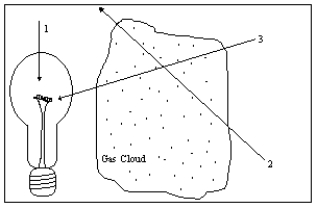 -Diagram 6-2 illustrates a light source, a gas cloud, and three different lines of sight. Along which line of sight would an observer see an emission spectrum?
 (Multiple Choice)
4.9/5 (67)
(67) Diagram 6-2
-Diagram 6-2 illustrates a light source, a gas cloud, and three different lines of sight. Along which line of sight would an observer see a continuous spectrum?
-Diagram 6-2 illustrates a light source, a gas cloud, and three different lines of sight. Along which line of sight would an observer see a continuous spectrum? (Multiple Choice)
4.8/5 (77)
(77) Which of the following can be determined by using the Doppler effect? 
(Multiple Choice)
4.8/5 (68)
(68) Earth's atmosphere blocks most forms of electromagnetic radiation from entering except for ____________________ and ____________________.
(Short Answer)
4.9/5 (61)
(61) Diagram 6-1 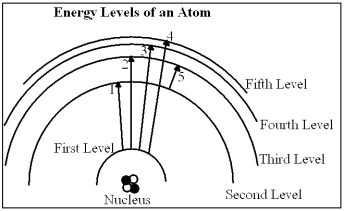 -In Diagram 6-1, which of the transitions would absorb a photon with the smallest energy?
 (Multiple Choice)
4.9/5 (77)
(77) How much energy is radiated each second by one square meter of a star whose temperature is 10,000 K? Note: in the Stefan-Boltzmann law is equal to 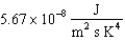 .
. (Multiple Choice)
4.8/5 (85)
(85) ____________________ is a measure of the amount of energy due to the motion of the particles in a gas, liquid, or solid.
(Short Answer)
4.8/5 (68)
(68) Describe the appearance of each of the three types of spectra described by Kirchhoff's laws. Describe how each of the three types of spectra is formed.
(Not Answered)
This question doesn't have any answer yet
The process of making an electron less tightly bound to an atom's nucleus is known as
(Multiple Choice)
4.9/5 (73)
(73) The figure shows a color image of Betelgeuse, a red giant star. Which of the surface temperatures below best matches Betelgeuse's surface temperature? Hint: Our sun at 6000 K is yellow. 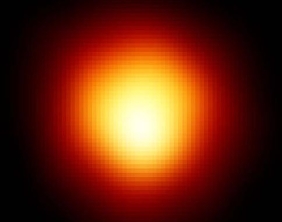
(Multiple Choice)
4.9/5 (72)
(72) What is the order of star colors with increasing temperature?
(Multiple Choice)
4.7/5 (74)
(74) 
Filters
- Essay(0)
- Multiple Choice(0)
- Short Answer(0)
- True False(0)
- Matching(0)