
Exam 6: The Trigonometric Functions

arrow
  • Select Tags
search iconSearch Question
flashcardsStudy Flashcards
  • Select Tags

The popular biorhythm theory uses the graphs of three simple sine functions to make predictions about an individual's physical, emotional, and intellectual potential for a particular day. The graphs are given by The popular biorhythm theory uses the graphs of three simple sine functions to make predictions about an individual's physical, emotional, and intellectual potential for a particular day. The graphs are given by   with t in days and t = 0 corresponding to birth. Find the value of b for the physical cycle, which has a period of 23 days. with t in days and t = 0 corresponding to birth. Find the value of b for the physical cycle, which has a period of 23 days.

(Multiple Choice)
4.9/5
(65)

Radio stations often have more than one broadcasting tower because federal guidelines do not usually permit a radio station to broadcast its signal in all directions with equal power. Since radio waves can travel over long distances, it is important to control their directional patterns so that radio stations do not interfere with one another. Suppose that a radio station has two broadcasting towers located along a north-south line, as shown in the figure. If the radio station is broadcasting at a wavelength Radio stations often have more than one broadcasting tower because federal guidelines do not usually permit a radio station to broadcast its signal in all directions with equal power. Since radio waves can travel over long distances, it is important to control their directional patterns so that radio stations do not interfere with one another. Suppose that a radio station has two broadcasting towers located along a north-south line, as shown in the figure. If the radio station is broadcasting at a wavelength   and the distance between the two radio towers is equal to   , then the intensity I of the signal in the direction   is given by   where I<sub> o </sub> is the maximum intensity.   Approximate I in terms of I<sub> o </sub> for   . and the distance between the two radio towers is equal to Radio stations often have more than one broadcasting tower because federal guidelines do not usually permit a radio station to broadcast its signal in all directions with equal power. Since radio waves can travel over long distances, it is important to control their directional patterns so that radio stations do not interfere with one another. Suppose that a radio station has two broadcasting towers located along a north-south line, as shown in the figure. If the radio station is broadcasting at a wavelength   and the distance between the two radio towers is equal to   , then the intensity I of the signal in the direction   is given by   where I<sub> o </sub> is the maximum intensity.   Approximate I in terms of I<sub> o </sub> for   . , then the intensity I of the signal in the direction Radio stations often have more than one broadcasting tower because federal guidelines do not usually permit a radio station to broadcast its signal in all directions with equal power. Since radio waves can travel over long distances, it is important to control their directional patterns so that radio stations do not interfere with one another. Suppose that a radio station has two broadcasting towers located along a north-south line, as shown in the figure. If the radio station is broadcasting at a wavelength   and the distance between the two radio towers is equal to   , then the intensity I of the signal in the direction   is given by   where I<sub> o </sub> is the maximum intensity.   Approximate I in terms of I<sub> o </sub> for   . is given by Radio stations often have more than one broadcasting tower because federal guidelines do not usually permit a radio station to broadcast its signal in all directions with equal power. Since radio waves can travel over long distances, it is important to control their directional patterns so that radio stations do not interfere with one another. Suppose that a radio station has two broadcasting towers located along a north-south line, as shown in the figure. If the radio station is broadcasting at a wavelength   and the distance between the two radio towers is equal to   , then the intensity I of the signal in the direction   is given by   where I<sub> o </sub> is the maximum intensity.   Approximate I in terms of I<sub> o </sub> for   . where I o is the maximum intensity. Radio stations often have more than one broadcasting tower because federal guidelines do not usually permit a radio station to broadcast its signal in all directions with equal power. Since radio waves can travel over long distances, it is important to control their directional patterns so that radio stations do not interfere with one another. Suppose that a radio station has two broadcasting towers located along a north-south line, as shown in the figure. If the radio station is broadcasting at a wavelength   and the distance between the two radio towers is equal to   , then the intensity I of the signal in the direction   is given by   where I<sub> o </sub> is the maximum intensity.   Approximate I in terms of I<sub> o </sub> for   . Approximate I in terms of I o for Radio stations often have more than one broadcasting tower because federal guidelines do not usually permit a radio station to broadcast its signal in all directions with equal power. Since radio waves can travel over long distances, it is important to control their directional patterns so that radio stations do not interfere with one another. Suppose that a radio station has two broadcasting towers located along a north-south line, as shown in the figure. If the radio station is broadcasting at a wavelength   and the distance between the two radio towers is equal to   , then the intensity I of the signal in the direction   is given by   where I<sub> o </sub> is the maximum intensity.   Approximate I in terms of I<sub> o </sub> for   . .

(Multiple Choice)
4.9/5
(80)

Radio stations often have more than one broadcasting tower because federal guidelines do not usually permit a radio station to broadcast its signal in all directions with equal power. Since radio waves can travel over long distances, it is important to control their directional patterns so that radio stations do not interfere with one another. Suppose that a radio station has two broadcasting towers located along a north-south line, as shown in the figure. If the radio station is broadcasting at a wavelength Radio stations often have more than one broadcasting tower because federal guidelines do not usually permit a radio station to broadcast its signal in all directions with equal power. Since radio waves can travel over long distances, it is important to control their directional patterns so that radio stations do not interfere with one another. Suppose that a radio station has two broadcasting towers located along a north-south line, as shown in the figure. If the radio station is broadcasting at a wavelength   and the distance between the two radio towers is equal to   , then the intensity I of the signal in the direction   is given by   where I<sub> o </sub> is the maximum intensity.   Approximate I in terms of I<sub> o </sub> for   . and the distance between the two radio towers is equal to Radio stations often have more than one broadcasting tower because federal guidelines do not usually permit a radio station to broadcast its signal in all directions with equal power. Since radio waves can travel over long distances, it is important to control their directional patterns so that radio stations do not interfere with one another. Suppose that a radio station has two broadcasting towers located along a north-south line, as shown in the figure. If the radio station is broadcasting at a wavelength   and the distance between the two radio towers is equal to   , then the intensity I of the signal in the direction   is given by   where I<sub> o </sub> is the maximum intensity.   Approximate I in terms of I<sub> o </sub> for   . , then the intensity I of the signal in the direction Radio stations often have more than one broadcasting tower because federal guidelines do not usually permit a radio station to broadcast its signal in all directions with equal power. Since radio waves can travel over long distances, it is important to control their directional patterns so that radio stations do not interfere with one another. Suppose that a radio station has two broadcasting towers located along a north-south line, as shown in the figure. If the radio station is broadcasting at a wavelength   and the distance between the two radio towers is equal to   , then the intensity I of the signal in the direction   is given by   where I<sub> o </sub> is the maximum intensity.   Approximate I in terms of I<sub> o </sub> for   . is given by Radio stations often have more than one broadcasting tower because federal guidelines do not usually permit a radio station to broadcast its signal in all directions with equal power. Since radio waves can travel over long distances, it is important to control their directional patterns so that radio stations do not interfere with one another. Suppose that a radio station has two broadcasting towers located along a north-south line, as shown in the figure. If the radio station is broadcasting at a wavelength   and the distance between the two radio towers is equal to   , then the intensity I of the signal in the direction   is given by   where I<sub> o </sub> is the maximum intensity.   Approximate I in terms of I<sub> o </sub> for   . where I o is the maximum intensity. Radio stations often have more than one broadcasting tower because federal guidelines do not usually permit a radio station to broadcast its signal in all directions with equal power. Since radio waves can travel over long distances, it is important to control their directional patterns so that radio stations do not interfere with one another. Suppose that a radio station has two broadcasting towers located along a north-south line, as shown in the figure. If the radio station is broadcasting at a wavelength   and the distance between the two radio towers is equal to   , then the intensity I of the signal in the direction   is given by   where I<sub> o </sub> is the maximum intensity.   Approximate I in terms of I<sub> o </sub> for   . Approximate I in terms of I o for Radio stations often have more than one broadcasting tower because federal guidelines do not usually permit a radio station to broadcast its signal in all directions with equal power. Since radio waves can travel over long distances, it is important to control their directional patterns so that radio stations do not interfere with one another. Suppose that a radio station has two broadcasting towers located along a north-south line, as shown in the figure. If the radio station is broadcasting at a wavelength   and the distance between the two radio towers is equal to   , then the intensity I of the signal in the direction   is given by   where I<sub> o </sub> is the maximum intensity.   Approximate I in terms of I<sub> o </sub> for   . .

(Multiple Choice)
4.9/5
(85)

A forester, 210 feet from the base of a redwood tree, observes that the angle between the ground and the top of the tree is A forester, 210 feet from the base of a redwood tree, observes that the angle between the ground and the top of the tree is   . Estimate the height of the tree. . Estimate the height of the tree.

(Multiple Choice)
4.9/5
(84)

Sketch the graph of the equation. Sketch the graph of the equation.

(Multiple Choice)
4.9/5
(73)

Points on the terminal sides of angles play an important part in the design of arms for robots. Suppose a robot has a straight arm 18 inches long that can rotate about the origin in a coordinate plane. If the robot's hand is located at (18, 0) and then rotates through an angle of 60 o , what is the new location of the hand?

(Multiple Choice)
4.9/5
(87)

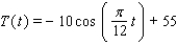
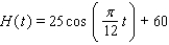
On March 17, 1981, in Tucson, Arizona, the temperature in degrees Fahrenheit could be described by the equation On March 17, 1981, in Tucson, Arizona, the temperature in degrees Fahrenheit could be described by the equation   while the relative humidity in percent could be expressed by   where t is in hours and t = 0 corresponds to 6 AM. Find the maximum value of the humidity. while the relative humidity in percent could be expressed by On March 17, 1981, in Tucson, Arizona, the temperature in degrees Fahrenheit could be described by the equation   while the relative humidity in percent could be expressed by   where t is in hours and t = 0 corresponds to 6 AM. Find the maximum value of the humidity. where t is in hours and t = 0 corresponds to 6 AM. Find the maximum value of the humidity.
(Multiple Choice)
4.8/5
(81)

On a certain spring day with 12 hours of daylight, the light intensity I takes on its largest value of 390 calories/cm 2 at midday. If t = 0 corresponds to sunrise and t is measured in hours, find a formula I = a sin bt that fits this information.

(Multiple Choice)
4.9/5
(67)

Find the period of the equation. Find the period of the equation.

(Multiple Choice)
4.7/5
(78)

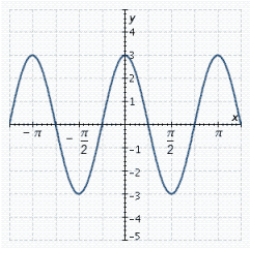
The graph of an equation of a sine wave is shown in the figure. Find the amplitude, period, and phase shift. The graph of an equation of a sine wave is shown in the figure. Find the amplitude, period, and phase shift.
(Multiple Choice)
4.7/5
(90)
Showing 141 - 150 of 150
close modal

Filters

  • Essay(0)
  • Multiple Choice(0)
  • Short Answer(0)
  • True False(0)
  • Matching(0)