



 Chat with AI
Exam 6: The Trigonometric Functions

Exam 1: Fundamental Concepts of Algebra150 Questions
Exam 2: Equations and Inequalities142 Questions
Exam 3: Functions and Graphs147 Questions
Exam 4: Polynomial and Rational Functions147 Questions
Exam 5: Inverse, Exponential, and Logarithmic Functions144 Questions
Exam 6: The Trigonometric Functions150 Questions
Exam 7: Analytic Trigonometry150 Questions
Exam 8: Applications of Trigonometry144 Questions
Exam 9: Systems of Equations and Inequalities147 Questions
Exam 10: Sequences, Series and Probability150 Questions
Exam 11: Topics From Analytic Geometry150 Questions
Select questions type


An airplane flying at a speed of 360 mi/hr flies from a point A in the direction  for 15 minutes and then flies in the direction
 for 30 minutes. Approximate, to the nearest mile, the distance from the airplane to A.
for 15 minutes and then flies in the direction for 30 minutes. Approximate, to the nearest mile, the distance from the airplane to A. (Multiple Choice)
4.8/5  (79)
(79) Points on the terminal sides of angles play an important part in the design of arms for robots. Suppose a robot has a straight arm 18 inches long that can rotate about the origin in a coordinate plane. If the robot's hand is located at (18, 0) and then rotates through an angle of 60 o , what is the new location of the hand?
(Multiple Choice)
4.9/5 (80)
(80) Approximate, to the nearest 0.01 radian, all angles  in the interval [ 0, 2
 ) that satisfy the equation.
 = 0.2518
in the interval [ 0, 2 ) that satisfy the equation. = 0.2518 (Multiple Choice)
4.8/5 (77)
(77) Find y by referring to the graph of the trigonometric function. 
(Multiple Choice)
4.9/5 (88)
(88) A CB antenna is located on the top of a garage that is 17 feet tall. From a point on level ground that is 120 feet from a point directly below the antenna, the antenna subtends an angle of  , as shown in the figure. Approximate the length of the antenna. Give the answer to one decimal place.
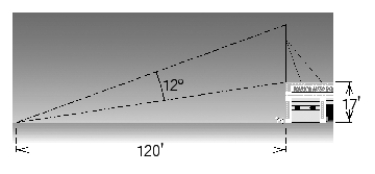
, as shown in the figure. Approximate the length of the antenna. Give the answer to one decimal place. (Multiple Choice)
4.7/5 (73)
(73) Find the quadrant containing  if the given conditions are true.
 and

if the given conditions are true. and (Multiple Choice)
4.7/5 (77)
(77) Approximate, to the nearest 0.01 radian, all angles  in the interval [ 0, 2
 ) that satisfy the equation.
 = 0.8412
in the interval [ 0, 2 ) that satisfy the equation. = 0.8412 (Multiple Choice)
4.9/5 (84)
(84)  to the nearest
 .


Let P ( t ) be the point on the unit circle U that corresponds to t. If P ( t ) has the coordinates  , find
 ,
 ,
 ,
 .
, find , , , . (Multiple Choice)
4.9/5 (74)
(74) A ladder 18 feet long leans against the side of a building, and the angle between the ladder and the building is  .
A. Approximate the distance from the bottom of the ladder to the building. Give the answer to one decimal place.
B. If the distance from the bottom of the ladder to the building is increased by 2 feet, approximately how far does the top of the ladder move down the building? Give the answer to one decimal place.
.
A. Approximate the distance from the bottom of the ladder to the building. Give the answer to one decimal place.
B. If the distance from the bottom of the ladder to the building is increased by 2 feet, approximately how far does the top of the ladder move down the building? Give the answer to one decimal place.
(Multiple Choice)
4.8/5 (63)
(63) Express the angle as a decimal, to the nearest ten-thousandth of a degree. 
(Multiple Choice)
4.8/5 (81)
(81) Let P ( t ) be the point on the unit circle U that corresponds to t. If P ( t ) has the coordinates  , find
 ,
 ,
 ,
 .
, find , , , . (Multiple Choice)
4.8/5 (74)
(74) Points on the terminal sides of angles play an important part in the design of arms for robots. Suppose a robot has a straight arm 16 inches long that can rotate about the origin in a coordinate plane. If the robot's hand is located at (16, 0) and then rotates through an angle of 60 o , what is the new location of the hand?
(Multiple Choice)
4.8/5 (80)
(80) Express  = 4.5 in terms of degrees, minutes, and seconds, to the nearest second.
 (Multiple Choice)
4.9/5 (77)
(77) Express  = 2.5 in terms of degrees, minutes, and seconds, to the nearest second.
 (Multiple Choice)
4.8/5 (84)
(84) Radio stations often have more than one broadcasting tower because federal guidelines do not usually permit a radio station to broadcast its signal in all directions with equal power. Since radio waves can travel over long distances, it is important to control their directional patterns so that radio stations do not interfere with one another. Suppose that a radio station has two broadcasting towers located along a north-south line, as shown in the figure. If the radio station is broadcasting at a wavelength  and the distance between the two radio towers is equal to
 , then the intensity I of the signal in the direction
 is given by
 where I o is the maximum intensity.
 Approximate I in terms of I o for
 .
and the distance between the two radio towers is equal to , then the intensity I of the signal in the direction is given by where I o is the maximum intensity. Approximate I in terms of I o for . (Multiple Choice)
4.9/5 (67)
(67) Scientists sometimes use the formula  to simulate temperature variations during the day, with time t in hours, temperature f ( t ) in
 , and t=0 corresponding to midnight. Assume that f ( t ) is decreasing at midnight. Determine values of a, b, c, and d that fit the information: the high temperature is 17
 , and the low temperature of -17
 occurs at 4 A.M.
to simulate temperature variations during the day, with time t in hours, temperature f ( t ) in , and t=0 corresponding to midnight. Assume that f ( t ) is decreasing at midnight. Determine values of a, b, c, and d that fit the information: the high temperature is 17 , and the low temperature of -17 occurs at 4 A.M. (Multiple Choice)
4.7/5 (79)
(79) If a circular arc of the length s = 16 cm subtends the central angle  = 2 on a circle, find the radius of the circle.
 (Multiple Choice)
5.0/5 (77)
(77) Rewrite the expression in nonradical form without using absolute values for the indicated values of  .
 ;

. ; (Multiple Choice)
4.8/5 (91)
(91) 
Filters
- Essay(0)
- Multiple Choice(0)
- Short Answer(0)
- True False(0)
- Matching(0)