



 Chat with AI
Exam 10: Sequences, Series and Probability

Exam 1: Fundamental Concepts of Algebra150 Questions
Exam 2: Equations and Inequalities142 Questions
Exam 3: Functions and Graphs147 Questions
Exam 4: Polynomial and Rational Functions147 Questions
Exam 5: Inverse, Exponential, and Logarithmic Functions144 Questions
Exam 6: The Trigonometric Functions150 Questions
Exam 7: Analytic Trigonometry150 Questions
Exam 8: Applications of Trigonometry144 Questions
Exam 9: Systems of Equations and Inequalities147 Questions
Exam 10: Sequences, Series and Probability150 Questions
Exam 11: Topics From Analytic Geometry150 Questions
Select questions type


A girl has three skirts, five blouses and four sweaters. How many different skirt-blouse-sweater combinations can she wear?

Free
(Multiple Choice)
4.8/5  (76)
(76) Correct Answer: Verified
B
A pile of logs has 34 logs in the bottom layer, 32 in the second layer, 30 in the third, and so on. The top layer contains 12 logs. Find the total number of logs in the pile.
Free
(Multiple Choice)
4.7/5 (84)
(84) Correct Answer:Verified
VerifiedA

Without expanding completely, find the middle term in the expansion of the expression. 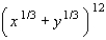
(Multiple Choice)
4.9/5 (89)
(89) In a round-robin tennis tournament, every player meets every other player exactly once. How many players can participate in a tournament of 66 matches?
(Multiple Choice)
4.9/5 (80)
(80) Consider any four points such that no three are collinear. How many lines are determined?
(Multiple Choice)
4.9/5 (89)
(89) In a round-robin tennis tournament, every player meets every other player exactly once. How many players can participate in a tournament of 55 matches?
(Multiple Choice)
4.9/5 (72)
(72) To win a state lottery game, a player must correctly select six numbers from the numbers 1 through 49. Find the total number of selections possible if a player selects only even numbers.
(Multiple Choice)
5.0/5 (79)
(79) Find the third term of the sequence:  is the number of decimal places in
 .
is the number of decimal places in . (Multiple Choice)
4.8/5 (74)
(74) 
A rubber ball is dropped from a height of 60 feet. If it rebounds approximately two-thirds the distance after each fall, use an infinite geometric series to approximate the total distance the ball travels.
(Multiple Choice)
4.9/5 (77)
(77) Use the principle of mathematical induction to find the equivalent expression for every positive integer n. 
(Multiple Choice)
4.8/5 (83)
(83) Find the third term of the recursively defined infinite sequence. 
(Multiple Choice)
4.9/5 (88)
(88) Use the principle of mathematical induction to find the equivalent expression for every positive integer n. 
(Multiple Choice)
4.9/5 (87)
(87) If seven basketball teams are in a tournament, find the number of different ways that first, second, and third place can be decided, assuming ties are not allowed.
(Multiple Choice)
4.8/5 (80)
(80) A bicycle rider coasts downhill, traveling 7 feet the first second. In each succeeding second, the rider travels 4 feet farther than in the preceding second. If the rider reaches the bottom of the hill in 8 seconds, find the total distance traveled.
(Multiple Choice)
4.8/5 (77)
(77) Find the nth term and the fifth term of the geometric sequence. 
(Multiple Choice)
5.0/5 (72)
(72) A contest will have five cash prizes totaling $13,000, and there will be a $500 difference between successive prizes. Find the first prize.
(Multiple Choice)
4.7/5 (78)
(78) Find the nth term and the fifth term of the geometric sequence. 
(Multiple Choice)
5.0/5 (89)
(89) A man is 52 years old and a woman is 34 years old. The probability that the man will be alive in 10 years is 0.78, whereas the probability that the woman will be alive 10 years from now is 0.88. Assume that their life expectancies are unrelated.
A. Find the probability that they will both be alive 10 years from now.
B. Find the probability that neither one will be alive 10 years from now.
C. Find the probability that at least one of the two will be alive 10 years from
(Multiple Choice)
4.9/5 (75)
(75) 
Filters
- Essay(0)
- Multiple Choice(0)
- Short Answer(0)
- True False(0)
- Matching(0)