



 Chat with AI
Exam 10: Sequences, Series and Probability

Exam 1: Fundamental Concepts of Algebra150 Questions
Exam 2: Equations and Inequalities142 Questions
Exam 3: Functions and Graphs147 Questions
Exam 4: Polynomial and Rational Functions147 Questions
Exam 5: Inverse, Exponential, and Logarithmic Functions144 Questions
Exam 6: The Trigonometric Functions150 Questions
Exam 7: Analytic Trigonometry150 Questions
Exam 8: Applications of Trigonometry144 Questions
Exam 9: Systems of Equations and Inequalities147 Questions
Exam 10: Sequences, Series and Probability150 Questions
Exam 11: Topics From Analytic Geometry150 Questions
Select questions type


A girl has three skirts, ten blouses and five sweaters. How many different skirt-blouse-sweater combinations can she wear?
(Multiple Choice)
4.9/5  (84)
(84) Bode's sequence, defined by  can be used to approximate distances of planets from the sun. These distances are measured in astronomical units, with 1 AU = 93,000,000 mi. For example, the third term corresponds to earth and the fifth term to the minor planet Ceres. Find the 6th term of the sequence.
 (Multiple Choice)
4.8/5 (74)
(74) A bicycle rider coasts downhill, traveling 7 feet the first second. In each succeeding second, the rider travels 4 feet farther than in the preceding second. If the rider reaches the bottom of the hill in 15 seconds, find the total distance traveled.
(Multiple Choice)
4.9/5 (88)
(88) A girl has three skirts, eight blouses and four sweaters. How many different skirt-blouse-sweater combinations can she wear?
(Multiple Choice)
4.9/5 (84)
(84) Find the smallest positive integer j for which the statement is true. 
(Multiple Choice)
4.8/5 (79)
(79) 

A company is to distribute $29,000 in bonuses to its top five salespeople. The fifth salesperson on the list will receive $4,600, and the difference in bonus money between successively ranked salespeople is to be constant. Find the bonus for each salesperson.
(Multiple Choice)
4.8/5 (72)
(72) Express the sum in terms of n. 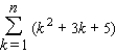 (Hint: Use the theorem on sums to write the sum as
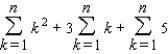 . Next, use the following formulas
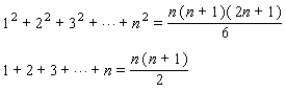 and the theorem on the sum of a constant.)
(Hint: Use the theorem on sums to write the sum as . Next, use the following formulas and the theorem on the sum of a constant.) (Multiple Choice)
5.0/5 (77)
(77) Find the fifth term of the geometric sequence whose first two terms are 3 and 6.
(Multiple Choice)
4.7/5 (77)
(77) Find the specified term of the arithmetic sequence that has the two given terms. 
(Multiple Choice)
4.9/5 (81)
(81) A pile of logs has 28 logs in the bottom layer, 27 in the second layer, 26 in the third, and so on. The top layer contains 20 logs. Find the total number of logs in the pile.
(Multiple Choice)
4.8/5 (73)
(73) A committee of 4 men and 3 women is to be chosen from a group of 11 men and 5 women. Determine the number of different ways of selecting the committee.
(Multiple Choice)
4.9/5 (76)
(76) 
Use the principle of mathematical induction to find the equivalent expression for every positive integer n. 
(Multiple Choice)
4.8/5 (82)
(82) 

Use the principle of mathematical induction to find the equivalent expression for every positive integer n. 
(Multiple Choice)
4.9/5 (91)
(91) Bode's sequence, defined by  can be used to approximate distances of planets from the sun. These distances are measured in astronomical units, with 1 AU = 93,000,000 mi. For example, the third term corresponds to earth and the fifth term to the minor planet Ceres. Find the 5th term of the sequence.
 (Multiple Choice)
5.0/5 (70)
(70) 
Filters
- Essay(0)
- Multiple Choice(0)
- Short Answer(0)
- True False(0)
- Matching(0)