



 Chat with AI
Exam 10: Sequences, Series and Probability

Exam 1: Fundamental Concepts of Algebra150 Questions
Exam 2: Equations and Inequalities142 Questions
Exam 3: Functions and Graphs147 Questions
Exam 4: Polynomial and Rational Functions147 Questions
Exam 5: Inverse, Exponential, and Logarithmic Functions144 Questions
Exam 6: The Trigonometric Functions150 Questions
Exam 7: Analytic Trigonometry150 Questions
Exam 8: Applications of Trigonometry144 Questions
Exam 9: Systems of Equations and Inequalities147 Questions
Exam 10: Sequences, Series and Probability150 Questions
Exam 11: Topics From Analytic Geometry150 Questions
Select questions type


To win a state lottery game, a player must correctly select six numbers from the numbers 1 through 45. Find the total number of selections possible.
(Multiple Choice)
4.8/5  (77)
(77) Express the sum in terms of n. 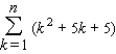 (Hint: Use the theorem on sums to write the sum as
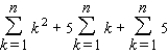 . Next, use the following formulas
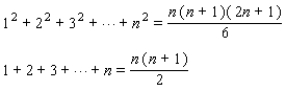 and the theorem on the sum of a constant.)
(Hint: Use the theorem on sums to write the sum as . Next, use the following formulas and the theorem on the sum of a constant.) (Multiple Choice)
5.0/5 (81)
(81) Consider any six points such that no three are collinear. How many lines are determined?
(Multiple Choice)
4.8/5 (84)
(84) 

A single card is drawn from a deck. Find the probability that the card is either red or a two.
(Multiple Choice)
4.9/5 (70)
(70) Find the sum of the arithmetic sequence  that satisfies the stated conditions.

that satisfies the stated conditions. (Multiple Choice)
4.9/5 (90)
(90) If eleven basketball teams are in a tournament, find the number of different ways that first, second, and third place can be decided, assuming ties are not allowed.
(Multiple Choice)
4.9/5 (84)
(84) Express the sum in terms of n.  (Hint: Use the theorem on sums to write the sum as
 . Next, use the following formulas
 and the theorem on the sum of a constant.)
(Hint: Use the theorem on sums to write the sum as . Next, use the following formulas and the theorem on the sum of a constant.) (Multiple Choice)
4.9/5 (84)
(84) Use the principle of mathematical induction to find the factor of the expression.  Hint:

Hint: (Multiple Choice)
4.9/5 (90)
(90) Find the number of terms in the arithmetic sequence with the given conditions.  ,
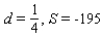
, (Multiple Choice)
4.9/5 (81)
(81) Without expanding completely, find the middle term in the expansion of the expression. 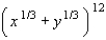
(Multiple Choice)
4.9/5 (74)
(74) Find the third term of the recursively defined infinite sequence. 
(Multiple Choice)
4.8/5 (75)
(75) Bode's sequence, defined by  can be used to approximate distances of planets from the sun. These distances are measured in astronomical units, with 1 AU = 93,000,000 mi. For example, the third term corresponds to earth and the fifth term to the minor planet Ceres. Find the 5th term of the sequence.
 (Multiple Choice)
5.0/5 (64)
(64) 
Find the number of terms in the arithmetic sequence with the given conditions.  ,

, (Multiple Choice)
4.7/5 (79)
(79) 
Without expanding completely, find the middle term in the expansion of the expression. 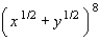
(Multiple Choice)
4.8/5 (84)
(84) Find the third term of the sequence:  is the number of decimal places in
 .
is the number of decimal places in . (Multiple Choice)
4.8/5 (92)
(92) 
Filters
- Essay(0)
- Multiple Choice(0)
- Short Answer(0)
- True False(0)
- Matching(0)