
Exam 8: Applications of Trigonometry

arrow
  • Select Tags
search iconSearch Question
flashcardsStudy Flashcards
  • Select Tags

Solve Solve    Solve

(Multiple Choice)
4.8/5
(85)

Given that Given that   , find the number.  , find the number. Given that   , find the number.

(Multiple Choice)
4.9/5
(77)

A triangular field has sides of lengths a, b, and c (in yards). Approximate the number of acres in the field ( A triangular field has sides of lengths a, b, and c (in yards). Approximate the number of acres in the field (   ).  ). A triangular field has sides of lengths a, b, and c (in yards). Approximate the number of acres in the field (   ).

(Multiple Choice)
4.9/5
(84)

Find || a ||. a = - < 7, - 5 >

(Multiple Choice)
4.9/5
(87)

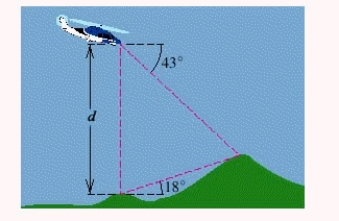
A helicopter hovers at an altitude that is A helicopter hovers at an altitude that is   feet above a mountain peak of altitude 5,122 feet, as shown in the figure. A second, taller peak is viewed from both the mountaintop and the helicopter. From the helicopter, the angle of depression is   , and from the mountaintop, the angle of elevation is   .   Approximate the altitude of the taller peak. feet above a mountain peak of altitude 5,122 feet, as shown in the figure. A second, taller peak is viewed from both the mountaintop and the helicopter. From the helicopter, the angle of depression is A helicopter hovers at an altitude that is   feet above a mountain peak of altitude 5,122 feet, as shown in the figure. A second, taller peak is viewed from both the mountaintop and the helicopter. From the helicopter, the angle of depression is   , and from the mountaintop, the angle of elevation is   .   Approximate the altitude of the taller peak. , and from the mountaintop, the angle of elevation is A helicopter hovers at an altitude that is   feet above a mountain peak of altitude 5,122 feet, as shown in the figure. A second, taller peak is viewed from both the mountaintop and the helicopter. From the helicopter, the angle of depression is   , and from the mountaintop, the angle of elevation is   .   Approximate the altitude of the taller peak. . A helicopter hovers at an altitude that is   feet above a mountain peak of altitude 5,122 feet, as shown in the figure. A second, taller peak is viewed from both the mountaintop and the helicopter. From the helicopter, the angle of depression is   , and from the mountaintop, the angle of elevation is   .   Approximate the altitude of the taller peak. Approximate the altitude of the taller peak.
(Multiple Choice)
4.9/5
(75)

Use De Moivre's theorem to change the given complex number to the form Use De Moivre's theorem to change the given complex number to the form   , where   and   are real numbers.  , where Use De Moivre's theorem to change the given complex number to the form   , where   and   are real numbers.  and Use De Moivre's theorem to change the given complex number to the form   , where   and   are real numbers.  are real numbers. Use De Moivre's theorem to change the given complex number to the form   , where   and   are real numbers.

(Multiple Choice)
4.9/5
(67)

Find the two square roots of Find the two square roots of

(Multiple Choice)
4.9/5
(78)

Express in the form Express in the form   , where a and b are real numbers.  , where a and b are real numbers. Express in the form   , where a and b are real numbers.

(Multiple Choice)
4.9/5
(82)

Find (a) the dot product of the two vectors and (b) the angle between the two vectors. Find (a) the dot product of the two vectors and (b) the angle between the two vectors.   and  and Find (a) the dot product of the two vectors and (b) the angle between the two vectors.   and

(Multiple Choice)
4.9/5
(90)

The trigonometric form of complex numbers is often used by electrical engineers to describe the current I, voltage V, and impedance Z in electrical circuits with alternating current. Impedance is the opposition to the flow of current in a circuit. Most common electrical devices operate on 115-volt, alternating current. The relationship among these three quantities is The trigonometric form of complex numbers is often used by electrical engineers to describe the current I, voltage V, and impedance Z in electrical circuits with alternating current. Impedance is the opposition to the flow of current in a circuit. Most common electrical devices operate on 115-volt, alternating current. The relationship among these three quantities is   . The real part of I represents the actual current delivered to an electrical appliance in amps. Approximate this current when   and   , and express the answer in rectangular form to two decimal places. . The real part of I represents the actual current delivered to an electrical appliance in amps. Approximate this current when The trigonometric form of complex numbers is often used by electrical engineers to describe the current I, voltage V, and impedance Z in electrical circuits with alternating current. Impedance is the opposition to the flow of current in a circuit. Most common electrical devices operate on 115-volt, alternating current. The relationship among these three quantities is   . The real part of I represents the actual current delivered to an electrical appliance in amps. Approximate this current when   and   , and express the answer in rectangular form to two decimal places. and The trigonometric form of complex numbers is often used by electrical engineers to describe the current I, voltage V, and impedance Z in electrical circuits with alternating current. Impedance is the opposition to the flow of current in a circuit. Most common electrical devices operate on 115-volt, alternating current. The relationship among these three quantities is   . The real part of I represents the actual current delivered to an electrical appliance in amps. Approximate this current when   and   , and express the answer in rectangular form to two decimal places. , and express the answer in rectangular form to two decimal places.

(Multiple Choice)
4.9/5
(82)

Represent the complex number geometrically. Represent the complex number geometrically.

(Multiple Choice)
4.8/5
(94)

Use De Moivre's theorem to change the given complex number to the form Use De Moivre's theorem to change the given complex number to the form   , where   and   are real numbers.  , where Use De Moivre's theorem to change the given complex number to the form   , where   and   are real numbers.  and Use De Moivre's theorem to change the given complex number to the form   , where   and   are real numbers.  are real numbers. Use De Moivre's theorem to change the given complex number to the form   , where   and   are real numbers.

(Multiple Choice)
4.9/5
(67)

Find (a) the dot product of the two vectors and (b) the angle between the two vectors. Find (a) the dot product of the two vectors and (b) the angle between the two vectors.   and  and Find (a) the dot product of the two vectors and (b) the angle between the two vectors.   and

(Multiple Choice)
4.8/5
(74)

Find (a) the dot product of the two vectors and (b) the angle between the two vectors. Find (a) the dot product of the two vectors and (b) the angle between the two vectors.   and  and Find (a) the dot product of the two vectors and (b) the angle between the two vectors.   and

(Multiple Choice)
4.9/5
(81)

Represent the complex number geometrically. Represent the complex number geometrically.

(Multiple Choice)
4.8/5
(76)

Find 2a + 5b. a = < 2, - 2>, b = <6, 2 >

(Multiple Choice)
4.9/5
(85)

Find 5a - 2b. a = i + 4j, b = 6i - 6j

(Multiple Choice)
4.8/5
(83)

Given that Given that   , find the number.  , find the number. Given that   , find the number.

(Multiple Choice)
4.9/5
(75)

Find the absolute value. Find the absolute value.

(Multiple Choice)
4.9/5
(89)

A triangular field has sides of lengths a, b, and c (in yards). Approximate the number of acres in the field ( A triangular field has sides of lengths a, b, and c (in yards). Approximate the number of acres in the field (   ).  ). A triangular field has sides of lengths a, b, and c (in yards). Approximate the number of acres in the field (   ).

(Multiple Choice)
4.9/5
(78)
Showing 121 - 140 of 144
close modal

Filters

  • Essay(0)
  • Multiple Choice(0)
  • Short Answer(0)
  • True False(0)
  • Matching(0)

