
Exam 8: Applications of Trigonometry

arrow
  • Select Tags
search iconSearch Question
flashcardsStudy Flashcards
  • Select Tags

The volume V of the right triangular prism shown in the figure is The volume V of the right triangular prism shown in the figure is   where B is the area of the base and h is the height of the prism.   Approximate h, if   . where B is the area of the base and h is the height of the prism. The volume V of the right triangular prism shown in the figure is   where B is the area of the base and h is the height of the prism.   Approximate h, if   . Approximate h, if The volume V of the right triangular prism shown in the figure is   where B is the area of the base and h is the height of the prism.   Approximate h, if   . .

(Multiple Choice)
4.9/5
(82)

Find (a) the dot product of the two vectors and (b) the angle between the two vectors. Find (a) the dot product of the two vectors and (b) the angle between the two vectors.   and  and Find (a) the dot product of the two vectors and (b) the angle between the two vectors.   and

(Multiple Choice)
4.8/5
(74)

A helicopter hovers at an altitude that is A helicopter hovers at an altitude that is   feet above a mountain peak of altitude 5,847 feet, as shown in the figure. A second, taller peak is viewed from both the mountaintop and the helicopter. From the helicopter, the angle of depression is   , and from the mountaintop, the angle of elevation is   .   Approximate the altitude of the taller peak. feet above a mountain peak of altitude 5,847 feet, as shown in the figure. A second, taller peak is viewed from both the mountaintop and the helicopter. From the helicopter, the angle of depression is A helicopter hovers at an altitude that is   feet above a mountain peak of altitude 5,847 feet, as shown in the figure. A second, taller peak is viewed from both the mountaintop and the helicopter. From the helicopter, the angle of depression is   , and from the mountaintop, the angle of elevation is   .   Approximate the altitude of the taller peak. , and from the mountaintop, the angle of elevation is A helicopter hovers at an altitude that is   feet above a mountain peak of altitude 5,847 feet, as shown in the figure. A second, taller peak is viewed from both the mountaintop and the helicopter. From the helicopter, the angle of depression is   , and from the mountaintop, the angle of elevation is   .   Approximate the altitude of the taller peak. . A helicopter hovers at an altitude that is   feet above a mountain peak of altitude 5,847 feet, as shown in the figure. A second, taller peak is viewed from both the mountaintop and the helicopter. From the helicopter, the angle of depression is   , and from the mountaintop, the angle of elevation is   .   Approximate the altitude of the taller peak. Approximate the altitude of the taller peak.

(Multiple Choice)
4.9/5
(67)

Express the complex number in trigonometric form with Express the complex number in trigonometric form with   .  . Express the complex number in trigonometric form with   .

(Multiple Choice)
4.9/5
(71)

Express in the form Express in the form   , where a and b are real numbers.  , where a and b are real numbers. Express in the form   , where a and b are real numbers.

(Multiple Choice)
4.8/5
(90)

The volume V of the right triangular prism shown in the figure is The volume V of the right triangular prism shown in the figure is   where B is the area of the base and h is the height of the prism.   Approximate h, if   . where B is the area of the base and h is the height of the prism. The volume V of the right triangular prism shown in the figure is   where B is the area of the base and h is the height of the prism.   Approximate h, if   . Approximate h, if The volume V of the right triangular prism shown in the figure is   where B is the area of the base and h is the height of the prism.   Approximate h, if   . .

(Multiple Choice)
4.8/5
(83)

Determine whether the given pair of vectors are orthogonal or not. Determine whether the given pair of vectors are orthogonal or not.   and  and Determine whether the given pair of vectors are orthogonal or not.   and

(Multiple Choice)
4.7/5
(97)

Express the complex number in trigonometric form with Express the complex number in trigonometric form with   .  . Express the complex number in trigonometric form with   .

(Multiple Choice)
4.9/5
(78)

The volume V of the right triangular prism shown in the figure is The volume V of the right triangular prism shown in the figure is   where B is the area of the base and h is the height of the prism.   Approximate h, if   . where B is the area of the base and h is the height of the prism. The volume V of the right triangular prism shown in the figure is   where B is the area of the base and h is the height of the prism.   Approximate h, if   . Approximate h, if The volume V of the right triangular prism shown in the figure is   where B is the area of the base and h is the height of the prism.   Approximate h, if   . .

(Multiple Choice)
4.8/5
(85)

Represent the complex number geometrically. Represent the complex number geometrically.

(Multiple Choice)
4.8/5
(72)

Approximate the area of a parallelogram that has sides of lengths a and b (in feet) if one angle at a vertex has measure Approximate the area of a parallelogram that has sides of lengths a and b (in feet) if one angle at a vertex has measure   .    . Approximate the area of a parallelogram that has sides of lengths a and b (in feet) if one angle at a vertex has measure   .    Approximate the area of a parallelogram that has sides of lengths a and b (in feet) if one angle at a vertex has measure   .

(Multiple Choice)
4.9/5
(83)

Find the two square roots of Find the two square roots of

(Multiple Choice)
4.8/5
(81)

A straight road makes an angle of A straight road makes an angle of   with the horizontal. When the angle of elevation of the sun is   , a vertical pole at the side of the road casts a shadow   feet long directly down the road, as shown in the figure.   Approximate the length of the pole. with the horizontal. When the angle of elevation of the sun is A straight road makes an angle of   with the horizontal. When the angle of elevation of the sun is   , a vertical pole at the side of the road casts a shadow   feet long directly down the road, as shown in the figure.   Approximate the length of the pole. , a vertical pole at the side of the road casts a shadow A straight road makes an angle of   with the horizontal. When the angle of elevation of the sun is   , a vertical pole at the side of the road casts a shadow   feet long directly down the road, as shown in the figure.   Approximate the length of the pole. feet long directly down the road, as shown in the figure. A straight road makes an angle of   with the horizontal. When the angle of elevation of the sun is   , a vertical pole at the side of the road casts a shadow   feet long directly down the road, as shown in the figure.   Approximate the length of the pole. Approximate the length of the pole.

(Multiple Choice)
4.8/5
(81)

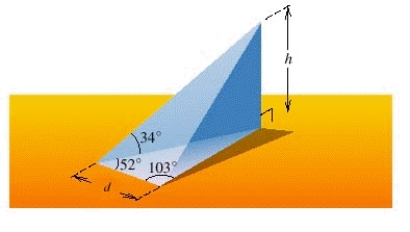
The volume V of the right triangular prism shown in the figure is The volume V of the right triangular prism shown in the figure is   where B is the area of the base and h is the height of the prism.   Approximate h, if   . where B is the area of the base and h is the height of the prism. The volume V of the right triangular prism shown in the figure is   where B is the area of the base and h is the height of the prism.   Approximate h, if   . Approximate h, if The volume V of the right triangular prism shown in the figure is   where B is the area of the base and h is the height of the prism.   Approximate h, if   . .
(Multiple Choice)
4.7/5
(79)

Represent the complex number geometrically. Represent the complex number geometrically.

(Multiple Choice)
4.8/5
(66)

Represent the complex number geometrically. Represent the complex number geometrically.

(Multiple Choice)
5.0/5
(95)

Use De Moivre's theorem to change the given complex number to the form Use De Moivre's theorem to change the given complex number to the form   , where   and   are real numbers.  , where Use De Moivre's theorem to change the given complex number to the form   , where   and   are real numbers.  and Use De Moivre's theorem to change the given complex number to the form   , where   and   are real numbers.  are real numbers. Use De Moivre's theorem to change the given complex number to the form   , where   and   are real numbers.

(Multiple Choice)
5.0/5
(83)

If c represents a constant force, find the work done if the point of application of c moves along the line segment from P to Q. If c represents a constant force, find the work done if the point of application of c moves along the line segment from P to Q.   and  and If c represents a constant force, find the work done if the point of application of c moves along the line segment from P to Q.   and

(Multiple Choice)
4.8/5
(72)

The trigonometric form of complex numbers is often used by electrical engineers to describe the current I, voltage V, and impedance Z in electrical circuits with alternating current. Impedance is the opposition to the flow of current in a circuit. Most common electrical devices operate on 115-volt, alternating current. The relationship among these three quantities is The trigonometric form of complex numbers is often used by electrical engineers to describe the current I, voltage V, and impedance Z in electrical circuits with alternating current. Impedance is the opposition to the flow of current in a circuit. Most common electrical devices operate on 115-volt, alternating current. The relationship among these three quantities is   . The real part of I represents the actual current delivered to an electrical appliance in amps. Approximate this current when   and   , and express the answer in rectangular form to two decimal places. . The real part of I represents the actual current delivered to an electrical appliance in amps. Approximate this current when The trigonometric form of complex numbers is often used by electrical engineers to describe the current I, voltage V, and impedance Z in electrical circuits with alternating current. Impedance is the opposition to the flow of current in a circuit. Most common electrical devices operate on 115-volt, alternating current. The relationship among these three quantities is   . The real part of I represents the actual current delivered to an electrical appliance in amps. Approximate this current when   and   , and express the answer in rectangular form to two decimal places. and The trigonometric form of complex numbers is often used by electrical engineers to describe the current I, voltage V, and impedance Z in electrical circuits with alternating current. Impedance is the opposition to the flow of current in a circuit. Most common electrical devices operate on 115-volt, alternating current. The relationship among these three quantities is   . The real part of I represents the actual current delivered to an electrical appliance in amps. Approximate this current when   and   , and express the answer in rectangular form to two decimal places. , and express the answer in rectangular form to two decimal places.

(Multiple Choice)
4.9/5
(70)

The trigonometric form of complex numbers is often used by electrical engineers to describe the current I, voltage V, and impedance Z in electrical circuits with alternating current. Impedance is the opposition to the flow of current in a circuit. Most common electrical devices operate on 115-volt, alternating current. The relationship among these three quantities is The trigonometric form of complex numbers is often used by electrical engineers to describe the current I, voltage V, and impedance Z in electrical circuits with alternating current. Impedance is the opposition to the flow of current in a circuit. Most common electrical devices operate on 115-volt, alternating current. The relationship among these three quantities is   . Approximate the unknown quantity, and express the answer in rectangular form to two decimal places.  . Approximate the unknown quantity, and express the answer in rectangular form to two decimal places. The trigonometric form of complex numbers is often used by electrical engineers to describe the current I, voltage V, and impedance Z in electrical circuits with alternating current. Impedance is the opposition to the flow of current in a circuit. Most common electrical devices operate on 115-volt, alternating current. The relationship among these three quantities is   . Approximate the unknown quantity, and express the answer in rectangular form to two decimal places.

(Multiple Choice)
4.8/5
(82)
Showing 21 - 40 of 144
close modal

Filters

  • Essay(0)
  • Multiple Choice(0)
  • Short Answer(0)
  • True False(0)
  • Matching(0)